A Look Back At DefCon 18 Badges

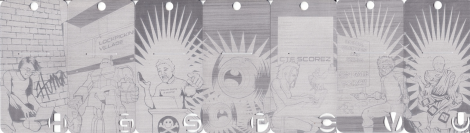
As he does every year, [Joe Grand] gave a talk explaining the development process for Defcon 18 badges. We looked in on these when details started trickling out back in July. They feature a neat bit of tech in the form of an LCD that acts much like ePaper. It doesn’t take any electricity to hold the image, only to change the display. This is a valuable feature for a battery powered device and allowed him to get about 9 days of juice out of a CR2032. This year’s badges also used laser-etched Aluminum as a substrate.

We’ve embedded the talk after the break and found it interesting enough to watch the entire hour. If you’re more interested in the hacks that came out of the badge, we’ve put together a playlist of videos [Joe] took while at the conference.
Continue reading “A Look Back At DefCon 18 Badges” →

Fixing The Rovio Battery Charging Circuit

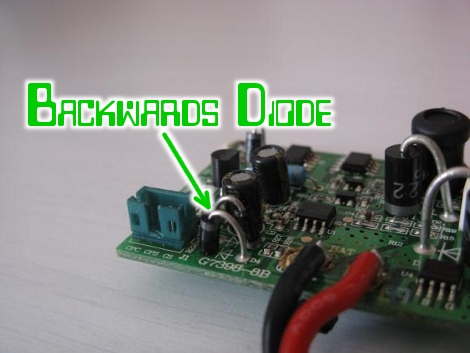
[Chris] was unhappy with the battery performance of his Rovio. It seems that he’s not alone, so he set out to reverse engineer the battery charging circuit to see if there was a fix. Boy is there, what he found is the diode above, apparently installed backwards when compared to the silk screen diode symbol. Now it’s entirely possible that the silk screen is wrong and this was fixed during assembly. We think that’s unlikely because if the closer of the two diodes was supposed to have the same polarity as the one next to it there should have been room to install them both in exactly the same orientation. [Chris] pulled out a soldering iron and changed the diode to match the silk screen. That fixed his problem and he’s now getting better performance than he ever has.

[From our comments section]

CES: Where Are They Now? CES Of Course!

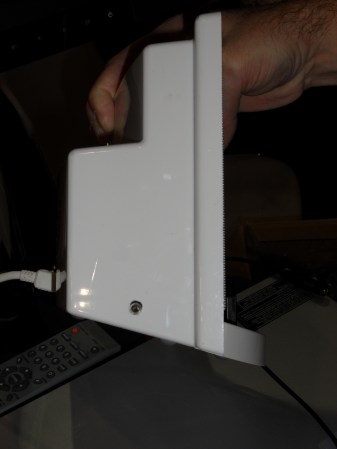
CES is a time for showcasing the latest and greatest innovative products. While the crowd milled around the iLounge there was one company who stood out amongst the rest. [Mike] from CableJive is making his debut on the biggest stage for innovation this year. Many of you will remember [Mike] from a post back in 2006, where he was fed up of with all of the good docks being for the apple products exclusively. He set out to fix this and, when talking with him, attributes his success to the coverage Hack a Day did on his project. CableJive has become so popular that he has hired staff that help him produce his products. All detailed information for their products can be found at their website.  The finished product is displayed after the break.

Continue reading “CES: Where Are They Now? CES Of Course!” →

Internet Enabled Drip Coffee

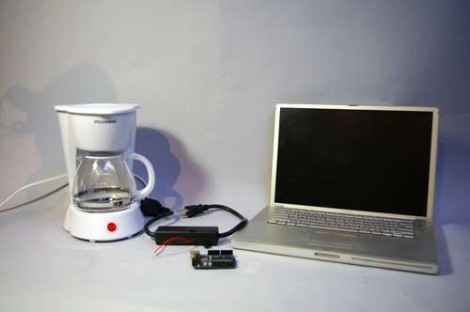
A fresh pot of coffee is never more than a tweet away with the Tweet-a-Pot. It works in much the same way that our Troll Sniffing Rat does. For that build we used a Python script to monitor our comments, and this does the same except that the script read tweets through the Twitter API. It watches for a specific hash tag (#driptwit) and when found it sends a serial command to an Arduino. The microcontroller then writes a digital pin high to actuate a relay, powering up the coffee maker.

Sure, you have to preload the pot with grounds and water, but what do you expect, automatic coffee roasting and brewing? That’s quite a bit more work.

CES: Microsoft Hacks Up Next OS As SOC

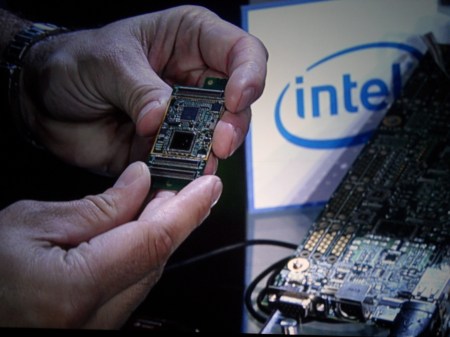
With the Pre-CES Keynote made by [Steve Ballmer], the announcement came that the next iteration of their operating system being available in SOC specific form.  This will lead to windows being able to run a very diverse hardware set in a much more efficient manner than it does right now.  Microsoft displayed 4 different versions of what the next generation prototypes are from 4 different manufacturers but there has been no work done yet on the GUI for SOC as [Ballmer] was very clear to mention that more than a couple of times.  Some photos of the prototypes can be found after the break!

Continue reading “CES: Microsoft Hacks Up Next OS As SOC” →

Drill-based Kinect Camera

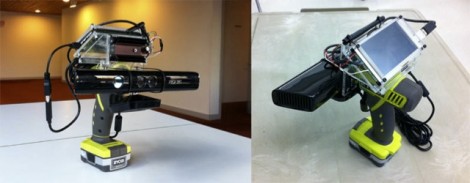
[Brett Graham] and [David Cox] are taking the Kinect out into the world thanks to this handheld hack they call the Drill of Depth. Apparently, the Kinect wants 12V at 1A which is quite easy to provide with a rechargeable power tool like this Ryobi drill. The setup features a 4.3″ touchscreen display, connected to the Gumstix Overo Air that is running Linux. They claim that there’s a “legitimate scientific reason” for building the device but they’re not sharing it yet.

So what would you use this for? We wonder if it would be possible to roll a GPS into the mix, then use post processing from the captured data to recreate the environment in a virtual setting? Imagine if a weekend spent walking around campus and processing the results let you model your University and make it an add-on level for your favorite game. Or perhaps this could be paired with a regular camera to generate high-quality 3D skinning data for Google Earth. That’s what we came up with, what do you think?

Making Punch Card Programming A Snap

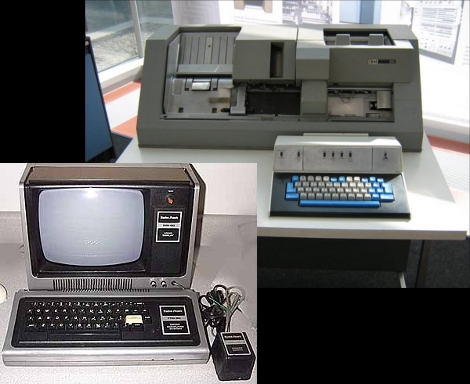
About thirty years ago [H. P. Friedrichs] pulled off a hack that greatly improved the process of programming with punch cards. At the time, his school had just two IBM 029 keypunch machines. One of them is shown in the upper right and it uses a keyboard to choose which parts of each card should be punched out. This was time-consuming, and one misplaced keystroke could ruin the card that you were working on. Since you had to sit at the machine and type in your source code these machines were almost always in use.

But wait, the school acquired a dozen of the TRS-80 computers seen in the lower left. They were meant to be used when teaching BASIC, but [HPF] hatched a plan to put them to task for punch card generation. He built his own interface hardware that connected to the expansion port of the new hardware. Using his custom interface a student could create a virtual card deck that could be rearranged and revised to correct mistakes in the source code. The hardware then allows the virtual deck to be dumped in to the punching machine. This broke the bottleneck caused by students sitting at the punch card terminal.

We think that [HPF] sent in this project after seeing the antiquated hardware from that 1970’s calculator. These hacks of yore are a blast to revisit so don’t be afraid to tip us off if you know of a juicy one.