20-channel DMX Controller

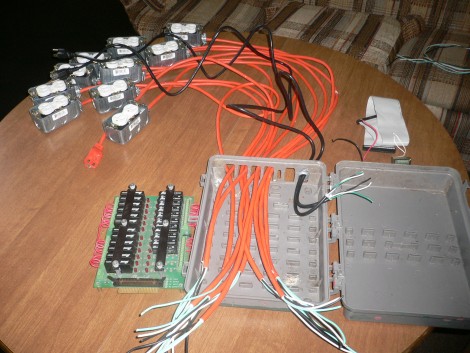
[Joshua] shares his details on building this 20-channel DMX controller. He’s sourced some extension cords to cut up for the complicated wiring project. He plans to drive 120V lights with the system so he’s also using the extension cords to connect a bunch of outlet boxes to the main controller. Inside you’ll find a set of AVR chips ready for your commands. Instead of using jumpers or DIP switches to set their addresses he set them in the firmware and burned a different version to each chip. The key here is writing the address right on the chips to prevent any confusion.

This will be used of Halloween and Christmas displays. We love Halloween hacks just about as much as we love Christmas hacks, so hit the basement and don’t forget to share the result of your labors with us.
Spirograph Generator

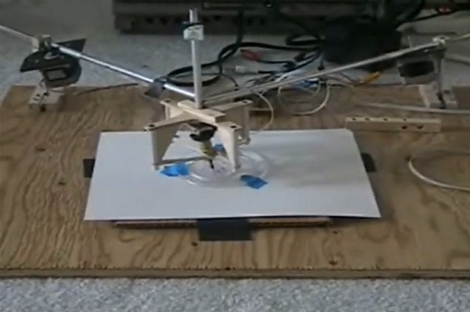
The Agnewgraph I can turn out a pretty nice Spirograph drawing. Instead of relying on meticulously acurate CNC hardware, it uses a Spirograph stencil similiar to that business card we’re so fond of. The key to the [Mpark’s] design is an analog joystick which is attached to the pen. As the pen follows the plastic guide around, a Propeller microcontroller calculates the angle of travel based on that joystick. These measurements are used to decide how to move the two stepper motors that provide horizontal and vertical motion to the frame. We’ve attached a video after the break just in case our rough description didn’t do it for you.

Continue reading “Spirograph Generator” →

Terminal Node Controller In A Router

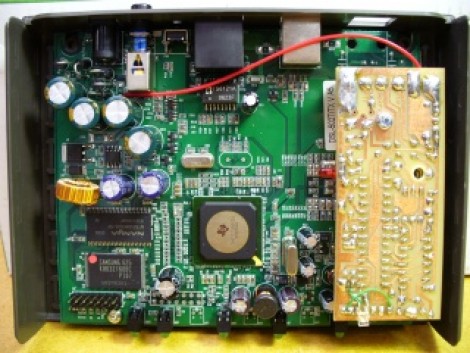
[Andrew] used a DSL router to make his own Terminal Node Controller. This will become part of an APRS-IS network, an Internet-based network built by amateur radio operators. The router used here is a Dlink DSL-502T with an AVR based TNC module attached to the serial port header. The phone line connector and its accompanying hardware have been removed to make room for the TNC module, which is supplied with 12V via that red wire. When the router boots up it sends data to the serial port header so the firmware on the TNC needed some tweaking to accommodate this (yay for open source).

Want some more APRS goodness? Check out this AVR APRS tracker.

A Bicycle Build For… 2.0

Here’s an interesting way to fill the second seat on your tandem bicycle. It seems no one ever wants to be the stoker, so this gentleman decided to build his riding partner. JouleS powers the bicycle from the back using the same motions a human would. It’s not the easiest way to make an electric bicycle but the mechanics that went into it are quite beautiful. See the old boy pedaling away after the beak.

Continue reading “A Bicycle Build For… 2.0” →

All That’s Needed Is A Retro Paintjob, MiniMAME

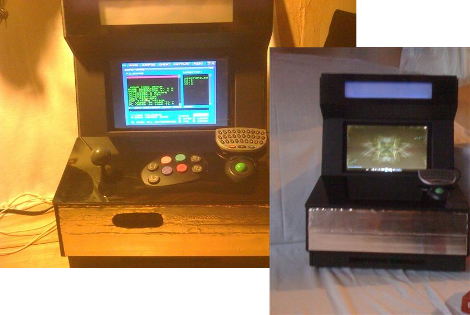
[Tim’s] miniMAME‘s construction follows the “light and cheap” approach, using foam core board and hot glue. Sure it won’t last a nuclear attack, but at least it’s light enough to carry to a friend’s house.

With a removable netbook at the core, CCFLs, speakers, trackball, and mini arcade fighting stick, the project completely surpassed our expectations. For those looking to build a miniMAME, [Tim] includes lots of pictures, details, and plans allowing anyone to make their own in about an afternoon.

Release The Kraken: Open Source GSM Cracking Tool Released.

Open source GSM cracking software called “Kraken” has been released into the wild. You may recognize some of the information from back in December when we announced that they had cracked GSM encryption. Well, now you can participate as well. You’ll need a pretty beefy Linux machine and some patience. They say that an easier GUI and support for GPU processing is coming in the near future.

[Thanks Eliot Via Slashdot and PCWorld]

Making Mobile Audio Work At Home

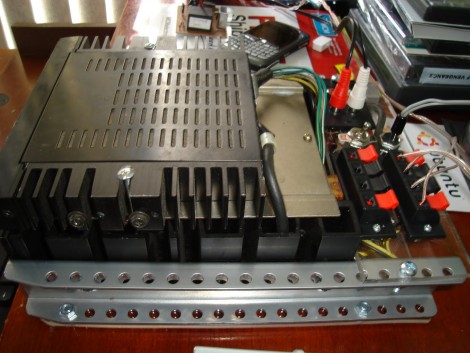
[Nikita] made a great find while cleaning out his garage: a set of audio amplifiers from a 1986 Volvo. After a bit of testing, he dislodged a stuck relay and set out to use these amps for a home audio system. He grabbed some left over brackets from his TV mount and used them as rail mounts. On the back he wired standard speaker connectors and RCA connectors to the wiring harness for the amplifiers. The final aspect is powering up the device, for which he used his ATX psu previously modified as a bench supply. 130-Watts of power for the cost of a few connectors.

We surprise to find we haven’t covered this common ATX bench-supply conversion before. What we have seen is an adapter to use one as a bench supply.