Poddwatt: Tube Amp With Mp3 In Mind

poddwatt

[Bruce] has designed a push-pull tube amp that has enough gain to connect to a portable audio player. The design is closely related to his OddWatt offering from a few years ago. The new amp has many redesigned circuits and the new hardware choices drop the price tag of the parts by about $50.

This little wonder pumps out 5-7 watts and [Bruce] is please with the end result. It doesn’t put out quite as much low-end as the KT88 amp we saw last year, but compared to some other iPod speaker solutions this provides stellar audio.

Make Your Own SNES Games With Developer Cartridge

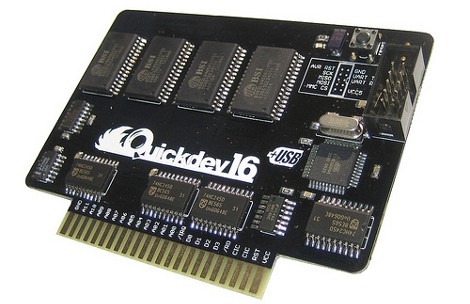
Have you always wished that you could develop games for the Super Nintendo but couldn’t because you were only 4 years old when it was released in 1990? Here’s a second chance. [Max] and his team have created a SNES developer’s cartridge that allows you to load your own code, run it on the SNES, and debug as needed. At its core is an Atmel AVR ATmega644 that is running a boot loader, allowing for firmware updates via USB. Once the system is powered on, ROM code is sent over USB to the 16 megabits of onboard SRAM. A debug terminal can be connected with an RS232 converter, providing status information and allowing some register manipulation.

We can believe there are a few hardcore SNES fans out there who will take the time to write custom code. We could also see this being used for the purposes of SNES sythesized music. But is there a wide demand for this type of hardware? If you’ve ever looked into developing for the SNES, let us know in the comments.

Hot Air Pencil For Under $20

hotairpencil20usd1

Here’s a project from back in 2001 that might be of interest to some of you. It is a guide on how to build your own hot air pencil for SMD soldering.  He is using a super cheap 45W soldering iron from “the shack” combined with a pump type desoldering tool and an aquarium pump. He says it works pretty well, and we don’t see why it shouldn’t. This is a pretty elegant solution. There are also some more recent versions of this mod, but the idea is basically the same.

[thanks Stuart]

Psystar Taunts Apple A Second Time

psystar

As if bankruptcy shenanigans and an unresolved exchange of lawsuits with Apple weren’t enough, Mac clone maker Psystar is really swatting the beehive now with the release of Rebel EFI, a $50 software package that promises a straightforward installation of Mac OS X on a variety of commodity x86 systems.

Setting up one’s own “Hackintosh” system has traditionally been a painstaking process of duplicating the OS install disc and fiddling around with various kernel extensions. Rebel EFI claims to do away with all this, bringing click-and-drool simplicity to the Hackintosh experience. The package can be downloaded free of charge in order to test compatibility with one’s hardware before committing to buy; in this trial mode, the system is limited to two hours run time. Minimum requirements include an Intel Core 2 Duo, Core 2 Quad, Core i7, or Xeon Nehalem CPU.

Normally we’re all for voiding warranties, challenging EULAs, and sticking it to The Man, but some have been calling Psystar’s underdog image a charade, claiming the commercial Rebel EFI software is simply an uncredited derivative of open source efforts such as the Chameleon bootloader. Whether or not this proves true, it will be interesting to see how this whole surreal skit plays out between Apple, Psystar and the open source Hackintosh community.

Unreasonably Bright Bike Light Apparently Hunts Deer

ureasonably-bright-bike-light

[Jukka] wanted a bike light that wasn’t afraid to go into the woods during the dark winter. He put together a lamp that uses eight 3 Watt LEDs to pump out 1680 lumens (english translation). The high power LEDs were mounted on a large aluminum heat sink and use lenses to optimize the beam of light. The system uses a 2 amp driver board that he assembled himself. Power is provided by sixteen AA Nickel Metal Hydride batteries that are housed along with the driver circuit in a water bottle.

This more than doubles the output of the last bike light we thought was too bright. Where will this lumen-arms-race stop?

[Thanks Sami]

Drone Lab Brings The Excitement Of Hypnotoad Home

Drone-lab-hypnotoad

[Peter] tipped us off about his new synthesizer kit, Drone Lab. It has the things we look for a synthesizer: knobs, inputs, switches, wacky sounds. You can get your soldering on with the kit version, or buy these pre-built. Peter bills this as an open source kit but we didn’t see board artwork, just a schematic.

What we didn’t expect is its ability to mimic the Hypnotoad. As seen in the video after the break, the glorious sounds of your favorite television show can now be created in your own home. If you’ve never seen an episode of the Hypnotoad (gasp!) we’ve got that covered after the break as well.

ALL GLORY TO THE HYPNOTOAD!

Update: PCB artwork has now been posted just below the schematic.

Continue reading “Drone Lab Brings The Excitement Of Hypnotoad Home” →

Driving USB Peripherals With Arduino

arduino-driving-USB-keyboard

Circuits@Home have managed to host a USB keyboard with an Arduino and display the keyboard inputs on a character LCD. This uses the USB host shield we covered in August. That host shield includes a MAX3421 which is used here to drive the character LCD.

The control code for the keyboard ends up being fairly simple. The keyboard is polled for entries. The HID input is then examined and converted to ASCII codes for use with the LCD screen. This could make for an excellent controller or debugger for embedded systems. The Arduino, shield, and LCD could be integrated into the keyboard itself with an I/O port for connecting to your project. Commands can be typed out and sent through the I/O port when enter is pressed, with feedback displayed on the screen.

The example code provided with this project lays out the framework for hosting peripherals. We’re looking forward to more projects, and code libraries that take advantage of this new functionality.