British Steam Car


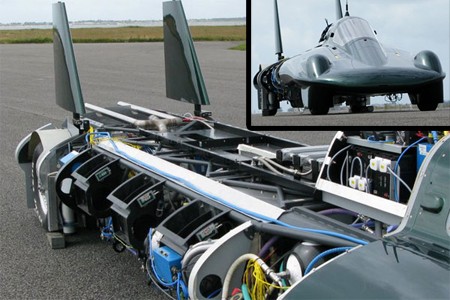
The land-speed record for steam-powered locomotion has been holding steady for 88 years at 127mph, but a team of British engineers and stunt drivers will attempt to break it with the Steam Car.

The Steam Car works by burning liquid petroleum fuel at 750° F, which heats 10.5 gallons of water, converting into steam. The steam passes through lagged pipes before it is injected into the 360-hp Curtis turbine at extremely high pressure and speed via compressed air hydraulics. It spins the turbine at over 13,000 rpm, powering the rear wheels, allowing the car to reach speeds higher than 150mph. The car itself is 25 feet long and uses about 1.86 miles of tubing. All of the hot pressurized steam is ejected from the exhaust, which means the car is only capable of running for about 3 minutes, and requires an 8-minute warmup.

The attempt to break the speed record will occur in late August at Bonneville.

[via Newlaunches]
LED Painter


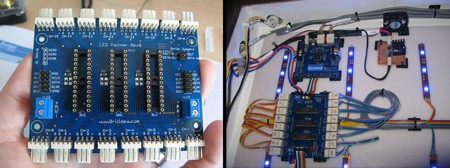
The people at Brilldea have come up with LED Painter, a 16-channel RGB LED controller capable of controlling up to 48 independent LEDs. It uses a Texas Instrument TLC5940 to control the LEDs and can be connected to more LED Painter boards, creating a large array of RGB lights. The TLC5940 itself has been modified to make connecting independent LEDs easier.

The team strung together nine of these along with a Propeller-based controller called a Prop Blade and fitted the lights into three windows with semi-opaque glass to create a display of dancing randomized RGB lights. If all the dancing lights have inspired you, the TLC5940s are fairly inexpensive, but you’ll need both through-hole devices and some SMT components to get if off the ground.

Continue reading “LED Painter”

External CD-ROM Turned Class A Headphone Amp


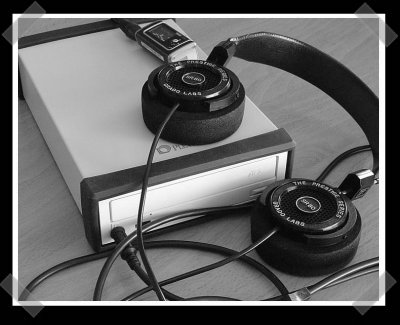
[Gio] sent in this slick Class A headphone amp. An old CD-ROM case was gutted to hold the goods. The design is fairly simple. Cost can be kept fairly low although the capacitors can add up if you’re a fanatic about quality. If you’ve ever lost any of your headphone gear to sticky fingers, you know that having it blending in to the background can be a great feature.

Create Your Own HDR Images


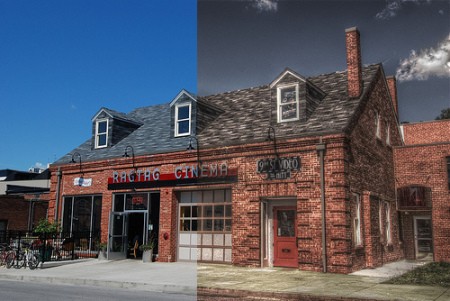
Hack-A-Day friend [Nathan] showed us some of his results creating his own High Dynamic Range images. Three normal Low Dynamic Range photos. One is under exposed, one is normal and the third is over exposed to capture the information needed. Then all three are used to create a single HDR image. Technically, the HDR image contains too much information to properly display, but even this limited version looks damn impressive.

You’ll need a tripod, a camera that allows you to adjust your exposure value and a decent CPU to do the processing. (This pic took a couple of minutes to render on a quad core cpu) You can check out the full HDR photo here and one of the original frames here. For the software side, you can use pfstools on the command line or QtpfsGUI for the graphics side – both are free and open source. [Nathan] suggests a camera with bracket mode and a remote shutter release for best results. If you’re all about theory, you can grab a white paper on the process here.

Wide Angle Lens For The ATC2K Video Camera


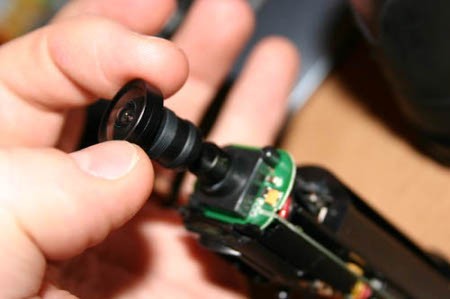
We just ordered up a new ATC3K video camera from Oregon Scientific for some, uh projects. (No, not our new porn site.) If you’ve got one of the older ATC2K cams, you can mod it a bit to avoid dropping another C-note on the new model. [Carlos] wrote up his mod to remove and replace the original narrow lens with a wide angle fisheye lens. The install requires some significant effort and some case modding – probably not a good idea if the waterproof feature is dear to you.

TB-303 Teardown


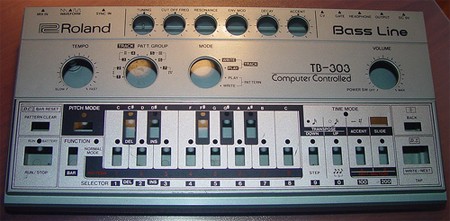
Flickr member and owner of awesome stuff [Firegroove] brought us a teardown of a Roland TR-909 drum machine before, and now he brings us a new photoset of a TB-303 synth teardown. The machines comprise two thirds of the holy trinity of 80’s electronic music machines, so look after the break for more photos.

Continue reading “TB-303 Teardown”

Arduino PhotoLab


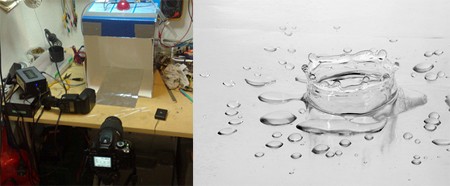
Droplet photography (link translated from French) often produces simple and beautiful images, but timing the exposure can be tricky. Snapping the photo too early or too late can cause you to miss the action, which only lasts a fraction of a second. EquinoxeFR (the people behind the Asus WL500GP audio hack) came up with a solution to this problem using a circuit with an ATmega168 running an Arduino environment. The circuit controls a syringe that contains a liquid and is triggered remotely to release a drop into a darkened chamber. A camera with the shutter open is attached to the chamber, and before the droplet hits, it crosses an IR sensor that triggers the flash to go off a few milliseconds later, capturing the unique crown shape of the impact. No schematic is available as yet, but comments at the bottom of the post suggest one will be coming soon.