MakiBox Turns Plastic Pellets Into 3D Objects

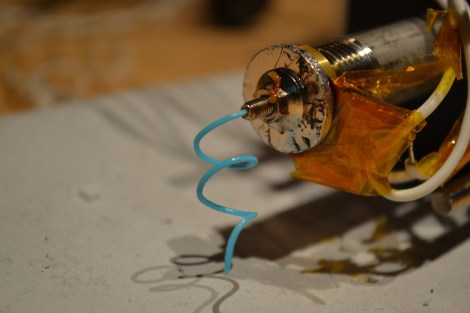
The holy grail of desktop 3D printers – aside from manufacturing full color objects in any shape imaginable – is turning tiny plastic pellets into a plastic filament. Many projects have attempted this with moderate levels of success but turning pellets into filament still an open problem. MakiBot hopes to solve this problem by manufacturing plastic filament just in time to be squirted out a nozzle onto the print bed.

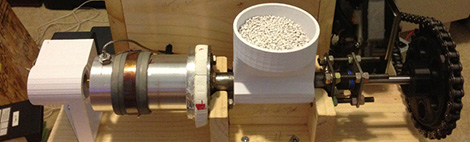
MakiBox is seeing a lot of potential with their pellet drive. Instead of sending huge amounts of pellets into an auger extruder, the team realized the best option would be to send pellets into the hot end one at a time. This makes for better thermal characteristics and produces a very consistent filament.

Turning plastic pellets into 3D objects is an enticing idea but producing a filament on the fly is an interesting concept. While the MakiBox team is making custom color filament right now, in the future it might be possible to mix colors for full-color prints.

Videos demonstrating the extruder after the break.

Continue reading “MakiBox Turns Plastic Pellets Into 3D Objects”
Finally, Turning Plastic Pellets Into 3D Printer Filament

Here’s the situation: a kilogram of 3D printer filament costs about $50. A kilogram of plastic pellets costs less than a tenth of that. Does anyone have a solution to this problem?

For years now, the general consensus was making your own 3D printer filament at home was nigh impossible, dealing with temperatures, pressures, and tolerances that home-built machines simply can’t handle. [Bradley] sent in a filament extruder he made because he was disturbed at this current mindset that desktop filament factories have huge technical issues that have yet to be overcome.

[Bradley]’s extruder is based on the Lyman Filament Extruder, a machine that has successfully demonstrated taking plastic pellets, forming them into a filament, and having this filament used in the production of 3D printed parts. [Bradley]’s improvements include a variable-speed motor, a larger hot end, and an automatic timing system to produce set quantities of printer filament.

Of course, since Inventables threw $40,000 at the problem of creating filament at home there were bound to be more than a few successful designs making their way out into the public. When we last covered the developments of home filament manufacturing, the Filabot seemed to be in the lead. Now with [Bradley] (and  [Lyman])’s machines turning out usable filament, it’s only a matter of time before the 40 grand prize is snatched.

A Harpsichord That Plays Itself

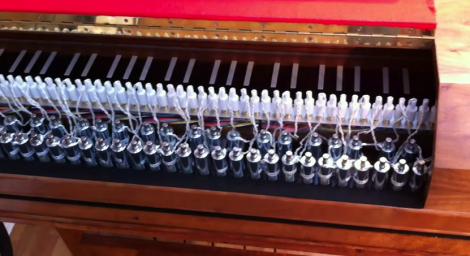
[Malcolm Messiter] is an Oboe player who loves to play pieces from the Baroque era. This often means playing with a Harpsichord and he managed to acquire one to call his very own. Unfortunately you can’t play both instruments at once so he set out to automate the keyboard. What you see here is a fully working version, but he soon went on to add solenoids to the upper rank as well. His story starts on page 27 of this newsletter (PDF).

He really went out of his way to make sure the instrument was not mistreated. A cabinet-maker built some brackets to mount the system above the keys. A friend drilled and tapped a sheet of acrylic to which each solenoid was mounted. The solenoid shafts have each been padded with felt to cushion the blow on the keys. We’ve embedded two demo video after the break that show off the first and second versions of the builds.

Harpsichords pluck the strings instead of hitting them with a hammer as the piano does. The mechanism that does the plucking had worn out on many of the keys so [Malcolm] used a 3D printer to help replace them.

Continue reading “A Harpsichord That Plays Itself”

Reproduce 3D Printed Models By Making Your Own Molds

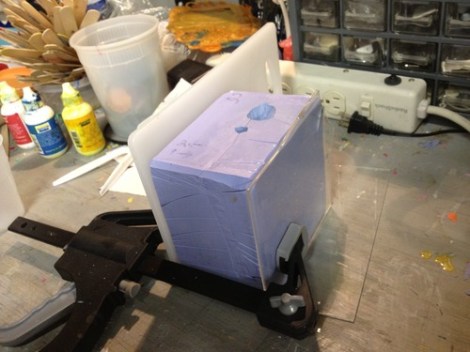
Need fifty copies of that 3D printed whirligig you’re so proud of? It might be faster to just cast copies by using the 3D printed model to make a mold. [Micah] found himself in this situation and managed to cast one copy every 10-12 minutes using the mold seen above.

With the object in hand, you need to find a container which will fit the mold without too much waste. The bottom half of the mold is then filled with modeling clay, a few uniquely shaped objects to act as keys, and the model itself. After getting a good coating of release agent the rest of the mold is filled with a silicone rubber product which is sold for mold making. This creates one half of the mold. After it cures the clay and key objects are removed, everything is sprayed with the release agent, and the other half of the mold is poured.

Now your 3D object can be copied by pouring two-part resins in the to shiny new mold.

Octopus Submarine Is Something Out Of [Jules Verne]’s Imagination

Making an octopus on a Reprap or Makerbot isn’t that terribly hard. There were dozens of these octopuses at nearly every Maker Faire booth with a 3D printer. These octopuses have almost become a right of passage for new owners of 3D printers, and serves as a wonderful reference object on par with the Utah teapot and the Stanford bunny.

[Sean Charlesworth] wasn’t happy with any old octopus; no, he had to build a better octopus, and what better way to do as such then to make a steampunk and [Jules Verne]-inspired model submarine?

[Sean]’s Octopod underwater salvage vehicle was almost entirely printed on a very expensive printer. Save for a few LEDs, electronics, and armature wire, the entire model sub/octopus was printed on an Objet 500 Connex printer.

The Objet is unique among most 3D printers in that it can print objects made of several types of materials. In [Sean]’s show and tell he showed me how the tentacles were made of a hard plastic material and a bendable rubber material. [Sean] put a piece of wire through the length of each tentacle so he could pose the Octopod in just about any way imaginable.

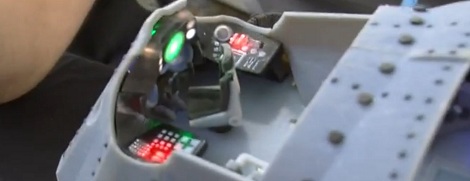
The hull of the Octopod is an amazing amount of work. The cockpit features miniature controls, an illuminated display for a very tiny pilot, and even moving parts that include a mechanical iris in the recovery bay, a winch that works, and even doors that open and close.

[Sean] put a bunch of glamour shots of the Octopod on his web site along with a few videos of the construction process. You can check those videos alongside my interview after the break.

Continue reading “Octopus Submarine Is Something Out Of [Jules Verne]’s Imagination”

Running Into The Form 1 Printer At Maker Faire

[youtube=http://www.youtube.com/watch?v=yxNqMg_dwJI&w=470]

The Form 1 resin printer Kickstarter met its funding goal in just about 8 hours, and after five days is on track to be the most successful Kickstarter to date. Being so successful meant we had to drop by the FormLabs booth at Maker Faire to see what the hubub is.

From the sample prints floating around the booth, the Form 1 printer has amazing resolution – a 3 inch tall statue of a Greek god had as many features as a life-sized statue.

In the video (both above the fold and after the break), [David Cranor] goes over the features and finishing process of objects made on the Form 1.

Continue reading “Running Into The Form 1 Printer At Maker Faire”

Ginormous Ultimaker Can Print Slightly Smaller Ultimakers

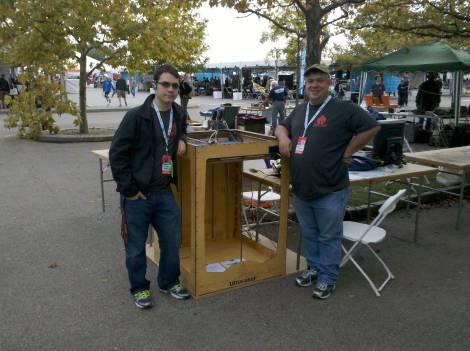
[bwattendorf] showed off his Gigimaker, a huge version of a Ultimaker at the Maker Faire this weekend.

It’s got a print area 2.5 feet square and 3.5 feet high. Currently, the team is using the machine to print off parts for smaller desktop-sized 3D printers, but theoretically this printer could be used to print life-sized companion cubes or full sized [Nefertiti] busts.

If you’d like to build your own giant Ultimaker, grab a few sheets of plywood and grab the git repo for the Gigimaker.