If you have a Bambu Labs printer and aren’t keen to send your files to Bambu’s servers with each print job, then check out Bambuddy, an open-source, self-hosted, cloud-free central command that offers a local alternative for managing Bambu Labs printers. It acts as a replacement for the official cloud services, allowing you to slice, print, and monitor with full local control and zero reliance on Bambu Labs’ servers. Continue reading “Bambuddy Says Bye To Bambu Lab Cloud Services”→
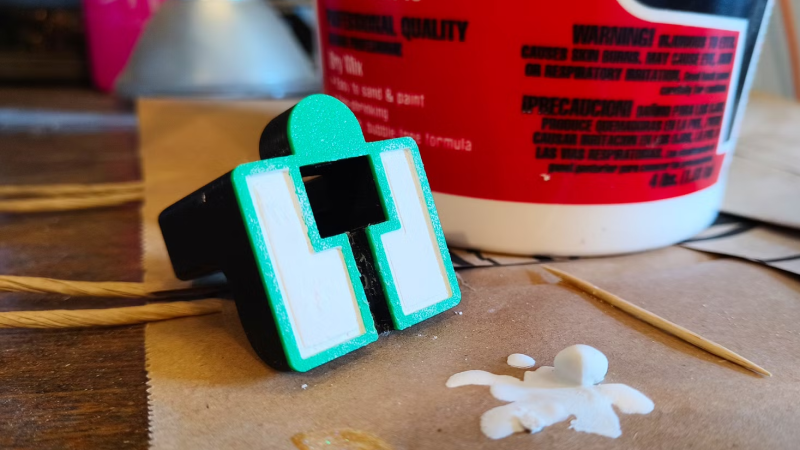
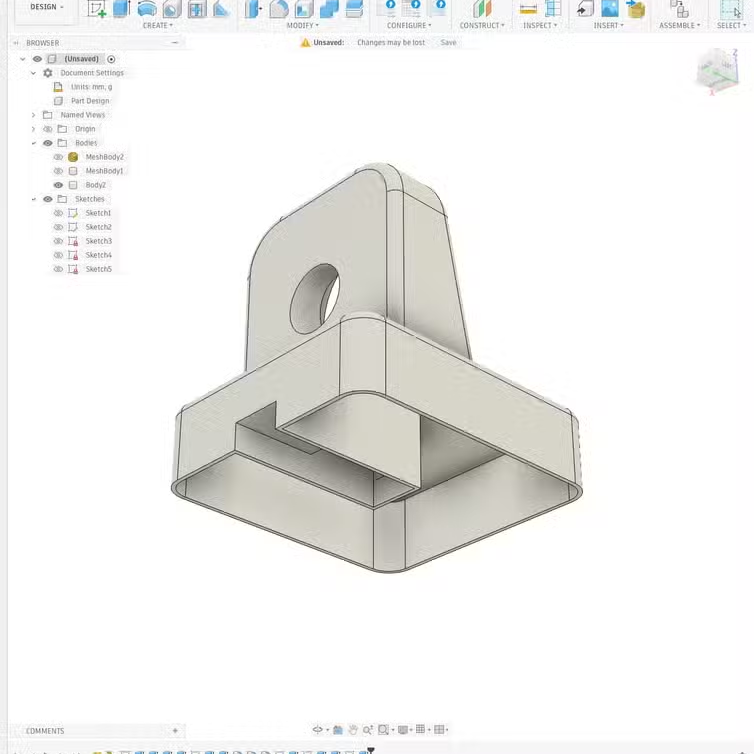
Sometimes it’s useful to add extra mass to a 3D print, and [Joe Fedewa] shared a simple and effective technique that uses plaster of Paris. Rather than pause the print and insert hardware or weighted bits inside, he designed the base as hollow. Not in the sense of zero infill, but in the sense of modeling a cavity into the open bottom of the object.
An open cavity in the base is perfect for filling with plaster of Paris.
After the print is complete, he mixes the dry plaster with water until it creates a thick but pourable mixture. Then the object gets turned upside-down and the cavity filled. In about an hour, it will have set up enough to be handled and worked.
Plaster of Paris has a good heft to it, but more importantly it can be made perfectly presentable thanks to being very friendly to post-processing. Any rough spots can be easily sanded and the whole bottom smoothed, so one doesn’t even need to cap it off. Completely cured plaster can be sealed with a clear coat for a more durable finish, if desired.
This basic concept has been used in other ways, such as reinforcing prints with concrete to yield parts solid enough to make tools out of. But using plaster of Paris not just to add mass, but specifically to create a presentable surface that doesn’t need covering up is a neat and highly economical adaptation of the idea.
Other methods of adding mass to a 3D print include inserting metal balls or chunky nuts, bolts, or other hardware, but this method doesn’t require pausing prints to insert things. Nor does it require sealing off or capping the print, messing with goopy epoxies or resins, or spending a lot of money — making it a good one to keep in mind in case it comes in handy someday.
When it comes to robots, few are as iconic as Robby. [Ogrinz Labs] has wanted to build one and even examined a real one up for auction to get high-res photos of it. He also combined his designs with some other open-source designs, and it looks good. He’s released his design as a Creative Commons-licensed set of STL files that you, in theory, could print. There are more details and instructions in the video below.
If you are looking for something quick to print for the weekend, this isn’t it. As you might expect, this is a lot to print. The creator admits, too, that it isn’t totally accurate. It has bigger feet, for example, so his feet can fit inside. There are a few other modifications made for different reasons, but only a hard-core Robby enthusiast would notice any of them.
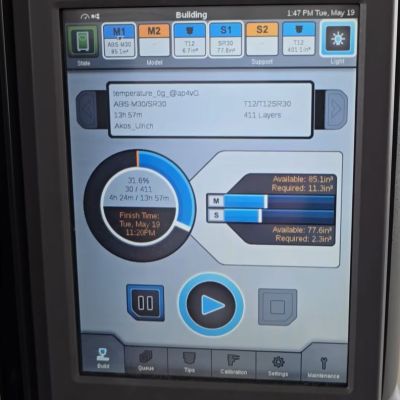
The test parts being printed on the Stratasys Fortus 450mc. (Credit: My Tech Fun, YouTube)
Professional Stratasys FDM printers demand a pretty hefty price premium over your typical hobbyist-level machine, with the gold-plating continuing even with the special filament cartridges that you buy for some of their printers.
This raises the question of in how far this eye-watering price tag is justified, and how much is just you paying for support and the brand name. After acquiring a spool of Stratasys ABS filament via a US viewer, [Dr. Igor Gaspar] set to work to try and answer this question.
The viewer had already liberated the spool of ABS+ P430 filament from its cartridge, making it easy to use that directly with the Bambu Lab FDM printer.
To make it a fair comparison, [Igor] also needed to have a sample printed on a real Stratasys printer, for which he used a local company’s services. An interesting sidenote here is that the US viewer’s company moved away from Stratasys to Bambu Lab printers.
[Igor] was able to see his test parts being printed on the Stratasys printer, as said company is in the same city. This showed him that it took 14 hours to print the parts versus 3.5 hours on the Bambu Lab printer, suggesting that his worries about the right printing parameters for the Stratasys filament were warranted. Sussing those out was thus paramount for a fair comparison and warranted some test prints.
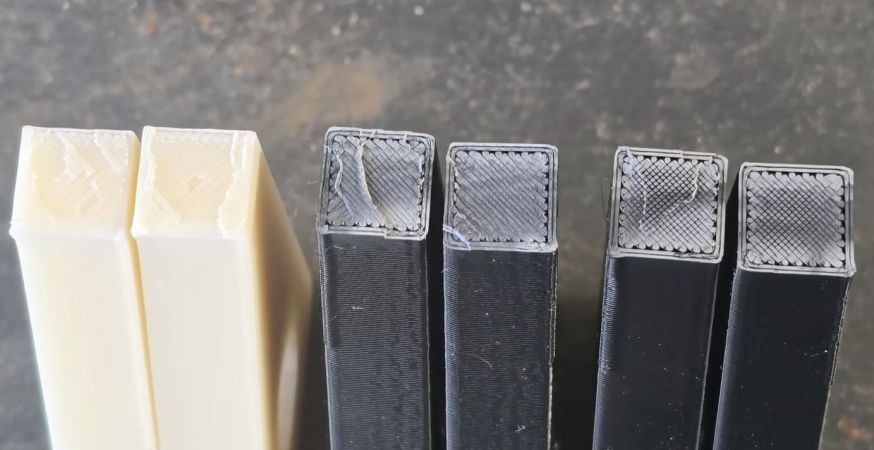
From a sheer aesthetic point of view the Stratasys-printed parts looked much cleaner, and their dimensional accuracy was also significantly better due to the slicer adjusting for this. Between the used Stratasys M30 and Bambu Lab ABS filaments there’s no clear winner, with both trading blows. Amusingly enough, the older Stratasys ABS type in the form of the ABS+ P430 filament performed the best of all when printed on the Bambu Lab printer at its preferred temperature setting.
Moral of the story is thus that – unless you really want to pay for that service contract – to loot old Stratasys ABS spool cartridges and use them in your hobbyist FDM printer. As [Igor] says in the conclusion, the nicer looks is probably due to them printing very thin layers, much finer than the 0.2 mm layers he used. This would also match the much longer print time and is thus something we can replicate on any FDM printer with a temperature-controlled printing environment.
Although no longer so common as during the heyday of the RepRap movement, it’s easier than ever to build your own largely-printed 3D printer, with designs such as Voron’s delivering excellent quality. Nevertheless, there are still niches to be filled by new designs, such as [Alex Yu]’s mostly-printed Encore design.
The Encore uses CoreXY kinematics and linear rails for the X and Y axes. Its has no internal frame; the linear rails are mounted directly to the side panels, which were printed but provided sufficient rigidity. The printer is modular, and all the parts are designed to fit within a 225 mm print bed. The Encore itself uses a 120 mm bed, a Bowden extruder, and a lightweight Bambu-style hotend. The drive motors are NEMA 17 stepper motors, and they use sliding mounts for belt tensioning. The power supply sits behind the rods supporting the Z axis, and the controller board is in the base of the printer.
Building the printer was simple; tuning it, less so. The combination of a Bambu-type hotend with a Bowden extruder created some complications, and the hotend initially received too little cooling. [Alex] solved the cooling issues by using a stronger fan on the hotend, redesigning the ventilation shroud, and adding two inward-blowing fans along the sides of the build volume. After correcting some issues with Z-axis stability, the Encore produced some quite good-looking parts. [Alex] is still improving and documenting some aspects of the printer, but he’s uploaded his progress so far to GitHub.
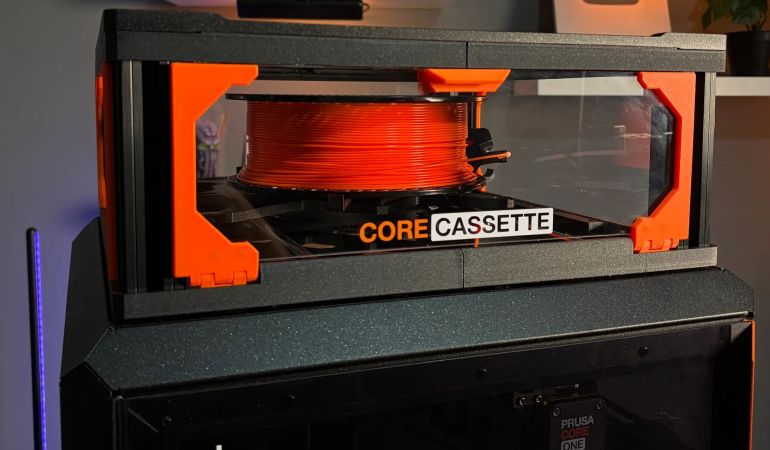
Unlike resin printers where you generally just pour the fresh resin into the easily accessible vat, FDM printers need to squirrel away at least one spool and its requisite holder somewhere. For bed slingers this generally means a top-mounted spool holder, while for CoreXY enclosed printers they can appear on the sides, top or – inexplicably – on the back. While a side-mounted spool is often convenient, access to the side can still be blocked, in which case you do what [3D Maker Noob] did and over-engineer a fancy top-mounted spool holder.
The problem started after converting a Prusa Mk4S to a Core One using the conversion kit, which changes the position of the spool, forcing him to work around not having access to the right side of the machine where the default position is. After a first version using many of the left-over parts of the original Mk4S to create a fancy box-shaped spool holder, he proceeded to upgrade it as detailed in the video. All project files and instructions are available on Printables.
The result is a box you stack on top of the printer somewhat like a multi-spool box, just flatter and with a flippy lid on the front from which a rail slides out with the magnetically attached spool holder. A spool holder which you naturally can further customize to fit different spools. Even if over-engineered, you can’t deny that it would fit in confined spaces and looks pretty good while doing its job.
Adding magnets to a 3D print can be very useful in a design, but there are some things that can trip you up if you’re not aware of them. In a recent video by [Lost in Tech] some of the essentials are covered, including why you shouldn’t get magnets near most extruder nozzles or the printing bed.
The easiest method is of course to add magnets in after printing, using friction fit with or without ribs, or with a dab of glue. Here making sure that the magnet stays in place is the trick, as you do not want the magnet to get lost or end up in the tummy of a curious pet or toddler.
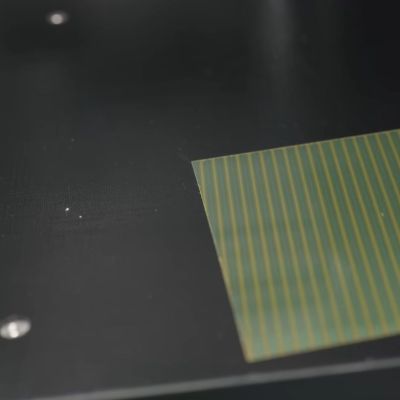
The magnetic pattern on an FDM printer’s magnetic bed.
Things get spicy when you’re talking about adding magnets during the printing process, as some extruders are made of a ferromagnetic material and thus a magnet will happily stick to said nozzle if it’s not pure brass or similar. As seen in the video even some purported ‘brass’ nozzles aren’t pure enough to not be significantly ferromagnetic.
Another issue is that of heat, which is something that magnets generally do not like much. Using magnets like you’d use heat inserts for bolts is a recipe for disaster, as the heat from a soldering iron will demagnetize the magnet, which for the typical magnet is less than 200°C. At least this should mean that the magnet stuck to your extruder nozzle will eventually fall off by itself after it demagnetizes.
With the bed of the typical FDM printer these days you’re talking about magnetically attached plates, with the underlying heated bed using a Halbach array configuration as is typical of flat magnets, yet with the gotcha that these aren’t typically real Halbach arrays, but knock-offs with simply alternating north-south pole magnets. As it turns out, these types of magnetic arrays can be disturbed by another magnet, such as a powerful neodymium magnet near said printing bed, flipping polarity in a way that cannot be easily undone.
You can still install magnets during printing, but it’s recommended to use something like side-insertion, where the extruder nozzle cannot pull out a magnet. Regardless of your approach, it’s good to know of the risks with ferromagnetic nozzles, the magnetic bed and treating magnets like they’re just heat inserts. While you can get higher-temperature magnets, many of the same issues still remain here.