The Trouble With Hubble: Payload Computer Glitch Stops Science At The Space Observatory

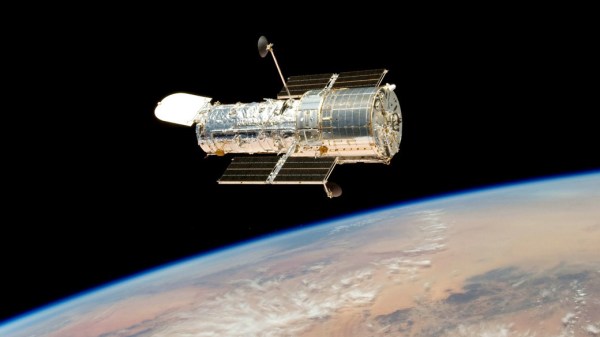
The Hubble Space Telescope’s remarkably long service life and its string of astonishing contributions to astronomy belie its troubled history. Long before its launch into low Earth orbit in 1990, Hubble suffered from design conflicts, funding and budgetary pressures, and even the death of seven astronauts. Long delayed, much modified, and mistakenly sent aloft with suboptimal optics, Hubble still managed to deliver results that have literally changed our view of the universe, and is perhaps responsible for more screensaver and desktop pictures than any other single source.

But all of that changed on June 13 of this year, when Hubble suffered a computer glitch that interrupted the flow of science data from the orbiting observatory. It’s not yet clear how the current issue with Hubble is going to pan out, and what it all means for the future of this nearly irreplaceable scientific asset. We all hope for the best, of course, but while we wait to see what happens, it’s worth taking the opportunity to dive inside Hubble for a look at its engineering and what exactly has gone wrong up there.

Continue reading “The Trouble With Hubble: Payload Computer Glitch Stops Science At The Space Observatory”

China’s Mars Rover Goes Exploring

China’s space program has big goals and is already starting to achieve them. Recently, the China National Space Administration has landed its first rover on Mars, and begun to explore the surface of the red planet.

It’s a huge step, and something only previously achieved successfully by NASA. Let’s take a look at the Chinese project, its goals, and see how it compares to the American rovers that have also roamed so far away.

Continue reading “China’s Mars Rover Goes Exploring”

The Great Windows 11 Computer Extinction Experiment

There was a time when a new version of Windows was a really big deal, such the launch of Windows 95 for which the tones of the Rolling Stones’ Start me up could be heard across all manner of media outlets. Gradually over years this excitement has petered out, finally leaving us with Windows 10 that would, we were told, be the last ever version of the popular operating system and thence only receive continuous updates

But here we are in 2021, and a new Windows has been announced. Windows 11 will be the next latest and greatest from Redmond, but along with all the hoopla there has been an undercurrent of concern. Every new OS comes with a list of hardware requirements, but those for Windows 11 seem to go beyond the usual in their quest to cull older hardware. Aside from requiring Secure Boot and a Trusted Platform Module that’s caused a run on the devices, they’ve struck a load of surprisingly recent processors including those in some of their current Surface mobile PCs off their supported list, and it’s reported that they will even require laptops to have front-facing webcams if they wish to run Windows 11.

Continue reading “The Great Windows 11 Computer Extinction Experiment”

ISS Gets Roll-Out Solar Panels In Post-Shuttle Fix

Astronauts are currently installing the first of six new solar arrays on the International Space Station (ISS), in a bid to bolster the reduced power generation capability of the original panels which have now been in space for over twenty years. But without the Space Shuttle to haul them into orbit, developing direct replacements for the Stations iconic 34 meter (112 foot) solar “wings” simply wasn’t an option. So NASA has turned to next-generation solar arrays that roll out like a tape measure and are light and compact enough for the SpaceX Dragon to carry them into orbit.

Space Shuttle Atlantis carrying part of the ISS truss.

Considering how integral the Space Shuttle was to its assembly, it’s hardly a surprise that no major modules have been added to the ISS since the fleet of winged spacecraft was retired in 2011. The few small elements that have been installed, such as the new International Docking Adapters and the Nanoracks “Bishop” airlock, have had to fit into the rear unpressurized compartment of the Dragon capsule. While a considerable limitation, NASA had planned for this eventuality, with principle construction of the ISS always intended to conclude upon the retirement of the Shuttle.

But the International Space Station was never supposed to last as long as it has, and some components are starting to show their age. The original solar panels are now more than five years beyond their fifteen year service life, and while they’re still producing sufficient power to keep the Station running in its current configuration, their operational efficiency has dropped considerably with age. So in January NASA announced an ambitious timeline for performing upgrades the space agency believes are necessary to keep up with the ever-increasing energy demands of the orbiting laboratory.

Continue reading “ISS Gets Roll-Out Solar Panels In Post-Shuttle Fix”

Injection-Molded Glass Breakthrough Shatters Ceiling Of Work Methods

Glass is one of humanity’s oldest materials, and it is still used widely for everything from drinking vessels and packaging to optics and communications. Unfortunately, the methods for working with glass are stuck in the past. Most methods require a lot of high heat in the range of 1500 °C to 2000 °C, and they’re all limited in the complexity of shapes that can be made.

As far as making shapes goes, glass can be blown and molten glass pressed into molds. Glass can also be ground, etched, or cast in a kiln. Glass would be fantastic for many applications if it weren’t for the whole limited geometry thing. Because of the limitations of forming glass, some optic lenses are made with polymers, even though glass has better optical characteristics.

Ideally, glass could be injection molded like plastic. The benefits of this would be twofold: more intricate shapes would be possible, and they would have a much faster manufacturing time. Well, the wait is over. Researchers at Germany’s University of Freiburg have figured out a way to apply injection molding to glass. And it’s not just any glass — they’ve made highly-quality, transparent fused quartz glass, and they did it at lower temperatures than traditional methods. The team used x-ray diffraction to verify that the glass is amorphous and free of crystals, and were able to confirm its optical transparency three ways — light microscopy, UV-visible, and infrared measurements. All it revealed was a tiny bit of dust, which is to be expected outside of a clean room.

Continue reading “Injection-Molded Glass Breakthrough Shatters Ceiling Of Work Methods”

Electric Vehicles Could Be The Grid Storage Solution We’ve Been Dreaming Of

As nation states grapple with the spectre of environmental and economic losses due to climate change, we’ve seen an ever greater push towards renewable energy sources to replace heavier polluters like coal and natural gas. One key drawback of these sources has always been their intermittent availability, spurring interest in energy storage technologies that can operate at the grid level.

With the rise in distributed energy generation with options like home solar power, there’s been similar interest in the idea of distributed home battery storage. However, homeowners can be reluctant to make investments in expensive batteries that take years to pay themselves off in energy savings. But what if they had a giant battery already, just sitting outside in the driveway? Could electric vehicles become a useful source of grid power storage? As it turns out, Ford wants to make their electric trucks double as grid storage batteries for your home.

Continue reading “Electric Vehicles Could Be The Grid Storage Solution We’ve Been Dreaming Of”

Fueling Up For Fusion: MAST’s Super-X, JET’s Deuterium-Tritium Experiments For ITER, And More

We’ve had nuclear fission reactors in operation all over the world for ages, but nuclear fusion always seems to be a decade or two away. While one cannot predict when we’ll reach the goal of sustained nuclear fusion, the cutting edge in test hardware is advancing at a rapid pace that makes us optimistic. Beginning as soon as this month and extending over a few years, we’re living through a very exciting time for nuclear fusion and plasma physics.

The Mega Ampere Spherical Tokamak (MAST) got a big upgrade to test a new cooled divertor design. JET (Joint European Torus) will be testing the deuterium-tritium fuel mixture that will be powering the ITER (the research project whose name began as an acronym for International Thermonuclear Experimental Reactor but has since been changed to just ITER). And the Wendelstein 7-X stellarator is coming back online with upgraded cooled divertors by next year.

Here the MAST Upgrade’s Super-X divertors have so far shown a ten-fold decrease in the temperature which the divertor is exposed to while carrying thermal energy out of the tokamak reactor. This means a divertor design and ultimately a fusion reactor that will last longer between maintenance sessions. On the stellarator side of things, Wendelstein 7-X’s new divertors may allow it to demonstrate the first continuous operation of a stellarator fusion reactor. Meanwhile, JET’s fuel experiments should allow us to test the deuterium-tritium fuel while ITER is working towards first plasma by 2025.

Continue reading “Fueling Up For Fusion: MAST’s Super-X, JET’s Deuterium-Tritium Experiments For ITER, And More”