Retro Computing Coding Competition Still Open

There’s still time to enter Octojam 10, a competition to write a new program for a rather old (and virtual) machine: the CHIP-8. This interpreted language on a virtual machine was used in the 1970s and 1980s to write games that could run on several consoles, such as the COSMAC VIP. Since then, a community of tinkerers has grown up around CHIP-8 and figuring out how to get the most out of the minimal resources the machine gives you.

Continue reading “Retro Computing Coding Competition Still Open”

Retrotechtacular: The $175,000 Laser Printer

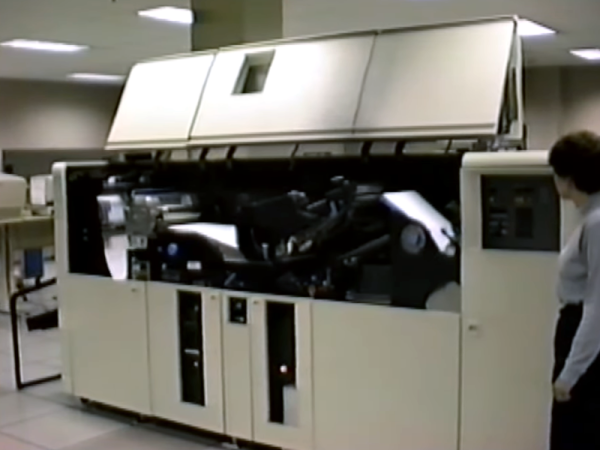
Laser printers today are cheap and readily available. But in 1976, they were the height of printing technology. The IBM 3800 was the $175,000 printer to have in that year. (Video, embedded below.) But you couldn’t have one on your desktop. Even if you could afford it, the thing is the size of a car, and we don’t even want to guess what it weighs. The printer took tractor-fed continuous form paper and could do 167 pages a minute at about 150 dots per inch (actually 180 x 144). For the record, that was as much as 1.7 miles of paper an hour!

In those days, people who would use this printer traditionally had massive banks of noisy impact printers. We imagine this device saved many data processing person’s hearing. Compared to a modern laser printer, though, it needed a lot of maintenance. For example, the initial models needed a xenon flash lamp replaced every month, although later models could go years on one bulb. Looking at some of the hardware in the video, it was probably made closer to the end of life for these printers which were made through 1999.

Continue reading “Retrotechtacular: The $175,000 Laser Printer”

Antique Motherboard Speaks

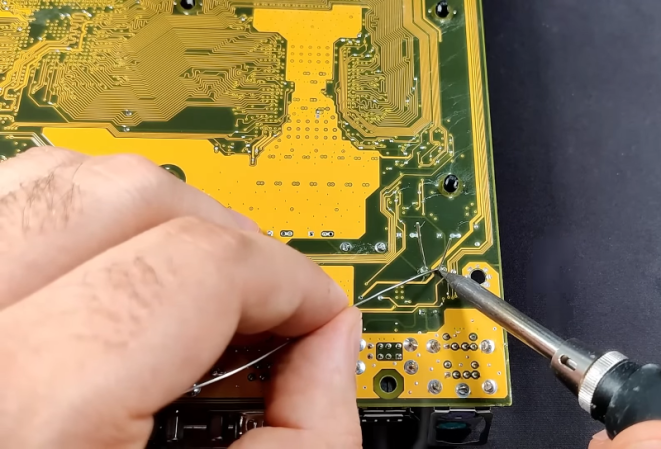
[Bits und Bolts] has been restoring an old PC motherboard with the infamous bad electrolytic capacitors. The video of his exploits was interesting enough, but pretty standard stuff. What we found interesting though, was an odd feature of the ASUS Bios called “Post Reporter” that let the motherboard speak error codes and status through the external speaker. (Video, embedded below.) We aren’t sure who wanted that, and since we haven’t seen it around lately, we are guessing the answer was nobody wanted it.

We enjoyed watching the PCB rework. Those large internal ground plane layers do make it hard to unsolder and then solder the caps. That makes the job seem deceptively easy. However, if you want to skip to the exotic BIOS, jump to the 8:20 mark.

Continue reading “Antique Motherboard Speaks”

Pocket Calculator Isn’t A Brain Or Magic

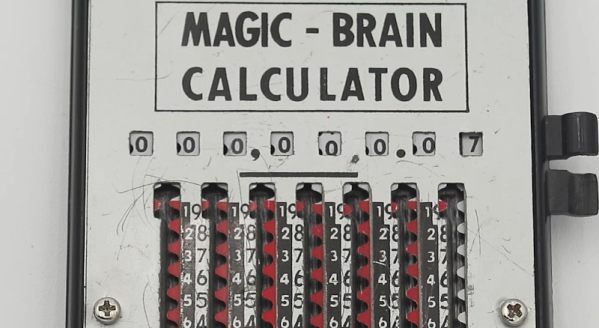
If you predate the pocket calculator, you may remember slide rules. But slide rules take a a little skill to use. There was a market for other devices that were simpler or, in some cases, cheaper. One common one was the “magic brain” or Addiator which was a little metal box with some slots that could add numbers. However, using clever tricks it could also subtract and — in a fashion — multiply. [Our Own Devices] has a teardown of the device you can see in the video below. It is deceptively simple, and the description of how it works is at least as interesting as the peek inside.

We remember these on the market and, honestly, always thought they were simple tally mechanisms. It turns out they are both less and more than that. Internally, the device is a few serrated sheet metal strips in a plastic channel. The subtraction uses a complement addition similar to how you do binary subtraction using 2’s complement math. Multiplication is just repetitive addition, which is fine for simple problems.

Continue reading “Pocket Calculator Isn’t A Brain Or Magic”

Finally, An Open-Source 8088 BIOS

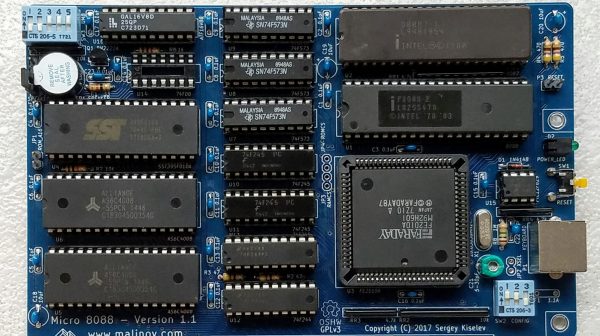
The Intel 8088 is an interesting chip, being a variant of the more well-known 8086. Given the latter went on to lend its designation to one of the world’s favorite architectures, you can tell which of the two was higher status. Regardless, it was the 8088 that lived in the first IBM PC, and now, it even has its own open-source BIOS.

As with any BIOS, or Basic Input Output System, it’s charged with handling core low-level features for computers like the Micro 8088, Xi 8088, and NuXT. It handles chipset identification, keyboard and mouse communication, real-time clock, and display initialization, among other things.

Of course, BIOSes for 8088-based machines already exist. However, in many cases, they are considered to be proprietary code that cannot be freely shared over the internet. For retrocomputing enthusiasts, it’s of great value to have a open-source BIOS that can be shared, modified, and tweaked as needed to suit a wide variety of end uses.

If you want to learn more about the 8088 CPU, we’ve looked in depth at that topic before. Feel free to drop us a line with your own retro Intel hacks if you’ve got them kicking around!


Debugging A 1950s Computer Sounds Like A Pain

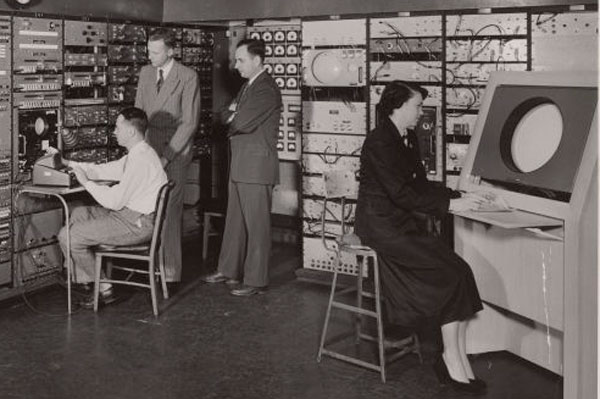
Debugging computers in the 1950s sounds like it wasn’t an easy task. That’s one of the interesting facts from this fascinating talk by [Guy Fedorkow] about the Whirlwind, one of the first digital computers ever built. The development of this remarkable computer started at MIT (Funded by the US Navy) in 1949 as a flight simulator but pivoted to plotting interceptions in the early 1950s. That was because the USSR had just set off their first boosted nuclear bomb, which could be mounted on a missile or bomber. So, the threat of incoming missiles and atomic bombers became real, and the need arose to intercept nuclear bombers.

As a real-time computer, Whirlwind received radar data from radar stations around the US that showed the location of the interceptor and the incoming bogey, then calculated the vector for the two to meet up and, erm, have a frank exchange of views. So, how do you debug one of the first real-time computers? Carefully, it seems.

Continue reading “Debugging A 1950s Computer Sounds Like A Pain”

Commodore Datassette Does Barbershop Quartet

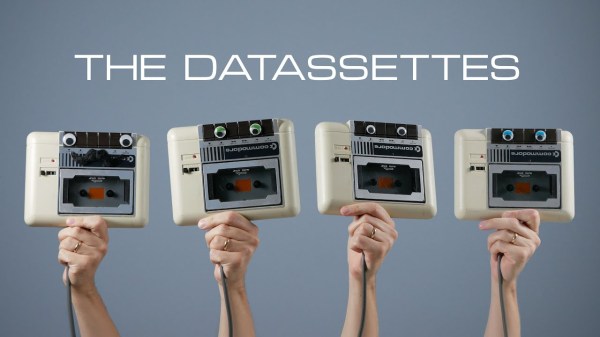
Okay, now this is just plain fun. [Linus Ã…kesson] modified a Commodore Datassette player to move its “mouth” and, when quadrupled, sing a clever barbershop tune called “Sweet End of Line” that’s a play on “Sweet Adeline“, a top hit from the summer of 1903.

What? Let us explain. Those with Commodore 64s who lacked disk drives often had the Datassette — a magnetic storage tape device, or cassette player used to load and save files. But they couldn’t open the doors themselves with a keypress, and they certainly couldn’t sing barbershop.

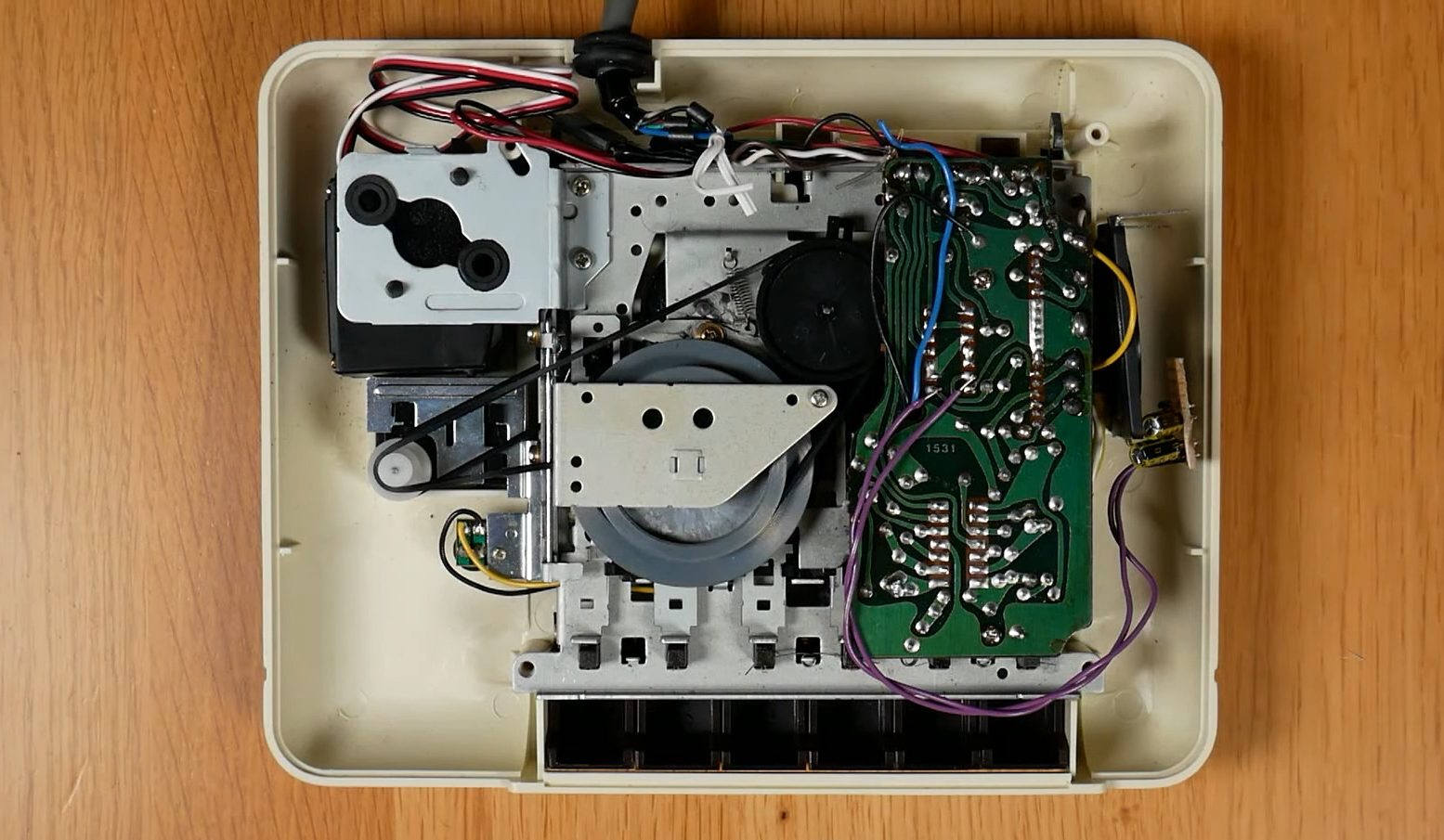
First off, [Linus] redirected the current that drives the magnetizing tape head through a speaker coil instead. Then he replaced the motor with a servo that opens the lid from the inside. A simple rubber band pulls the lid back shut. Software-wise, [Linus] is using a timer interrupt to run code that toggles the output signal, the rate of which determines the pitch.

Don’t worry — all of these modifications are reversible, so no Datassettes were truly harmed in the making. Don’t forget to check out the brief build/demo video after the break.

We’ve seen our share of tape players, but we’d never seen one with a crank until recently.

Continue reading “Commodore Datassette Does Barbershop Quartet”