[Stoppi] always has interesting blog posts and videos, even when we don’t understand all the German in them. The latest? Computer simulation of wave propagation (Google Translate link), which, if nothing else, makes pretty pictures that work in any language. Check out the video below.
Luckily, most browsers will translate for you these days, or you can use a website. We’ve seen waves modeled with springs before, but between the explanations and the accompanying Turbo Pascal source code, this is worth checking out.
Although often glossed over, the human liver is a pretty amazing organ. Not just because it’s pretty much the sole thing that prevents our food from killing us, but also because it’s the only organ in our body that is capable of significant regeneration. This is a major boon in medicine, as you can remove most of a person’s liver and it’ll happily regrow back to its original volume. Obviously this is very convenient in the case of disease or when performing a liver transplant.
Despite tissue regeneration being very common among animals, most mammalian species have only limited regenerative ability. This means that while some species can easily regrow entire limbs and organs including eyes as well as parts of their brain, us humans and our primate cousins are lucky if we can even count on our liver to do that thing, while limbs and eyes are lost forever.
This raises many questions, including whether the deactivation of regenerative capabilities is just an evolutionary glitch, and how easily we might be able to turn it back on.
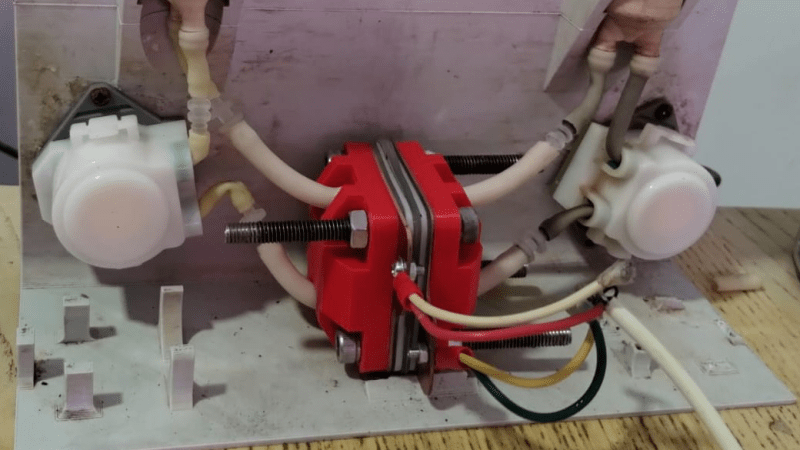
The flow battery is one of the more interesting ideas for grid energy storage – after all, how many batteries combine electron current with fluid current? If you’re interested in trying your hand at building one of these, the scientists behind the Flow Battery Research Collective just released the design and build instructions for a small zinc-iodide flow battery.
The battery consists of a central electrochemical cell, divided into two separated halves, with a reservoir and peristaltic pump on each side to push electrolyte through the cell. The cell uses brass-backed grafoil (compressed graphite sheets) as the current collectors, graphite felt as porous electrodes, and matte photo paper as the separator membrane between the electrolyte chambers. The cell frame itself and the reservoir tanks are 3D printed out of polypropylene for increased chemical resistance, while the supporting frame for the rest of the cell can be printed from any rigid filament.
The cell uses an open source potentiostat to control charge and discharge cycles, and an Arduino to control the peristaltic pumps. The electrolyte itself uses zinc chloride and potassium iodide as the main ingredients. During charge, zinc deposits on the cathode, while iodine and polyhalogen ions form in the anode compartment. During discharge, zinc redissolves in what is now the anode compartment, while the iodine and polyhalogen ions are reduced back to iodides and chlorides. Considering the stains that iodide ions can leave, the researchers do advise testing the cell for leaks with distilled water before filling it with electrolyte.
If you decide to try one of these builds, there’s a forum available to document your progress or ask for advice. This may have the clearest instructions, but it isn’t the only homemade flow cell out there. It’s also possible to make these with very high energy densities.
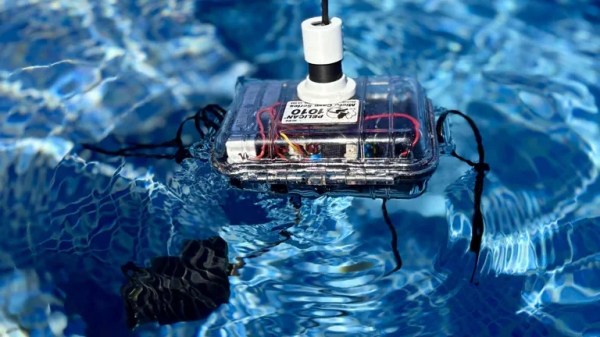
The build uses a Xiao ESP32-S3 as the brains of the operation. It’s paired with a Wio-SX1262 radio kit, which sends LoRa signals over longer distances than is practical with the ESP32’s onboard WiFi and Bluetooth connections. The microcontroller is hooked up with a one-wire temperature sensor, a DF Robot turbidity sensor, and an MPU6050 gyroscope and accelerometer, which allow it to measure the water’s condition and the motion of the waves. The whole sensor package is wrapped up inside a 3D printed housing, with the rest of the electronics in a waterproof Pelican case.
It’s a neat project that combines a bunch of off-the-shelf components to do something useful. [rabbitcreek] notes that the data would be even more useful with a grid of such sensors all contributing to a larger dataset for further analysis. We’ve seen similar citizen science projects executed nicely before, too. If you’ve been doing your own ocean science, don’t hesitate to let us know what you’re up to on the tipsline!
3D printing is arguably over-used in the maker community. It’s just so easy to run off a quick prototype and then… well, it’s good enough, right? Choosing the right plastic can go a long way to making sure your “good enough” prototype really is good enough for long term use. If you’re producing anything with gearing, you might want to cast your eyes to a study by [Mert Safak Tunalioglu] and [Bekir Volkan Agca] titled: Wear and Service Life of 3-D Printed Polymeric Gears.
No spin doctoring here, spinning gears.
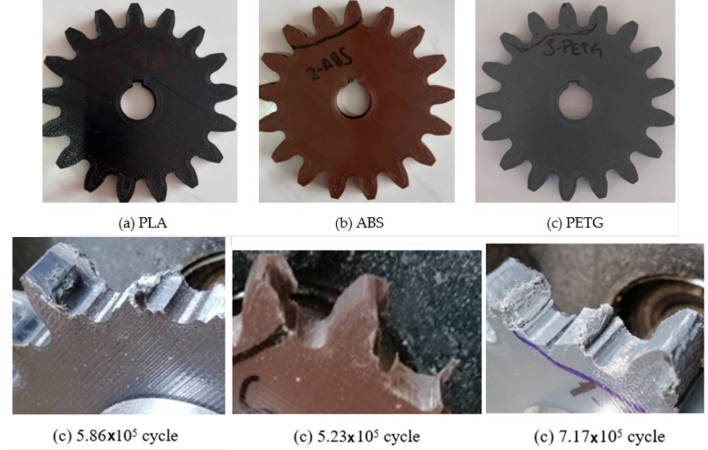
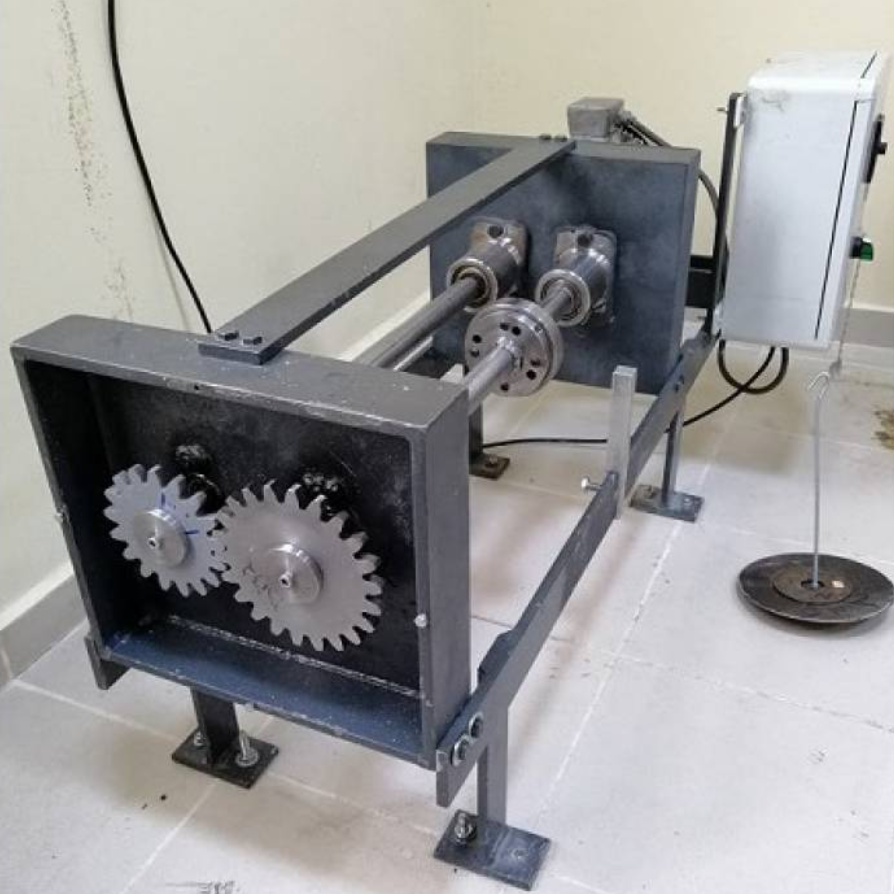
The authors printed simple test gears in ABS, PLA, and PETG, and built a test rig to run them at 900 rpm with a load of 1.5 Nm against a steel drive gear. The gears were pulled off and weighed every 10,000 rotations, and allowed to run to destruction, which occurred in the hundreds-of-thousands of rotations in each case. The verdict? Well, as you can tell from the image, it’s to use PETG.
The authors think that this is down to PETG’s ductility, so we would have liked to see a hard TPU added to the mix, to say nothing of the engineering filaments. On the other hand, this study was aimed at the most common plastics in the 3D printing world and also verified a theoretical model that can be applied to other polymers.
This tip was sent in by [Benjamin], who came across it as part of the research to build his first telescope, which we look forward to seeing. As he points out, it’s quite lucky for the rest of us that the U.S. government provides funding to make such basic research available, in a way his nation of France does not. All politics aside, we’re grateful both to receive your tips and for the generosity of the US taxpayer.
We’ve seen similar tests done by the community — like this one using worm gears — but it’s also neat to see how institutional science approaches the same problem. If you need oodles of cycles but not a lot of torque, maybe skip the spurs and print a magnetic gearbox. Alternatively you break out the grog and the sea shanties and print yourself a capstan.
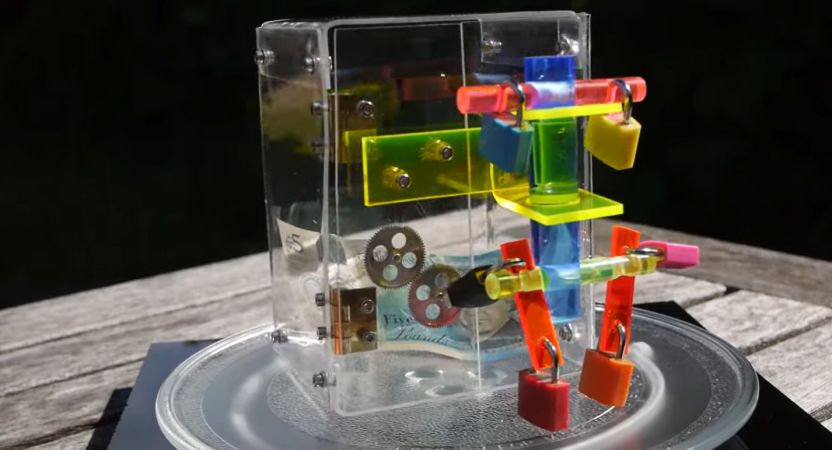
Brunnian links are a type of nontrivial link – or knot – where multiple linked loops become unlinked if a single loop is cut or removed. Beyond ‘fun’ disentanglement toys and a tantalizing subject of academic papers on knot theory, it can also be used for practical applications, as demonstrated by [Anthony Francis-Jones] in a recent video. In it we get a safe that is locked with multiple padlocks, each of which can unlock and open the safe by itself.
This type of locked enclosure is quite commonly used in military and other applications where you do not want to give the same key to each person in a group, yet still want to give each person full access. After taking us through the basics of Brunnian links, including Borromean rings, we are introduced to the design behind the safe with its six padlocks.
As a demonstration piece it uses cheap luggage padlocks and Perspex (acrylic) rods and sheets to give a vibrant and transparent view of its workings. During the assembly it becomes quite apparent how it works, with each padlock controlling one direction of motion of a piece, each of which can be used to disassemble the entire locking mechanism and open the safe.
Brunnian links are also found in the braids often made by children out of elastic bands, which together with this safe can be used to get children hooked on Brunnian links and general knot theory.
Supersonic air travel is great if you want to get somewhere quickly. Indeed, the Concorde could rush you from New York to London in less than three and a half hours, over twice as fast as a conventional modern airliner. Despite the speed, though, supersonic passenger service has never really been sustainable thanks to the noise involved. Disruption from sonic booms has meant that supersonic travel over land is near-universally banned. This strictly limits the available routes for supersonic passenger jets, and thus their economic viability.
Solving this problem has been a hot research topic for some time. Now, it appears there might be a way forward for supersonic air travel over land, using a neat quirk of Earth’s atmosphere.