An Apartment-Hunting AI

Finding a good apartment is a lot of work and includes searching websites for available places and then cross-referencing with a list of characteristics. This can take hours, days or even months but in a world where cars drive themselves, it is possible to use machine learning in your hunt.

[veesot] lives in a city between Europe and Asia and was looking for a new home, and his goal was to create a model that can use historical data to not only suggest if an advertised price was right, but also recommend waiting by predicting the decrease in the the future. The data-set includes parameters such as “area”, “district”, “number of balconies” etc and tried to determine an optimal property to view.

There is a lot that [veesot] describes in his post which includes cleaning the data in terms of removing flats that are tool small or tool large. This is essentially creating a training data-set for the machine learning system that will allow the system to generate usable output. [veesot] also added parameters such districts which relate to the geographical location, age of the building and even the materials used in the construction.

There is also an interesting bit about analyzing the data variables and determining cross-correlation which ultimately leads to the obvious conclusions that the central/older districts have older apartments and newer ones are larger. It makes for a few cool graphs but the code can certainly come in handy when dealing with similar data-sets. The last part of the writing discusses applying Linear Regression and then testing its accuracy. Interpreting the model produces interesting results about the trained model and the values of the coefficients.

Continue reading “An Apartment-Hunting AI”

A Web API For Your Pi

There are many ways to attach a project to the Internet, and a plethora of Internet-based services that can handle talking to hardware. But probably the most ubiquitous of Internet protocols for the average Joe or Jane is the web browser, and one of the most accessible of programming environments lies within it. If only somebody with a bit of HTML and Javascript could reach a GPIO pin on their Raspberry Pi!

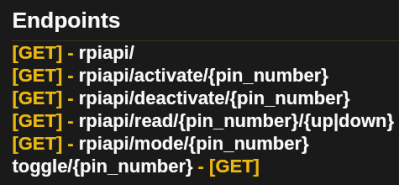
If that’s your wish, then help could be at hand in the form of [Victor Ribeiro]’s RPiAPI. As its name suggests, it’s an API for your Raspberry Pi, and in particular it provides a simple web-accessible endpoint wrapper for the Pi’s GPIO library from which its expansion port pins can be accessed. By crafting a simple path on the address of the Pi’s web server each pin can be read or written to, which while it’s neither the fastest or most accomplished hardware interface for the platform, could make it one of the easiest to access.
Security comes courtesy of Apache password protected directories via .htaccess files, so users would be well-advised to consider the implications of connecting this to a public IP address very carefully. But for non experts in security it still has the potential to make a very useful tool in the armoury of ways to control hardware from the little single board computer. It’s not the first try at this idea as we’ve seen a PHP example early in the Pi’s lifetime as well as one relying upon MySQL, but it does seem to be a simpler option than the others.

Compiler Explorer, Explored

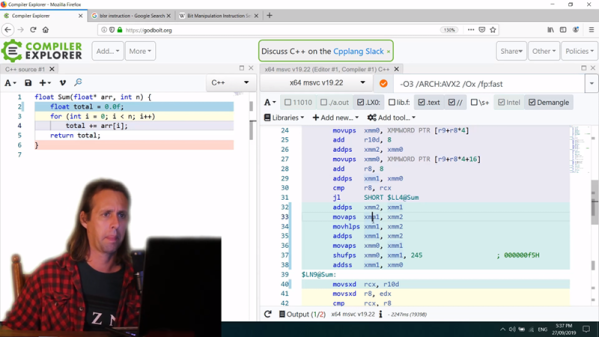
It wasn’t long ago that we introduced you to a web site, the Godbolt compiler explorer, that allows the visitor to compile code using a slew of compilers and compare their output. We suspect some number of readers said, “Wow! I can use that!”, while perhaps everyone else said, “Huh?” Well if you were in the second group, you ought to watch [What’s a Creel’s] video below where he walks through using the website. He looks at four different algorithms using four different compilers and it is a good example of how you might use the tool to make decisions about how you write software.

Continue reading “Compiler Explorer, Explored”

Asynchronous Routines For C

[Sandro Magi] noted that the async/await idiom has become more prevalent in programming recently. According to him, he first encountered it in C# but has found examples of it in JavaScript and Rust, too. The idea is simple: allow a function to return but come back later to complete something that takes a long time. Of course, multithreading is one answer to this, but generally, this technique implies more of a coroutine setup where functions cooperate to some degree to get good behavior. [Sandro] took some ideas from the existing protothread library and used it to create a system to get this effect in C and, by extension, C++.

Adding this “library” is as simple as including a header file. All the magic occurs at the preprocessor and compiler. There’s no code to link. The async routines only need two bytes of overhead and — unlike proper threads — don’t need a preallocated private stack.

Continue reading “Asynchronous Routines For C”

Control Lighting Effects Without Programming

Working in a theater or night club often requires a specialized set of technical skills that you might not instantly think about. Sure, the audio system needs to be set up and managed but the lighting system is often actively managed as well. For simple setups, this is usually not too difficult to learn. With more complicated systems you will need to get elbow-deep into some software. With [trackme518]’s latest tool, though, you will only need to be able to edit video.

Sure, this sounds like just trading one piece of software for another, but it’s more likely that professionals working in lighting will already know how to edit video rather than know programming or complicated proprietary lighting software. All you have to do to control a set of lights is to create a video, or use an existing one, and the lighting system will mimic the video on its own. If you do know programming, though, it’s written in Processing Java so changes aren’t too difficult to make.

The software (available on the project’s GitHub page) will also work outside of a professional environment, as well. It’s set up to work with DMX systems as well as LED strips so you could use it to run a large LED display board using only an input video as control. You could even use it to run the display on your guitar.

Photo courtesy of Rob Sinclair (Gribiche) [CC BY-SA 2.0 (https://creativecommons.org/licenses/by-sa/2.0)]

Peek Into The Compiler’s Code — Lots Of Compilers

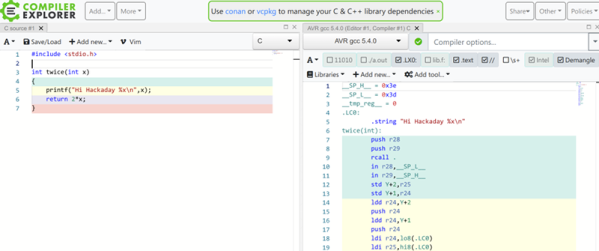
We don’t know what normal people argue about, but we know we spend a lot of time arguing about the best microcontroller, which editor is the best, and what language or compiler does the best job. The problem with all those compilers is getting them loaded and digging into the generated code. If you too spend your time thinking about those things, you ought to have a look at [Matt Godbolt’s] Compiler Explorer. We know that hosting an IDE-like web page and compiling code is old hat — although [Matt’s] site has been around quite some time. But [Matt’s] doing it differently. The code you build on the left hand pane shows up as assembly language on the right hand side.

There are plenty of options, too. For example, here’s a bit of C code from the site’s example:

int square(int num) {
   return num * num;
}

Here’s the corresponding assembly from gcc 9.2 for x86-64:

square:
  push rbp
  mov rbp, rsp
  mov DWORD PTR [rbp-4], edi
  mov eax, DWORD PTR [rbp-4]
  imul eax, eax
  pop rbp
  ret

Continue reading “Peek Into The Compiler’s Code — Lots Of Compilers”

This Week In Security: Simjacker, Microsoft Updates, Apple Vs Google, Audio DeepFakes, And NetCAT

We often think of SIM cards as simple data storage devices, but in reality a SIM card is a miniature Universal integrated circuit card, or smart card. Subscriber data isn’t a simple text string, but a program running on the smart cards tiny processor, acting as a hardware cryptographic token. The presence of this tiny processor in everyone’s cell phone was eventually put to use in the form of the Sim application ToolKit (STK), which allowed cell phone networks to add services to very basic cell phones, such as mobile banking and account management.

Legacy software running in a place most of us have forgotten about? Sounds like it’s ripe for exploitation. The researchers at Adaptive Mobile Security discovered that exploitation of SMS messages has been happening for quite some time. In an era of complicated and sophisticated attacks, Simjacker seems almost refreshingly simple. An execution environment included on many sim cards, the S@T Browser, can request data from the cell phone’s OS, and even send SMS messages. The attacker simply sends an SMS to this environment containing instructions to request the phones unique identifier and current GPS location, and send that information back in another SMS message.

It’s questionable whether there is actually an exploit here, as it seems the S@T Browser is just insecure by design. Either way, the fact that essentially anyone can track a cell phone simply by sending a special SMS message to that phone is quite a severe problem. Continue reading “This Week In Security: Simjacker, Microsoft Updates, Apple Vs Google, Audio DeepFakes, And NetCAT”