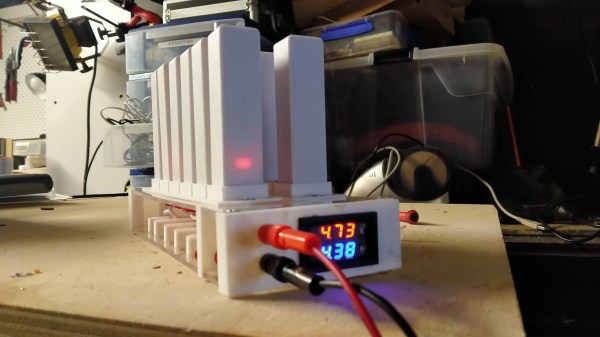
[jasonwinfieldnz] uses twelve small powerbanks day to day – powering LED strips around his trampoline, presumably, to avoid the mess of wires and make the assembly easily portable. However, if you have twelve powerbanks, you’ll find yourself hogging all the household’s microUSB cables every so often, as they eventually discharge. This was not good enough for our hacker, and he decided to build a charging station to refill them all at once.
If you need 5 volts and many amps, an ATX PSU isn’t your worst bet. From there, he only had to add twelve microUSB connectors to – and condensed the entire contraption into a beautiful charging station. For the microUSB part, he hacked some microUSB cable ends off and embedded them into the case. An embedded voltage and current module is of big help – letting you see at a glance when charging has really finished. Using copper tape as bus bars and banana plugs for charging input, this project is easy to build and solves the problem well.
The 3D printing files and cutting templates are right there on the project page, so if any of us hackers has a problem that twelve powerbanks could help with, [Jason]’s project is quite repeatable. If your devices are more diverse, you could use a pegboard to build a stylish charging station for them! If, on the other hand, you have a single device you need to plug multiple cords into, moldable plastic is there to help.