Can A Scan Tool Kill A Car?

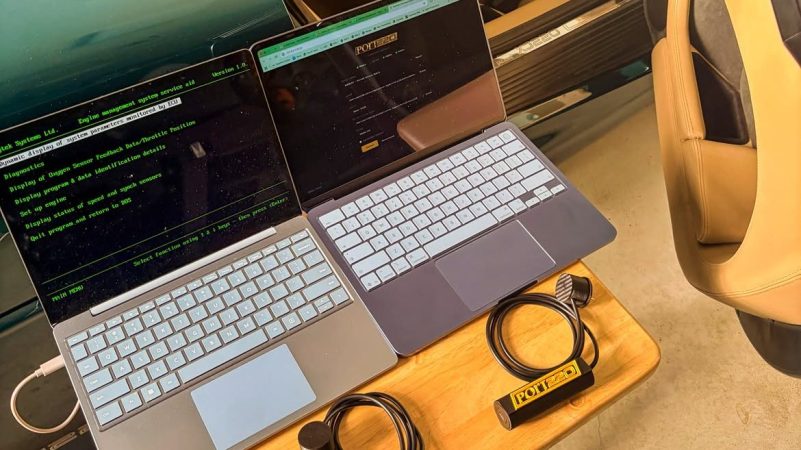
It’s no real secret that modern-day cars are basically a collection of computers on wheels, which also means that we get all the joys of debugging complex computer systems and software with cars these days. Rather than a quick poke under the hood to rebuild a carburetor and adjust the engine timing by hand, you’ll be pulling out a scan tool to gain access to the computer and figure out why the darn thing won’t start after someone else used a scan tool on it, as happened to [DiagnoseDan].

The question was whether the third-party scan tool that was used by the owner had done something to the software settings that would prevent the engine of this 2012 Renault Megane RS from starting, such as erasing keys, or if it was something more subtle. With no stored fault codes and the engine having healthy fuel, spark, and cam sensor readings, the conclusion was that the ECU was not doing its fuel injector things for some reason.

Ultimately, the root cause was that the ECU had been modded, with a re-mapping performed in 2020, meaning that the scan tool that [Dan] was using couldn’t properly interact with the ECU. Reflashing the ECU with the original manufacturer’s firmware was thus the next step, which is pretty involved in itself.

Reinstalling the OS on the car proved to be the solution. Likely, the modded firmware had stored some fault codes, as the ECU normally doesn’t start the engine if there are active codes stored. The third-party scan tool was thus likely blameless, but the inability to just clear fault codes was the real issue.

Continue reading “Can A Scan Tool Kill A Car?”

Tech In Plain Sight: Finding A Flat Tire

There was a time when wise older people warned you to check your tire pressure regularly. We never did, and would eventually wind up with a flat or, worse, a blowout. These days, your car will probably warn you when your tires are low. That’s because of a class of devices known as tire pressure monitoring systems (TPMS).

If you are like us, you see some piece of tech like this, and you immediately guess how it probably works. In this case, the obvious guess is sometimes, but not always, correct. There are two different styles that are common, and only one works in the most obvious way.

Obvious Guess

We’d guess that the tire would have a little pressure sensor attached to it that would then wirelessly transmit data. In fact, some do work this way, and that’s known as dTPMS where the “d” stands for direct.

Of course, such a system needs power, and that’s usually in the form of batteries, although there are some that get power wirelessly using an RFID-like system. Anything wireless has to be able to penetrate the steel and rubber in the tire, of course.

Continue reading “Tech In Plain Sight: Finding A Flat Tire”

The Rise And Fall Of The In-Car Fax Machines

Once upon a time, a car phone was a great way to signal to the world that you were better than everybody else. It was a clear sign that you had money to burn, and implied that other people might actually consider it valuable to talk to you from time to time.

There was, however, a way to look even more important than the boastful car phone user. You just had to rock up to the parking lot with your very own in-car fax machine.

Continue reading “The Rise And Fall Of The In-Car Fax Machines”

Nixie Tube Dashboard Is Period-Appropriate Hack To Vintage Volvo

There’s no accounting for taste, but it’s hard to argue with The Autopian when they declare that this Nixie tube dash by [David Forbes] is “the coolest speedometer of all time” — well, except to quibble that it’s also the coolest tachometer, temperature gauge, oil pressure indicator, and voltmeter. Yeah, the whole instrument cluster is on [David]’s Volvo PV544 is nixified, and we’re here for it.

He’s using a mixture of tubes here– the big ones in the middle are the speedo and tachometer, while the ovals on either side handle the rest. There’s a microcontroller on the front of the firewall that acts a bit like a modern engine control unit (ECU) — at least for the gauges; it sounds like the Volvo’s engine is stock, and that means carbureted for a car of that vintage.

The idea that this hack could have been done back in the 50s when the car was new just tickles us pink. Though you’d have probably needed enough valves to fill up the boot, as our British friends would say. Translate that to “enough vacuum tubes to fill the trunk” if you’re in one of the rebellious colonies.

We’ve featured [David]’s projects previously, in the form of his wearable video coat. But his best known work is arguably the Nixie Watch, famously the timepiece of choice for Steve Wozniak.

Thanks to [JohnU] for the tip!


All images by Griffin Riley via The Autopian

Chinese Regulators May Kill Retractable Car Door Handles That Never Should Have Existed

Headlights. Indicators. Trunk releases. Seatbelts. Airbags. Just about any part of a car you can think of is governed by a long and complicated government regulation. It’s all about safety, ensuring that the car-buying public can trust that their vehicles won’t unduly injure or maim them in regular operation, or in the event of accident.

However, one part of the modern automobile has largely escaped regulation—namely, the humble door handle. Automakers have been free to innovate with new and wacky designs, with Tesla in particular making waves with its electronic door handles. However, after a series of deadly incidents where doors wouldn’t open, regulators are now examining if these door handles are suitable for road-going automobiles. As always, regulations are written in blood, but it raises the question—was not the danger of these complicated electronic door handles easy to foresee?

Continue reading “Chinese Regulators May Kill Retractable Car Door Handles That Never Should Have Existed”

Heated Seat controls

Retrofits Done Right: Physical Controls For Heated Seats

We’ve all owned something where one tiny detail drives us nuts: a blinding power LED, buttons in the wrong order, or a beep that could wake the dead. This beautifully documented project fixes exactly that kind of annoyance, only this time it’s the climate-controlled seats in a 2020 Ram 1500.

[projectsinmotion] wasn’t satisfied with adjusting seat heating and ventilation only through the truck’s touchscreen. Instead, they added real physical buttons that feel just like factory equipment. The challenge? Modern vehicles control seats through the Body Control Module (BCM) over a mix of CAN and LIN buses. To pull this off, they used an ESP32-S3 board with both CAN and LIN transceivers that sits in the middle and translates button presses into the exact messages the BCM expects.

The ESP32 also listens to the CAN bus so the new physical buttons always match whatever setting was last chosen on the touchscreen, no mismatched states, no surprises. On the mechanical side, there are 3D-printed button bezels that snap into blank switch plates that come out looking completely stock, plus a tidy enclosure for the ESP32 board itself. Wiring is fully reversible: custom adapters plug straight into the factory harness. Every pinout, every connector, and every wire color is documented with WireVis diagrams we’ve covered before, making this an easily repeatable seat-hack should you have a similar vehicle. Big thanks to [Tim] for the tip! Be sure to check out some of our other car hacks turning a mass produced item into one of a kind.

Autopsy Of A First-Generation RX7 Mazda Rotary Car Engine

The eccentric shaft and rotor of the Mazda 12A rotary engine. (Credit: Baked Beans Garage, YouTube)

In theory, Wankel-style rotary internal combustion engines have many advantages: they ditch the cumbersome crankcase and piston design, replacing it with a simple, single-chamber design and a thick, plectrum-shaped chunk of metal that spins around inside that chamber to create virtual combustion chambers. This saves weight and maximizes performance-to-weight. Unfortunately, these types of engines are also known for burning a lot of oil and endless seal troubles, especially with early rotary Mazda engines that easily died.

Yet even 1980 versions were not without issues, a case in point is the Mazda 1st gen RX7 with a 12A rotary engine that the [Baked Beans Garage] over at YouTube got their paws on. Starting with unsuccessful attempts to make the car start, the next step was to roll the car into the morgue garage for a full teardown of the clearly deceased engine.

About 35 minutes into the video, we get to the teardown of the engine, with its parts contrasted with those of a newer revision rotary engines alongside illustrations of their functioning, making it as much an autopsy as a detailed introduction to these rotary engines. Technically, they also aren’t the original DKM-style Wankel engines, but a KKM-style engine, as designed by [Hanns-Dieter Paschke]. [Wankel] didn’t like the eccentric KKM design, as he thought it’d put too much stress on the apex seals, but ultimately the more economical KKM design was further developed.

During the autopsy of the 12A revision Mazda engine, it becomes clear that it was likely overheating that killed the engine over the course of years of abuse, along with ‘chatter’ marks of the apex seals destroying the inner chrome coating. This would have compromised compression and with it any chance of the engine running, not unlike a piston engine with badly scored cylinder walls after ingesting some metal chunks.

While the Mazda 12B and subsequent designs addressed many of the issues with the early rotary engines, its use was limited to some sports models, ending in 2012 with the RX-8.  The currently produced Mazda MX-30 does use a rotary engine again in its plug-in hybrid version, but it’s only as a range extender engine that drives a generator. Looking at the internals of those Mazda rotary engines, it’s easy to see how complex they are to keep running, but you cannot help but feel a little bit of sadness that these small-but-powerful engines didn’t make much more of a splash.

Continue reading “Autopsy Of A First-Generation RX7 Mazda Rotary Car Engine”