You Can Use A CRT As An Audio Amplifier Tube

When we talk about audio amplifier tubes, we’re normally talking about the glass little blobby things you might find in a guitar amplifier. We’re not normally talking about big ol’ color CRTs, but apparently they can do the job too. That’s what [Termadnator] is here to show us.

The CRT in question is a 14″ unit from a common garden variety Philips color TV.  [Termadnator] pulled out the TV’s original circuitry, and replaced much of it with his own. He had to whip up a high-voltage power supply with a 555 and a laptop power supply, along with a bunch of fake MOSFETs pressed into service. He also had to build his own Leyden jar capacitor, too. The specifics of converting it to audio operation get a bit messy, but fear not—[Termadnator] explains the idea well, and also supplies a schematic. Perhaps the coolest thing, though, is the crazy color pattern that appears on the display when it’s working as an amp.

Sound output isn’t exactly loud, and it’s a little distorted, too. Still, it’s amusing to see an entire TV instead doing the job of a single amplifier tube. Video after the break.

Continue reading “You Can Use A CRT As An Audio Amplifier Tube”

Why The 555 Is Not A Timer, But Can Be One

Although commonly referred to as a ‘timer IC’, the venerable NE555 and derivatives are in fact not timer ICs. This perhaps controversial statement is the open door that gets kicked in by [PKAE Electronics] over at YouTube, as he explains with excellent diagrams and simulations how exactly these ICs work, and what it takes to make it actually do timer things. For anyone who has ever used one of these chips there is probably nothing too mind-blowing, but it’s an infinitely better way to wrap your way around an NE555 and kin than a datasheet.

At its core, the 555 contains three 5 kOhm resistors as a voltage divider, which has been incorrectly postulated to be the source of the chip’s name. This voltage divider controls two comparators, which in turn control an SR flipflop. These comparators are used for the voltage trigger and threshold inputs, which in turn toggle the flipflop, respectively setting and resetting it. This by itself just means that the 555 can be used as a threshold detector, with settable control voltage. How a 555 becomes a timer is when the discharge, trigger and threshold pins are combined with external resistors and a capacitor, which creates a smooth square wave on the 555’s output pin.

There are many ways to make basic components into an oscillator of some type, but the 555 is a great choice when you want something more refined that doesn’t involve using an entire MCU. That said, there’s far more that the 555 can be used for, as [PKAE] alludes to, and we hope that he makes more excellent videos on these applications.

Continue reading “Why The 555 Is Not A Timer, But Can Be One”

Bringing The 555 Mini-Notebook To Video

Like many of us [AnotherMaker] is a fan of the classic Forrest Mims electronics books, specifically, the Engineer’s Mini-Notebook series. They were great sources of inspiration, but at the time, he couldn’t afford to actually build most of the circuits described. Now as an adult, he decided to go through the 555 Timer IC Circuits Mini-Notebook, full of example circuits and explanations, all in Mims’ trademark handwritten style, and build all the circuits for real. And so, a series of YouTube videos are currently being released going over every circuit, how it works, and looking at waveforms on an oscilloscope!

So, PCBs were designed, each containing four of the circuits from the book. With the Mims circuit diagram on one side of the screen and the PCB on the other, [AnotherMaker] goes into a good amount of detail explaining how each circuit works, referring to the schematic and oscilloscope as needed. Each part in the series focuses on the next circuits in order, and eventually the whole series will cover every single circuit in the book.

It’s a great series of videos for anyone learning electronics, especially those who would like to learn about one of the most produced integrated circuits of all time! It’s also an excellent way to bring a fresh perspective to this classic book, while simultaneously bringing the content to a wider audience via online video.

Continue reading “Bringing The 555 Mini-Notebook To Video”

Building A Cassette Deck Controller To Save A Locked Out Car Stereo

Cars have had DRM-like measures for longer than you might think. Go back to the 1990s, and coded cassette decks were a common way to stop thieves being able to use stolen stereos. Sadly, they became useless if you ever lost the code. [Simon] had found a deck in great condition that was locked out, so he set about building his own controller for it. 

The build relies on the cassette transport of a car stereo and a VFD display, but everything else was laced together by Simon. It’s a play-only setup, with no record, seeing as its based on an automotive unit. [Simon]’s write up explains how he reverse engineered the transport, figuring out how the motors and position sensors worked to control the playback of a cassette.

[Simon] used an Atmega microcontroller as the brains of the operation, which reads the buttons of the original deck via an ADC pin to save I/O for other tasks. The chip also drives the VFD display for user feedback, and handles auto reverse too. The latter is thanks to the transport’s inbuilt light barriers, which detect the tape’s current status. On the audio side, [Simon] whipped up his own head amplifier to process the signal from the tape head itself.

Fundamentally, it’s a basic build, but it does work. We’ve seen other DIY tape decks before, too. There’s something about this format that simply refuses to die. The fans just won’t let Compact Cassette go down without a fight. Video after the break.

Continue reading “Building A Cassette Deck Controller To Save A Locked Out Car Stereo”

A small 3D-printed printing press with a print that says THE QUICK BROWN FOX JUMPED OVER THE LAZY BROWN DOG.

Mini 3D-Printed Press Is Sure To Make An Impression

Making stamps out of potatoes that have been cut in half is always a fun activity with the kids. But if you’ve got a 3D printer, you could really step up your printing game by building a mini relief printing press.

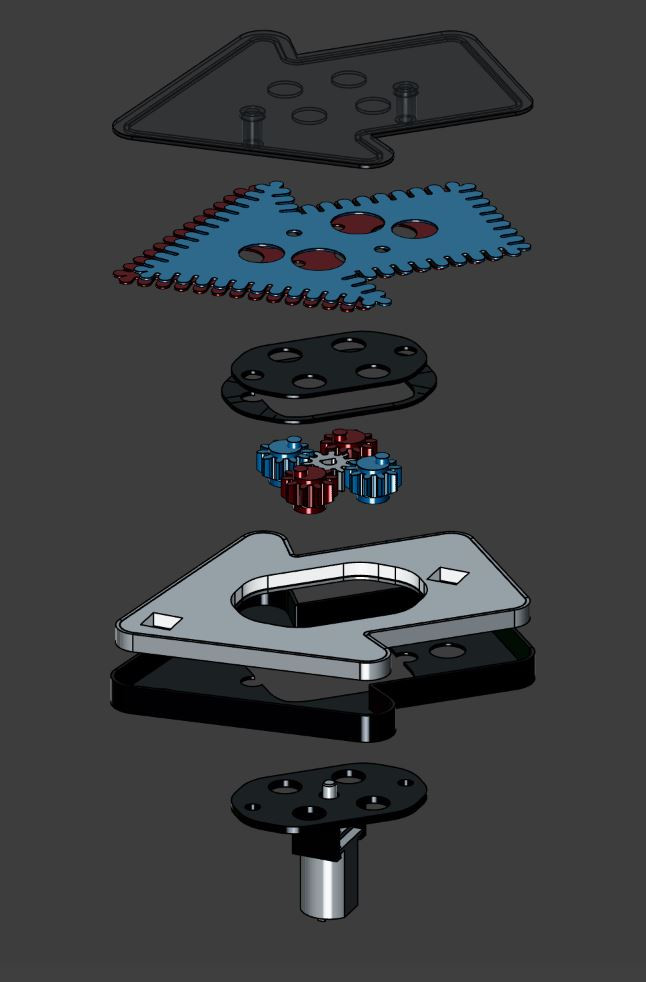
To create the gear bed/rack, [Kevr102] used a Fusion 360 add-in called GF Gear Generator. At first this was the most finicky part of the process, but then it was time to design the roller gears. However, [Kevr102] got through it with some clever thinking and a little bit of good, old-fashioned eyeballing.

Per [Kevr102], this press is aimed at the younger generation of printers in that the roller mechanism is spring-loaded to avoid pinched fingers. [Kevr102] 3D-printed some of the printing tablets, which is a cool idea. Unfortunately it doesn’t work that well for some styles of text, but most things came out looking great. You could always use a regular linocut linoleum tile, too.

This isn’t the first 3D-printed printing press to grace these pages. Here’s one that works like a giant rubber stamp.

Everyone Needs A 1950s Signal Generator In Their Life

At Hackaday, we comb the world of tech in search of good things to bring you. Today’s search brought up something very familiar, [Jazzy Jane] has an Advance E1 tube signal generator, the same model as the unit on the shelf above where this is being written. It’s new to her, so she’s giving it a teardown and fixing any safety issues before powering it on.

For a 70+ year old unit, the quality of these instruments was such that they remain useful and reliable to this day. Unsurprisingly a few things need looking at, such as an aged mains lead and a pair of filter caps in the power supply which haven’t aged well. These parts failed on the E1 here too, and while she’s taking the time to order appropriate replacements we have to admit to being cheapskates and robbing parts with an appropriate working voltage for ours from a nearby PC power supply.

Where this one becomes rather interesting is in an extra switch and socket. It’s a wafer switch with a load of capacitors, and the best guess is it provides some adjustability for the inbuilt audio oscillator which had a fixed frequency on stock models. This is part one of a series though, so we’re looking forward to finding out its purpose in the next installment. Take a look at the video below the break, and if that’s not enough, we seem to have had more than one piece of vintage British test equipment here of late.

Continue reading “Everyone Needs A 1950s Signal Generator In Their Life”

A Vintage AC Bridge Teardown

If you ever encounter a British engineer of a certain age, the chances are that even if they use a modern DMM they’ll have a big boxy multimeter in their possession. This is the famous Avo 8, in its day the analogue multimeter to have. Of course it wasn’t the only AVO product, and [Thomas Scherrer OZ2CPU] is here with another black box sporting an AVO logo. This one’s an AC bridge, one of a series of models manufactured from the 1930s through to the late 1940s, and he treats us to a teardown and restoration of it.

Most readers will probably be familiar with the operation of a DC Wheatstone Bridge in which two resistances can be compared, and an AC bridge is the same idea but using an AC source. A component under test is attached to one set of terminals while one with a known value is put on the other, and the device can then be adjusted for a minimum reading on its meter to achieve a state of balance. The amount by which it is adjusted can then be used as a measure of the difference between the two parts, and thus the value of an unknown part can be deduced.

In the case of this AVO the AC is the 50Hz (remembering that this is a British instrument) mains frequency, and the reading from the bridge is taken via a single tube amplifier to a rectifier circuit and the meter. Inside it’s a treasure trove of vintage parts with an electrolytic capacitor that looks as though it might not be original, with a selenium rectifier and a copper oxide signal diode in particular catching our eye. This last part is responsible for some reading anomalies, but after cleaning and lubricating all the switches and bringing up the voltage gently, he’s rewarded with a working bridge. You can see the whole story in the video below the break.

Test equipment from this era is huge, so perhaps not all of you have the space for something like this. Some of us have been known to own other AVO products though.

Continue reading “A Vintage AC Bridge Teardown”