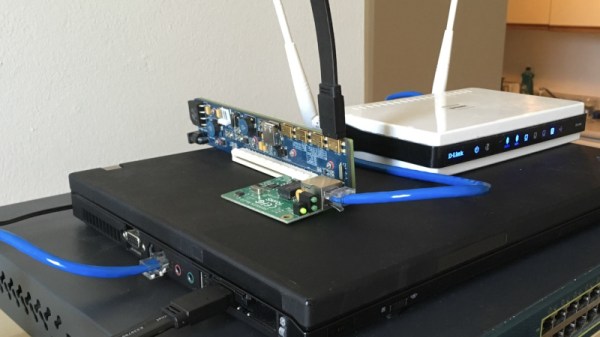
Closeup of WOPR interface on Raspberry Pi

Rebooting WarGames‘ WOPR With A Pi And Gemini

WarGames fans, rejoice: [Nick Bild] has rebooted WOPR for real. In his latest hack, the Falcon, he recreates the iconic AI from the 1983 film using a Raspberry Pi 400, a vintage SP0256-AL2 speech chip from General Instrument, and Google’s Gemini LLM. A build to bring us back to the Reagan-era.

Where most stop at visual homage, this one simulates true interaction. The Python script acts as dungeon master for Gemini 2.5 Flash, guiding it to roleplay as the WOPR computer. Keypress sounds click-clack in synchrony with every input. Gemini replies are filtered into allophones, through GI-Pi, [Nick]’s own Python library. The SP0256 then gives it an eerily authentic robotic voice, straight out of 1983.

[Nick] himself is no unfamiliar name to Hackaday. Back in 2020, he hosted a Hack Chat where he talked us through getting from ideas to prototype builds. He practices what he preaches, since he carried out projects like a breadboard 6502 computer, home-automation controlling AI sunglasses, and more silly inventions, like dazzle-proof glasses.

So… shall we play a game? If you’ve ever longed to chat with an 80s military AI about thermonuclear war or tic-tac-toe without doubting you end the world in a blink, start on this build.

Continue reading “Rebooting WarGames‘ WOPR With A Pi And Gemini”

The Epochalypse: It’s Y2K, But 38 Years Later

Picture this: it’s January 19th, 2038, at exactly 03:14:07 UTC. Somewhere in a data center, a Unix system quietly ticks over its internal clock counter one more time. But instead of moving forward to 03:14:08, something strange happens. The system suddenly thinks it’s December 13th, 1901. Chaos ensues.

Welcome to the Year 2038 problem. It goes by a number of other fun names—the Unix Millennium Bug, the Epochalypse, or Y2K38. It’s another example of a fundamental computing limit that requires major human intervention to fix. 

Continue reading “The Epochalypse: It’s Y2K, But 38 Years Later”

a Coleco Adams console on a desk

Coleco Adam: A Commodore 64 Competitor, Almost

For a brief, buzzing moment in 1983, the Coleco Adam looked like it might out-64 the Commodore 64. Announced with lots of ambition, this 8-bit marvel promised a complete computing package: a keyboard, digital storage, printer, and all for under $600. An important fact was that it could morph your ColecoVision into a full-fledged CP/M-compatible computer. So far this sounds like a hacker’s dream: modular, upgradeable, and… misunderstood.

The reality was glorious chaos. The Adam used a daisy-wheel printer as a power supply (yes, really), cassettes that demagnetized themselves, and a launch delayed into oblivion. Yet beneath the comedy of errors lurked something quite tempting: a Z80-based system with MSX-like architecture and just enough off-the-shelf parts to make clone fantasies plausible. Developers could have ported MSX software in weeks. Had Coleco shipped stable units on time, the Adam might well have eaten the C64’s lunch – while inspiring a new class of hybrid machines.

Instead, it became a collector’s oddball. But for the rest of us, it is a retro relic that invites us to ponder – or even start building: what if modular computing had gone mainstream in 1983?

8 Bit Mechanical Computer Built From Knex

Long before electricity was a common household utility, humanity had been building machines to do many tasks that we’d now just strap a motor or set of batteries onto and think nothing of it. Transportation, manufacturing, agriculture, and essentially everything had non-electric analogs, and perhaps surprisingly, there were mechanical computers as well. Electronics-based computers are far superior in essentially every way, but the aesthetics of a mechanical computer are still unmatched, like this 8-bit machine built from K’nex.

Continue reading “8 Bit Mechanical Computer Built From Knex”

One ROM to rule them all.

Software Defined Retro ROMs

Here’s something fun from our hacker [Piers]: Software Defined ROMs.

In this series of three videos, [Piers] runs us through what a software defined ROM is, how to make them, and then how to use them.

As [Piers] explains, one frustration a retro technician will face is a failed ROM chip. In the era he’s interested in, there are basically three relevant kinds of ROM chip, all 24-pin Dual Inline Package (DIP):

  • 2364 ROM chip: 8KB; 1x chip-select line
  • 2332 ROM chip: 4KB; 2x chip-select lines
  • 2316 ROM chip: 2KB; 3x chip-select lines

Continue reading “Software Defined Retro ROMs”

Before Macintosh banner with stylized pixelated picture of one

Before Macintosh: The Story Of The Apple Lisa

Film maker [David Greelish] wrote in to let us know about his recent documentary: Before Macintosh: The Apple Lisa.

The documentary covers the life of the Apple Lisa. It starts with the genesis of the Lisa Project at Apple, covering its creation, then its marketing, and finally its cancellation. It then discusses the Apple Lisa after Apple, when it became a collectible. Finally the film examines the legacy of the Apple Lisa, today.

The Apple Lisa was an important step on the journey to graphical user interfaces which was a paradigm that was shifting in the early 1980s, contemporary with the Macintosh and the work at Palo Alto. The mouse. Bitmapped graphics. Friendly error messages. These were the innovations of the day.

Continue reading “Before Macintosh: The Story Of The Apple Lisa”

Will HP Create A Carfax System For PCs?

When buying used cars there are plenty of ways to check on their history. In many countries there are systems, like Carfax for parts of North America and Europe, that can provide crash history in some situations and alert a potential buyer of hidden damage. Not so for computers, where anyone can run an intensive mining, gaming, rendering, or AI application for years on hardware which might not otherwise show any outward signs of heavy use. And that’s just for hard use; there’s all kinds of other ways of damaging hardware. HP is hoping to solve this problem with a PC history report of sorts.

Aimed at the enterprise or business arena, where companies tend to follow replacement schedules for laptops and other hardware which might get discarded before reaching a true end-of-life, HP is suggesting adding a data recorder at the firmware level of some computers. This software would monitor the computer’s temperatures, SSD wear, and other telematics on the computer and store a record that could be viewed by a potential buyer when the IT department is ready to take them out of service. And, since it’s 2025, HP is also claiming that this system needs and uses an AI of some sort.

Although HP is billing this as a way to improve sustainability and limit e-waste, we’d theorize that even with a report like this available, the economic gain of a program like this would be marginal at best. While the idea of giving each decommissioned laptop a clean bill of health is noble, it’s hard to imagine overworked IT staff carefully curating device histories when most used enterprise machines are already sold by the pallet.

HP is also proposing something that sounds a lot like Intel’s Management Engine, which we’re not too thrilled about around here. And also keep in mind that this is a company that has failed to innovate in any industry-leading way for as long as we can remember so we won’t expect this system to be widely adopted anytime soon.