2022 Sci-Fi Contest: Multi-Sensor Measurement System

Many sci-fi movies and TV shows feature hand-held devices capable of sensing all manner of wonderful things. The µ Spec Mk II from [j] is built very much in that vein, packing plenty of functionality into a handy palm-sized form factor. 

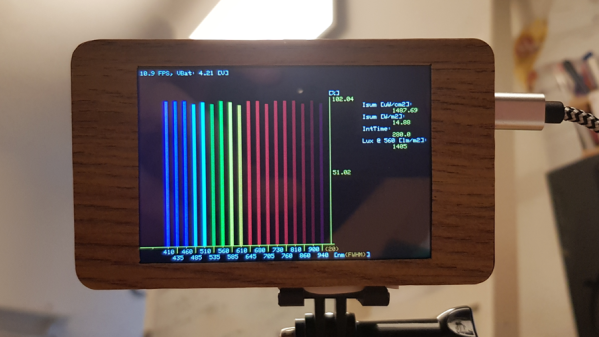
An ESP32 serves as the brains of the device, hooked up to a 480×320 resolution touchscreen display. On board is a thermal camera, with 32×24 pixel resolution from an MLX90640 sensor. There’s also a 8×8 LIDAR sensor, too, and a spectral sensor that can capture all manner of interesting information about incoming light sources. This can also be used to determine the transmission coefficient or reflection coefficient of materials, if that’s something you desire. A MEMS microphone is also onboard for capturing auditory data. As a bonus, it can draw a Mandelbrot set too, just for the fun of it.

Future plans involve adding an SD card so that data captured can be stored in CSV format, as well as expanding the sensor package onboard. It’s a project that reminds us of some of the tricorder builds we’ve seen over the years. Video after the break.

Continue reading “2022 Sci-Fi Contest: Multi-Sensor Measurement System”

2022 Sci-Fi Contest: A Mac-Based Droid Named R.O.B.

Droids and robot assistants are still not really a part of our daily lives, even if they started showing up in movies many long decades ago. [Rudy Aramaryo] perhaps hopes that will change one day, and is pursuing this goal with their own droid build named R.O.B.

R.O.B. is quite a hefty ‘bot, weighing 140 lbs and sporting a full 80 Ah of lithium-iron-phosphate batteries for a long running time and plenty of power. For brains, R.O.B. packs in an Apple Mac Mini M1 and a Mac Studio, running OS X. It’s an unusual choice for a robot, but one that brings plenty of computing power to bear, nonetheless. Equipped with tracked propulsion, R.O.B. also features a slip-ring setup in the base allowing the droid to rotate endlessly without tangling wires.

By virtue of its size and power, R.O.B. goes a long way to emulating the general feel of the droids of the Star Wars series. It’s all about the roughly-human-scaled design, and the anthropomorphic features. Further helping the cause are a basic chat ability powered by Python, along with arms and actuators to interact with the world.

The name of this droid recalls us of the charming Nintendo console toy from the 1980s. If these aren’t the droids you’re looking for, and you’ve been hacking on ‘bots of your own, be sure to drop us a line. 

2022 Sci-Fi Contest: CyberGlove Tests Your Reactions

Since the 1980s, we’ve seen innumerable attempts to revolutionize the way we interact with computers. Since the advent of keyboards and mice, we’ve seen everything from magic wands to electric gloves, with [Deemo Chen]’s project fitting into the latter category.

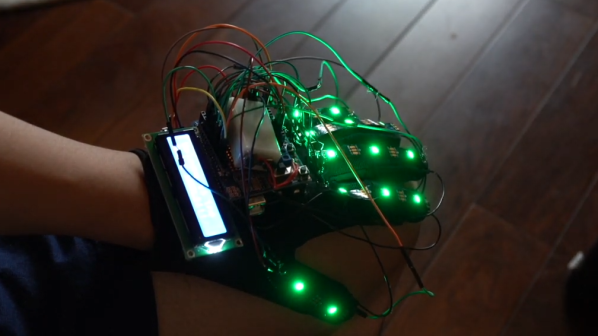
The build takes on a cyberpunk aesthetic, with addressable LEDs installed along each digit. The various digits light up randomly, and the wearer of the glove must tap a button on the corresponding digit in order to test their reaction times. An Arduino Uno runs the show, and keeps track of the score, displaying the results on an attached HD44870-compatible LCD.

The mess-o’-wires aesthetic, with bare electronics hanging off the glove, goes a long way to making this look like a proper bit of sci-fi kit. The lurid, colorful glow is a key part of this look, and something we’ve seen on many projects over the years.

Overall, the reaction trainer served as a great freshman project for [Deemo], along with their chums [Dhruv] and [Ryan]. Along the way, the team clearly picked up skills in microcontroller programming, as well as learning how to work with LCD displays and addressable LEDs. Master these skills and you can pull off some impressive feats. Video after the break.

Continue reading “2022 Sci-Fi Contest: CyberGlove Tests Your Reactions”

2022 Sci-Fi Contest: Your Home Assistant, HAL 9000

Anyone who has seen 2001: A Space Odyssey will easily remember HAL 9000, the sentient computer that turned against its human companions aboard Spacecraft Discovery One. [Ben Brooks] decided to recreate the foreboding digital being, and put it to work as a smart home assistant.

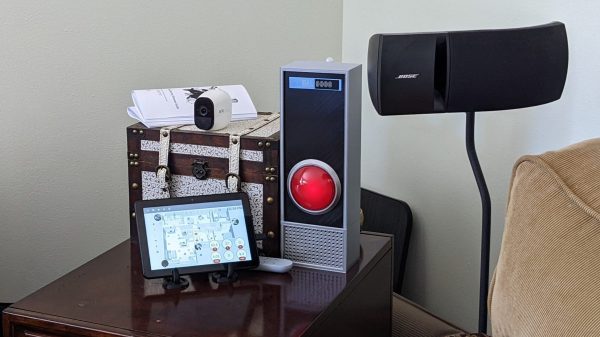
The build consists of a 3D printed assembly that looks very much like HAL did in the movie. It runs as a standalone device hooked up to [Ben]’s Home Assistant instance, a self-hosted home automation solution. The device is capable of playing sound clips from the movie, with the help of an ESP8266 and a DF Player Mini module. It’s triggered by a button or motion sensor, but it’s also hooked up to Home Assistant for some extra smarts. This setup makes sure HAL stays silent when a Chromecast is playing content on TV, so as not to disturb essential viewing.

Overall, it’s a fun movie tribute build that is remarkably true to the source material. Let’s just hope this HAL doesn’t get any maniacal ideas, forcing [Ben] to pull apart its processor to stop its dangerous machinations.

We’ve seen some other great HAL builds before, too. Video after the break.

Continue reading “2022 Sci-Fi Contest: Your Home Assistant, HAL 9000”

2022 Sci-Fi Contest: A Very Star Wars Door

Every fan of the original Star Wars trilogy knows the plight of Han Solo, who was so cruelly frozen in carbonite by Imperial forces. [erv.plecter] came into possession of a replica Solo, this time frozen in polyurethane, and set about using it as the door for a home theater setup.

Just like in the movie, there are a series of controls and lights on the side of the door, clearly intended to represent the state of the carbonite block and the smuggler trapped within. This was achieved with the use of a SAMD51 microcontroller, which controls five meters of WS2812B LED strip along with a small OLED display.

There’s also an amazing little smoke effect, built using a vape inhaler. These devices have proved popular for all kinds of theme builds and costumes, as it turns out. They’re a great way to produce a visible fog or smoke in a tiny, compact package.

[erv.plecter] was kind enough to share plenty of details on the build, including how the polyurethane cast was assembled into the door. The final result looks remarkably authentic, and would surely prove a hit at any Star Wars movie night. Just don’t spoil things by forcing everyone to sit through Revenge of the Sith. Video after the break. Continue reading “2022 Sci-Fi Contest: A Very Star Wars Door”

2022 Sci-Fi Contest: A Star Wars Mouse Droid Of Your Very Own

The show-stealing droids of Star Wars, R2-D2 and C-3PO, are quite challenging to replicate at home, due to their size and complexity. [curiousmarc] had built the former, with much work going into drawing and design. The more humble Mouse Droid, as seen skittering about the halls of the Death Star, is a considerably easier build — especially with this somewhat improvised approach.

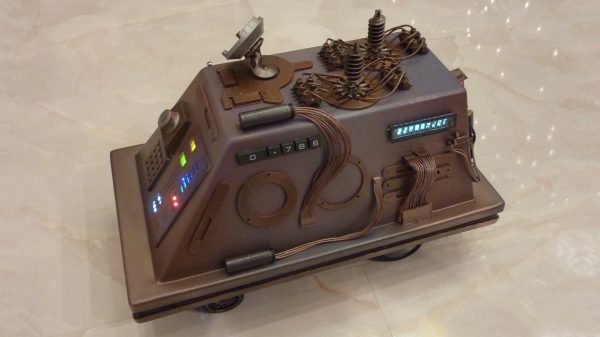
The build relies on reject parts from [curiousmarc]’s R2-D2 build, and other stuff laying around the house, like a toy eggbeater, a VFD, and other electronic bits and pieces. An RC car chassis was placed in the droid’s vacuum-formed shell in order to provide propulsion, with much of the rest of the work being decoration of the housing with various sci-fi ephemera. There’s also a pair of Arduinos inside, controlling the VFD, sound output, and the movable antenna dish on top.

It’s a build with a lot of personality. The sounds, flickering display, and moving antenna do a lot to imbue this droid with a soul, something Lucasfilm readily achieved with many of the robots in the series. It’s something we’ve also seen in robot companion builds from [Jorvon Moss], which are quite sci-fi in their own way, too. Video after the break.

Continue reading “2022 Sci-Fi Contest: A Star Wars Mouse Droid Of Your Very Own”

2022 Sci-Fi Contest: Glowing LED Cubes Make Captivating Artifacts

LED cubes were once an exercise in IO mastery, requiring multiplexing finesse in order to drive arrays of many LEDs. Going RGB only increased the challenge. This build from [DIY GUY Chris] shows how much easier it is these days, when every LED has a smart addressable controller on board, and serves as a great sci-fi prop to boot.

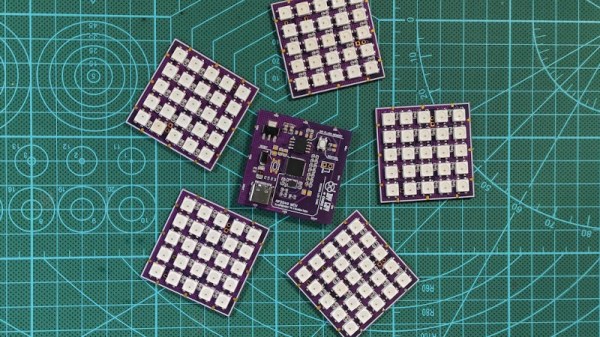
Yes, the build relies on the venerable WS2812B addressable LEDs, soldered up in 5×5 grids on each of the six faces of the cube. Running the show is the Raspberry Pi RP2040 microcontroller, sourced here as an individual part rather than in its development board form. An SPI memory chip is on board for the code, along with a USB-C connector for programming. Signals pass around the cube via soldered connections along the edges of the custom PCBs that make up the faces of the solid.

Sitting on its 3D printed stand, the cube glows brightly while drawing a full 2 amps of power. [Chris] coded up a variety of animations, from simple color breathing routines to frantic dazzle animations sure to captivate any cyberpunk thieves that come to steal your magic glowing artifact.

If rectangular prisms aren’t your fancy, though, you can always consider building yourself a glowing D20 instead. Video after the break.

Continue reading “2022 Sci-Fi Contest: Glowing LED Cubes Make Captivating Artifacts”