Rube Goldberg Machine Puts Engineering Students In The Record Books

rube_goldberg

Rube Goldberg machines are always a fan favorite around here. They truly embody the concept of over-engineering, and are an entertaining departure from what we normally cover on Hackaday.

Back in February, engineering students from two on-campus professional associations at Purdue University teamed up to construct a world record-setting Rube Goldberg machine. Their entry in the Purdue Regional Rube Goldberg Machine Contest not only won them the regional title, but also potentially put them in the books as creating the most complex device of its nature.

Their contraption was dubbed “The Time Machine” and acts out events in our planet’s history. It starts with the big bang, moving through various other time periods, including the stone age, ancient Egypt, and the medieval era. It also makes several stops in more recent times, including World War II and the Cold War, before self-destructing at the Apocalypse.

All told, the machine incorporates 244 steps to water a plant, which is 14 more than the previous record holder. Continue reading to see a video that highlights some of the machine’s more interesting features, and be sure to check out these Rube Goldberg machines we’ve covered in the past.

[via BoingBoing]

Continue reading “Rube Goldberg Machine Puts Engineering Students In The Record Books”

555_contest

555 Contest Winners To Be Announced Tonight

It’s been nearly two months since the official entry portion of the 555 timer contest came to a close, and the judges have been busy poring over the 200+ entries since. Now that the votes have been tallied, it’s just about time for the official results to be announced.

The results will be live streamed this evening at 9pm Eastern, and you can watch the results here on uStream or here, with an embedded IRC chat. There will be four main awards given out this evening, highlighting the most complex, most minimalistic, most artistic, and most useful 555 creations. There are also “Best in Show” and “Best Under 18” awards up for grabs, the winners of which were selected by celebrity judges Forrest Mims and Hans Camenzind.

The show will definitely be worth checking out – we’ll be there at 9pm sharp, see you there!

If you want to take a look at some of the 555 Contest entries we featured throughout February, check these out:

Mini nixie keychain

Le Dominoux – LED dominoes

555 timer from discrete components

Slide whistle toy

555 video game

Alien synth toy

555 Radio

Punch tape musical synth

Ludum Dare 20 Starting April 29th

Ludum Dare 20 is only 10 days away! Great, what the heck is Ludum Dare? Well its only the most awesome video game creation contest on the internet, thats what. While originally for the hardest of the hard core, it has recently been split up into 2 events so everyone gets to have some fun.

The Jam is pretty relaxed in the rules. Lets say you and 4 buddies want to make the ultimate zelda remix using fan sprites and free music. This is where you want to be. Its there to give people who want to join in the fun but not make serious obligations.

The Compo is the real deal for those who are insane, or really good. You are given a theme at the start of the contest and 48 hours. You must then work solo and create all original content to use within your game. You can however use premade frameworks, game engines, libraries etc to accomplish your goal, but if you really wanted to you could make a 3D engine with brain fu*k during the competition. (though I would not advise it)

Prizes include internet bragging rights, and quite possibility the best darn feeling of accomplishment possible IF you manage to come up with some form of game, based on a voted theme, by yourself, in less than 48 hours.

Be sure to check out the rules and guide page for all details and I hope to see you there.

Oscilloscope Piano Tuning 101

fft on scope

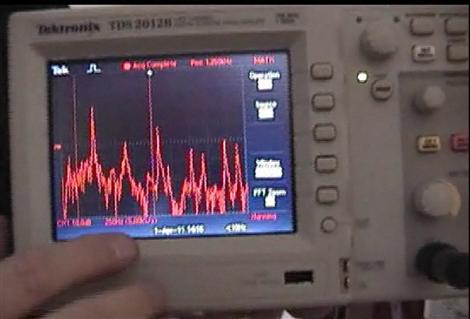
[Todd Harrison] recently wrote in to tip us off on his submission to the Tektronix oscilloscope contest – using a scope to tune a piano. In his video he demonstrates how a Fast Fourier Transform can be used to determine the fundamental frequency of the note being played. This is a quick and easy way to determine if that key is in tune, and if not, how far off it is from the desired frequency and in which direction.

He goes on to explain that a scope can only be used as a starting reference point since “mathematically correct” tuning on a piano doesn’t sound right to the human ear. It turns out that when struck, the stretched wires in the piano behave less than ideally. In the case of a piano, the overtones (the other peaks shown on the scope higher in frequency than the fundamental) are actually slightly sharper (higher in frequency) than the expected harmonic whole-number multiple of the fundamental frequency.  As a result, the frequency ranges of each octave must be “stretched” in order to accommodate this and sound correct when multiple notes are played together across octaves.

Typically, only the A4 key is actually tuned to its correct frequency of 440Hz and all of the other keys are manually tuned off of this baseline. The amount of necessary stretch applied to each octave increases as you get further away from this initial reference point in either direction and is unique to each and every individual instrument – thus there is no universal device capable of perfect tuning. Although [Todd] admits that he won’t attempt to tune the entire piano himself using this technique, he finds it a convenient way to keep the most heavily played center sections of the piano closer to true between professional tunings.

If you have any interesting or unique uses for your Techtronix scope, you can enter the contest here. Just don’t forget to tip us off too!  Thanks [Todd]!

Analog Scope Stands In To For Laser Light Show

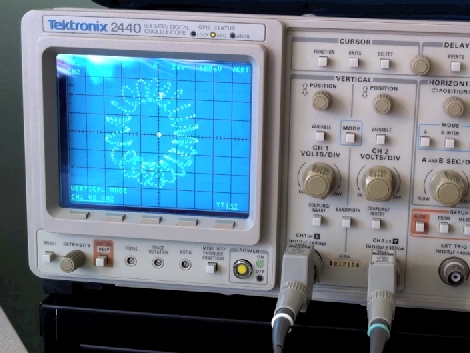
[Joey] likes to dabble in laser projection, building his own hardware and writing the software that drives it. One way that he tests his setup is by replacing the laser assembly with an analog oscilloscope. This allows him to ensure that the driver board is receiving data from the software, and translating it into the correct electrical signals to drive the motors controlling the mirrored redirection of the laser beam.

In the video linked above [Joey] walks us through this process. It starts by connecting scope probes to the digital-analog-converter card that outputs image data for the projector. From there the XY mode is used to map the two channels perpendicular to each other; the motors that these signals are meant to control have mirrors that also move perpendicular to one another. After adjusting the scale and the timebase you will see the pattern the laser dot is meant to trace.

[Joey] entered this in a Tectronix contest. There’s plenty of other interesting entries to browse though. If have an entry that you’d like to see featured, or if you come across any other interesting stuff, don’t forget to tip us off.

Analog Robot Navigates Around The Workshop With Ease

556_wall_following_robot

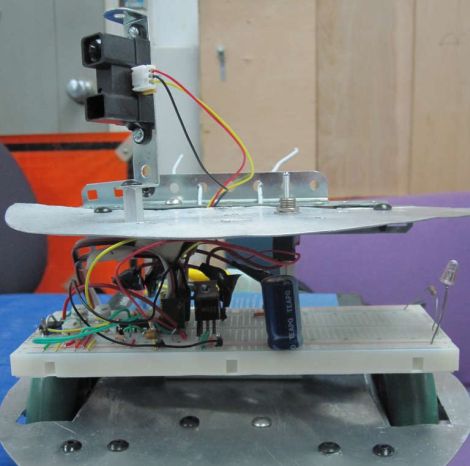
Many of the robots we feature here are driven by some sort of microcontroller, whether it be an Arduino, Launchpad, Picaxe, etc. Rarely do we see a robot however, using analog circuits to perform higher-level functions typically relegated to those more complex controllers. Instructables user [hasn0life] built such a robot recently, which he entered into a contest at his college. After hearing about the 555 design contest from a friend, he tweaked his project and created a wall-following robot using a 556 timer.

The robot is fairly simple when you take a close look, though that does not take away from the elegance of his design. A single IR sensor is used to detect objects in the robot’s periphery, guiding the robot along. When the robot gets too close to a wall, one wheel reverses, pulling the robot away. Once the robot has moved a sufficient distance, the other wheel is reversed in order to straighten out the robot. Then, both wheels work in concert to get the robot moving forward.

Take a look at the video below to watch the robot navigate its way around his workshop, and if you are interested in learning more about analog robotics, check out this post from a few days back.

Continue reading “Analog Robot Navigates Around The Workshop With Ease”

Pint-sized Nixie Display Fits Neatly In Your Pocket

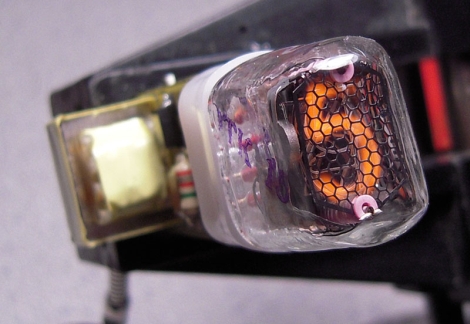
[Brett] has had Nixie tubes on the brain ever since being introduced to them by a good friend of his. He decided that building a Nixie-based key chain would be the best way to familiarize himself with the technology, while also giving him a project to enter in the 555 Design Contest. He dug up the smallest Nixie tube he could find that displayed digits, and got down to business.

The biggest obstacle he ran into was figuring out how he would provide the high voltage required to light the Nixie tube. He eventually built a transformer circuit driven by a 555 timer, using a small 12v battery as his power source. Once everything was up and running on a breadboard, he designed and etched some PCBs, then soldered everything together.

The end result is a nifty little key chain that flashes the number 5 when a button is pressed – pretty appropriate for the 555 contest. It’s a great looking project, though we’re still not 100% sure what we think about a naked high voltage circuit residing in our pocket.

Keep reading for a pair of videos documenting the key chain’s construction and operation.

Continue reading “Pint-sized Nixie Display Fits Neatly In Your Pocket”