A Modern, Upgraded BASIC Stamp

Back in the Before Times, when microcontroller development required ultraviolet light, building anything was a pain. You probably had to burn a ROM onto a chip with a parallel programmer, there was no in-circuit programming, and who knows what would happen if you needed a serial port.

This changed in the early 90s with the introduction of the BASIC Stamp from Parallax. This was a simple microcontroller development board using Microchip PIC. With a little bit of clever firmware developed by Parallax, you could write code in BASIC, upload your code over a serial or parallel port (which every computer had), and blink a LED with just a few lines of code. All microcontroller development boards — including the Arduino — owe a debt to the BASIC Stamp. It is the grandfather to the Arduino, and it is very, very old.

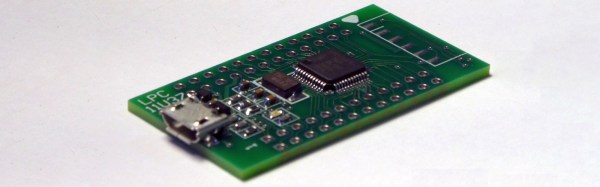
Microchip didn’t update the BASIC Stamp, but that doesn’t mean someone else can’t handle that. [Bruce Eisenhard] is crowdfunding an improved, updated version of the famous 24-pin BASIC Stamp. It’s got modern parts, runs seven hundred times faster than the original, and is still chock full of BASIC interpretation.

This upgraded Stamp is built around NXP’s LPC11U3 micrcontroller, an ARM Cortex-M0 part with about a hundred times more Flash than the chip in the original Stamp. Programming is done through modern IDEs, and yes, there’s a USB port. This project is pin-compatible with the original BASIC Stamp, so if your microcontroller project from twenty years ago is dying, this is the replacement for you.

The BASIC Stamp was an awesome device for its time, even though it cost more than two hundred dollars in today’s money. [Bruce]’s campaign is offering one of these for $25, which is pretty reasonable for what it is.
 

CNC Robot Makes A Move

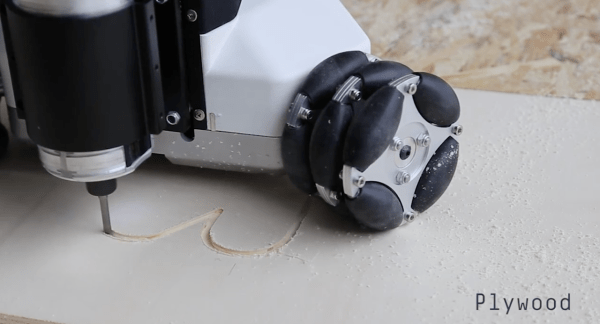
Another day, another Kickstarter. While we aren’t often keen on touting products, we are keen on seeing robotics and unusual mechanisms put to use. The Goliath CNC has long since surpassed its $90,000 goal in an effort to put routing robots in workshops everywhere.

Due to their cost and complexity, you often only find omni-wheels on robots scurrying around universities or the benches of robotics hobbyists, but the Goliath makes use of nine wheels configured as three sets in a triangular pattern. This is important as any CNC needs to make compound paths, and for wheeled robots an omni-wheel base is often the best bet for compound 2D translation.

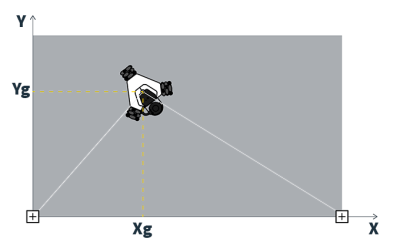
coordinate drawingWhat really caught our eye is the Goliath’s unique positioning system. While most CNC machines have the luxury of end-stops or servomotors capable of precise positional control, the Goliath has two “base sensors” that are tethered to the top of the machine and mounted to the edge of the workpiece. Each sensor connects to the host computer via USB and uses vaguely termed “Radio Frequency technology” that provides a 100Hz update for the machine’s coordinate system. This setup is sure to beat out dead-reckoning for positional awareness, but details are scant on how it precisely operates. We’d love to know more if you’ve used a similar setup for local positioning as this is still a daunting task for indoor robots.

A re-skinned DeWalt 611 router makes for the core of the robot, which is a common option for many a desktop milling machine and other bizarre, mobile CNCs like the Shaper Origin. While we’re certain that traditional computer controlled routers and proper machining centers are here to stay, we certainly wouldn’t mind if the future of digital manufacturing had a few more compact options like these.

Cheap, Full-Duplex Software Defined Radio With The LimeSDR

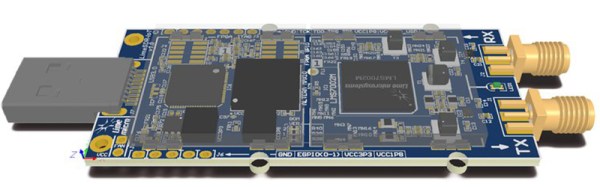
A few years ago, we saw the rise of software-defined radios with the HackRF One and the extraordinarily popular RTL-SDR USB TV tuner dongle. It’s been a few years, and technology is on a never-ending upwards crawl to smaller, cheaper, and more powerful widgets. Now, some of that innovation is making it to the world of software-defined radio. The LimeSDR Mini is out, and it’s the cheapest and most capable software defined radio yet. It’s available through a Crowd Supply campaign, with units shipping around the beginning of next year.

The specs for the LimeSDR mini are quite good, even when compared to kilobuck units from Ettus Research. The frequency range for the LimeSDR Mini is 10 MHz – 3.5 GHz, bandwidth is 30.72 MHz, with a 12-bit sample depth and 30.72 MSPS sample rate. The interface is USB 3.0 (the connector is male, and soldered to the board, but USB extension cables exist), and the LimeSDR is full duplex. That last bit is huge — the RTL-SDR can’t transmit at all, and even the HackRF is only half duplex. This enormous capability is thanks to the field programmable RF transceiver found in all of the LimeSDR boards. We first saw these a year or so ago, and now these boards are heading into the hands of hackers. Someone’s even building a femtocell out of a Lime board.

The major selling point for the LimeSDR is, of course, the price. The ‘early bird’ rewards for the Crowd Supply campaign disappeared quickly at $99, but there are still plenty available at $139. This is very inexpensive and very fun — on the Crowd Supply page, you can see a demo of a LimeSDR mini set up as an LTE base station, streaming video between two mobile phones. These are the golden days of hobbyist SDR.

A Smaller, Cheaper RISC V Board

Early this year, the world of electronics saw something amazing. The RISC-V, the first Open Source microcontroller was implemented in silicon, and we got an Arduino-derived dev board in the form of the HiFive 1. The HiFive 1 is just a bit shy of mindblowing; it’s a very fast microcontroller that’s right up there with the Teensy when it comes to processing power. There’s support for the Arduino IDE, so all those fancy libraries are ready to go. That’s not to say there aren’t a few problems; it’s a relatively expensive board, and it does use the ubiquitous but somewhat unfortunate Arduino form factor.

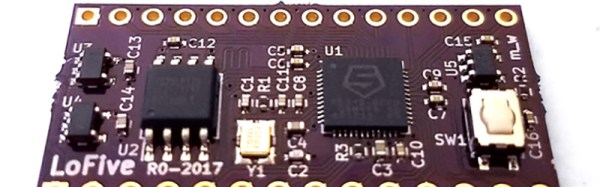
In the past few months, SiFive, the folks behind the FE310 microcontroller inside the HiFive 1, have been working to get bare chips out on the market. Now, those trays of microcontrollers are being turned into newer, slightly more development-friendly boards. Meet the LoFive RISC-V. It’s a GroupGets crowdfunding campaign from [Michael Welling], and it takes all the openness from the HiFive 1 and the FE310 microcontroller and stuffs it into a cheap, easy-to-use board.

Like the HiFive 1, the LoFive features the FE310 microcontroller and a 128 Mbit SPI flash. Unlike the HiFive 1, there’s not much else on this board. There’s a few voltage regulators, a crystal, some caps, and a button on an interrupt pin. If you’re looking for an Open Source microcontroller development board without a lot of cruft, here you go. This is a RISC-V microcontroller with the minimum amount of support circuitry.

The GroupGets campaign is offering up 1,000 of these little boards for $25 each plus shipping. If you’ve been looking for an excuse to play around with Open Source microcontrollers, this may be the best chance you’re going to get for a while.

False Claims On Kickstarter: What’s New?

Kickstarter and its ilk seem like the Wild West when it comes to claims of being “The world’s most (Insert feature here) device!” It does add something special when you can truly say you have the world record for a device though, and [MellBell Electronics] are currently running a Kickstarter claiming the worlds smallest Arduino compatible board called Pico.

We don’t want to knock them too much, they seem like a legit Kickstarter campaign who have at time of writing doubled their goal, but after watching their promo video, checking out their Kickstarter, and around a couple of minutes research, their claim of being the world’s smallest Arduino-compatible board seems to have been debunked. The Pico measures in at an impressive 0.6 in. x 0.6 in. with a total area of 0.36 sq.in. which is nothing to be sniffed at, but the Nanite 85 which we wrote up back in 2014 measures up at around 0.4 in. x  0.7in. with a total area of around 0.28 sq.in.. In this post-fact, fake news world we live in, does it really matter? Are we splitting hairs? Or are the Pico team a little fast and loose with facts and the truth?

There may be smaller Arduino compatible boards out there, and this is just a case study between these two. We think when it comes to making bold claims like “worlds smallest” or something similar perhaps performing a simple Google search just to be sure may be an idea.

Continue reading “False Claims On Kickstarter: What’s New?” →

Friday Hack Chat: Crowd Supply

Crowdfunding is a mixed bag, at best. On one hand, you have fantastically successful products like Pebble, Oculus, and the Kano personal computer that managed to take in money, turn out a product, and become a successful company. (If even just for a while, the Pebble was great.) On the other hand, you have obvious scams like a color-picking pen that are run by a literal Nigerian scammer.

Crowd Supply is different. Unlike other crowdfunding platforms, to get on Crowd Supply you’ll need a working prototype. Where other platforms can measure their success by how many campaigns were successfully funded, and how many of those campaigns successfully delivered rewards to backers, I’m not aware of any Crowd Supply campaigns that have ever failed completely.

For this week’s Hack Chat, we’ll be talking with [Josh Lifton], CEO of Crowd Supply. Topics will include determining if there’s a market for your product, the ins and outs of fulfillment, to shipping your product. We’re taking questions from the community, and there’s a question sheet we’ll be reading from.

Josh has a PhD from the MIT Media Lab and holds a BA in physics and mathematics from Swarthmore College. Prior to Crowd Supply, Josh worked in a variety of technology settings, from instrumenting thousands of audience members with custom wearable computers for a Cirque du Soleil performance to, most recently, serving as head of engineering at Puppet Labs.

Here’s How To Take Part:

join-hack-chatOur Hack Chats are live community events on the Hackaday.io Hack Chat group messaging. This Hack Chat will take place at noon Pacific time on Friday, July 28th. Confused about where and when ‘noon’ is? Here’s a time and date converter!

Log into Hackaday.io, visit that page, and look for the ‘Join this Project’ Button. Once you’re part of the project, the button will change to ‘Team Messaging’, which takes you directly to the Hack Chat.

You don’t have to wait until Friday; join whenever you want and you can see what the community is talking about.

JeVois Machine Vision Camera Nails Demo Mode

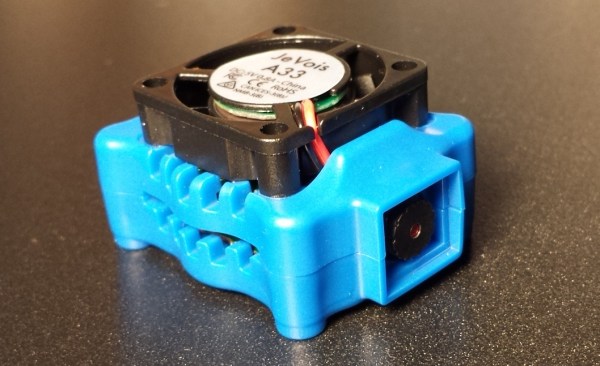
JeVois is a small, open-source, smart machine vision camera that was funded on Kickstarter in early 2017. I backed it because cameras that embed machine vision elements are steadily growing more capable, and JeVois boasts an impressive range of features. It runs embedded Linux and can process video at high frame rates using OpenCV algorithms. It can run standalone, or as a USB camera streaming raw or pre-processed video to a host computer for further action. In either case it can communicate to (and be controlled by) other devices via serial port.

But none of that is what really struck me about the camera when I received my unit. What really stood out was the demo mode. The team behind JeVois nailed an effective demo mode for a complex device. That didn’t happen by accident, and the results are worth sharing.

Continue reading “JeVois Machine Vision Camera Nails Demo Mode” →