Designing For Fab: A Heads-Up Before Designing PCBs For Professional Assembly

Designing pcbs for assembly is easy, right? We just squirt all the footprints onto a board layout, connect all the traces, send out the gerbers and position files, and we’re done–right?

Whoa, hold the phone, there, young rogue! Just like we can hack together some working source code with variables named after our best friends, we can also design our PCBs in ways that make it fairly difficult to assemble.

However, by following the agreed-upon design specs, we’ll put ourselves on track for success with automated assembly. If we want another party to put components on our boards, we need to clearly communicate the needed steps to get there. The best way to do so is by following the standards.

Proper Footprint Orientation

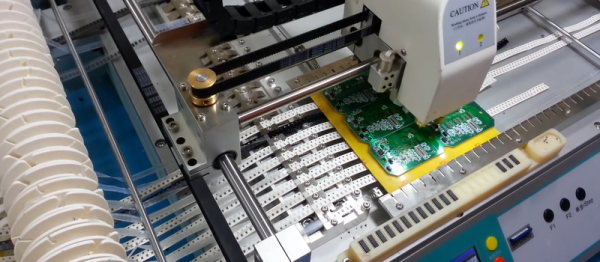
Now, for a momImage Credit: https://encrypted-tbn2.gstatic.com/images?q=tbn:ANd9GcQBEztpnSxpN_IRjq3y8GbetrMHKuoSu_s6myiFOHilL2FlQKyLrgent, let’s imagine ourselves as the tip of a vacuum pickup tool on a pick-and-place machine. These tools are designed to pick up components on the reel from their centroid and plunk them on their corresponding land pattern. Seems pretty straightforward, right? It is, provided that we design our footprints knowing that they’ll one day come face-to-face with the pick-and-place machine.

To get from the reel to the board, we, the designers, need two bits of information from out part’s datasheet: the part centroid and the reel orientation.

The part centroid is an X-Y location that calls out the center-of-mass of the part. It basically tells the machine: “pick me up from here!” As designers, it’s our responsibility to design all of our footprints such that the footprint origin is set at the part’s centroid. If we forget to do so, the pick-and-place will try to suck up our parts from a location that may not stick very well to the package, such as: the corner.

Continue reading “Designing For Fab: A Heads-Up Before Designing PCBs For Professional Assembly”

Another California Water Crisis

It’s no secret that a vast amount of American infrastructure is in great need of upgrades, repairs or replacements. The repairs that are desperately needed will come, and they will come in one of two ways. Either proactive repairs can be made when problems are first discovered, or repairs can be made at considerably greater cost after catastrophic failures have occurred. As was the case with the I-35 bridge collapse in Minnesota, we often pay in lives as well. Part of the problem is that infrastructure isn’t very exciting or newsworthy to many people outside of the civil engineering community which leads to complacency and apathy. As a result, it’s likely that you may not have heard about the latest struggle currently playing out in California even though it involves the largest dam in the United States and its potential failure.

Surprisingly enough, the largest dam in the US isn’t the famous Hoover Dam but the Oroville Dam at the base of the Sierra Nevada mountain range in California. At 235 meters, it is almost 15 meters taller than the Hoover Dam. It can store over four cubic kilometers of water but whether or not it will keep storing that water into the future is currently under question. In February of this year during a flood control operation damage was observed on the dam’s spillway where a massive hole had formed which only got larger as the dam was forced to continue releasing water. The hole quickly grew, and the floodwaters eroded much of the lower half of the spillway embankment, forming a canyon. Continue reading “Another California Water Crisis”

Fundamentals Of Fingerprint Scanning

Like most (if not all) Hackaday readers, I like to know how the technology I use works. I’m always amazed, for example, how many otherwise smart people have no idea how the cellphone network works other than “it’s a radio.” So now that I have two phones with fingerprint scanners on them, I decided I needed to know more about what’s going on in there.

Sure, I assumed the sensor was capacitive (but maybe not, I found out). Plus we all know some super glue, scotch tape, and gummy bears are all you need to fake one out. However, that’s been known for about 15 years and we are still seeing phones and other devices rolling out with the same scanners. So for now, put aside the debate about whether we should be using fingerprint scanners. Let’s talk about how those sensors work.

Continue reading “Fundamentals Of Fingerprint Scanning”

Making A Solar-Cell Tester With Mecrisp-Stellaris Forth

In the last two articles on Forth, I’ve ranted about how it’s beautiful but strange, and then gotten you set up on a basic system and blinked some LEDs. And while I’ve pointed you at the multitasker, we haven’t made much real use of it yet. Getting started on a Forth system like this is about half the battle. Working inside the microcontroller is different from compiling for the microcontroller, and figuring out the workflow, how to approach problems, and where the useful resources are isn’t necessarily obvious. Plus, there’s some wonderful features of Mecrisp-Stellaris Forth that you might not notice until you’ve hacked on the system for a while.

Ideally, you’d peek over the shoulder of someone doing their thing, and you’d see some of how they work. That’s the aim of this piece. If you’ve already flashed in our version of Mecrisp-Stellaris-plus-Embello, you’re ready to follow along. If not, go back and do your homework real quick. We’ll still be here when you’re done. A lot of this article will be very specific to the Mecrisp-Stellaris flavor of Forth, but given that it runs on tons of ARM chips out there, this isn’t a bad place to be.

Continue reading “Making A Solar-Cell Tester With Mecrisp-Stellaris Forth”

Pi Network Attenuators: Impedance Matching For The Strong Of Signal

If you catch a grizzled old radio amateur propping up the bar in the small hours, you will probably receive the gravelly-voiced Wisdom of the Ancients on impedance matching, antenna tuners, and LC networks. Impedance at RF, you will learn, is a Dark Art, for which you need a lifetime of experience to master. And presumably a taste for bourbon and branch water, to preserve the noir aesthetic.

It’s not strictly true, of course, but it is the case that impedance matching at RF with an LC network can be something of a pain. You will calculate and simulate, but you will always find a host of other environmental factors getting in the way when it comes down to achieving a match. Much tweaking of values ensues, and probably a bit of estimating just how bad a particular voltage standing wave ratio (VSWR) can be for your circuit.

Continue reading “Pi Network Attenuators: Impedance Matching For The Strong Of Signal”

Moving Forth With Mecrisp-Stellaris And Embello

In the last episode, I advocated a little bit for Forth on microcontrollers being a still-viable development platform, not just for industry where it’s usually seen these days, but also for hackers. I maybe even tricked you into buying a couple pieces of cheap hardware. This time around, we’re going to get the Forth system set up on that hardware, and run the compulsory “hello world” and LED blinky. But then we’ll also take a dip into one of the features that make Forth very neat on microcontrollers: easy multitasking.

To work!

Hardware

Mecrisp-Stellaris Forth runs on a great number of ARM microcontrollers, but I’ll focus here on the STM32F103 chips that are available for incredibly little money in the form of a generic copy of the Maple Mini, often called a “STM32F103 Minimum System Board” or “Blue Pill” because of the form-factor, and the fact that there used to be red ones for sale. The microcontroller on board can run at 72 MHz, has 20 kB of RAM and either 64 or 128 kB of flash. It has plenty of pins, the digital-only ones are 5 V tolerant, and it has all the usual microcontroller peripherals. It’s not the most power-efficient, and it doesn’t have a floating-point unit or a DAC, but it’s a rugged old design that’s available for much less money than it should be.

Programmer Connected, Power over USB

Similar wonders of mass production work for the programmer that you’ll need to initially flash the chip. Any of the clones of the ST-Link v2 will work just fine. (Ironically enough, the hardware inside the programmer is almost identical to the target.) Finally, since Forth runs as in interactive shell, you’re going to need a serial connection to the STM32 board. That probably means a USB/serial adapter.

This whole setup isn’t going to cost much more than a fast food meal, and the programmer and USB/serial adapter are things that you’ll want to have in your kit anyway, if you don’t already.

You can power the board directly through the various 3.3 and GND pins scattered around the board, or through the micro USB port or the 5V pins on the target board. The latter two options pass through a 3.3 V regulator before joining up with the 3.3 pins. All of the pins are interconnected, so it’s best if you only use one power supply at a time.

Continue reading “Moving Forth With Mecrisp-Stellaris And Embello”

Microswitches: Past The Tipping Point

You find them everywhere from 3D printers to jet airliners. They’re the little switches that detect paper jams in your printer, or the big armored switches that sense when the elevator car is on the right floor. They’re microswitches, or more properly miniature snap-action switches, and they’re so common you may never have wondered what’s going on inside them. But the story behind how these switches were invented and the principle of physics at work in the guts of these tiny and useful switches are both pretty interesting.

Continue reading “Microswitches: Past The Tipping Point”