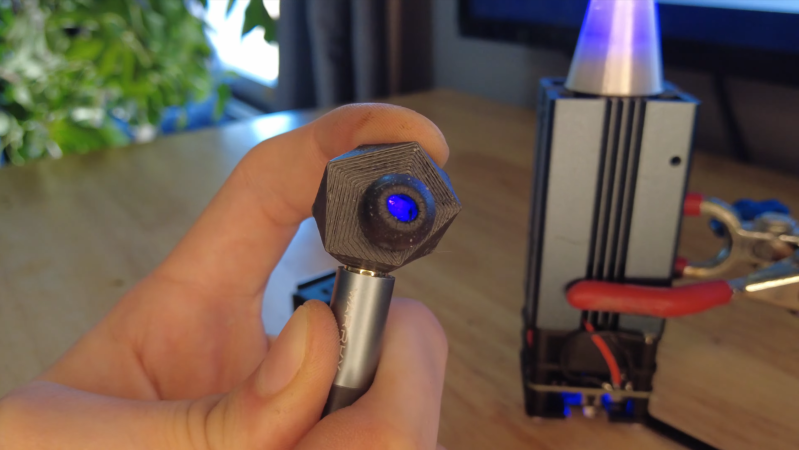
A man's hand is shown holding a 3D-printed structure. The structure is hollow and has a fiber-optic cable leading to it. Blue light shines from a hole in the structure. In the background, a laser module is coupled to a fiber-optic cable.

Building A Laser-Driven Photoacoustic Speaker

An MRI scan is never a pleasant occasion – even if you aren’t worried about the outcome, lying still in a confined, noisy space for long periods of time is at best an irksome experience. For hearing protection and to ameliorate boredom or claustrophobia, the patient wears headphones. Since magnets and wires can’t be used inside an MRI machine, the headphones have to literally pipe the sound in through tubes, which gives them poor sound quality and reduces the amount of noise they can block. [SomethingAboutScience], however, thinks that photoacoustic speakers could improve on these, and built some to demonstrate.

Continue reading “Building A Laser-Driven Photoacoustic Speaker”

Ask Hackaday: Wired Or Wireless Headphones?

They say you should never throw out old clothes because they will come back in style one day. Maybe they are right. We noted in a recent BBC post that, apparently, wired headphones are making a comeback. Like many people, we were dismayed when Apple took the headphone jack out of the iPhone and, as [Thomas Germain] notes, even Google eventually ejected the normal headphone jack. (Although, in fairness, most of the Pixel phones we’ve seen come with a pair of USB-C earbuds.)

On the face of it, though, wireless seems to be a good idea. You can get cheap Bluetooth earbuds now, although maybe still not as cheap as wired buds. Sure, they sound terrible, but so do cheap buds. It is a pain to charge them, of course, but not having to untangle wires is a benefit. On the other hand, you never have to charge your wired headphones.

Continue reading “Ask Hackaday: Wired Or Wireless Headphones?”

Building A Rad Bluetooth Speaker That Didn’t Really Exist

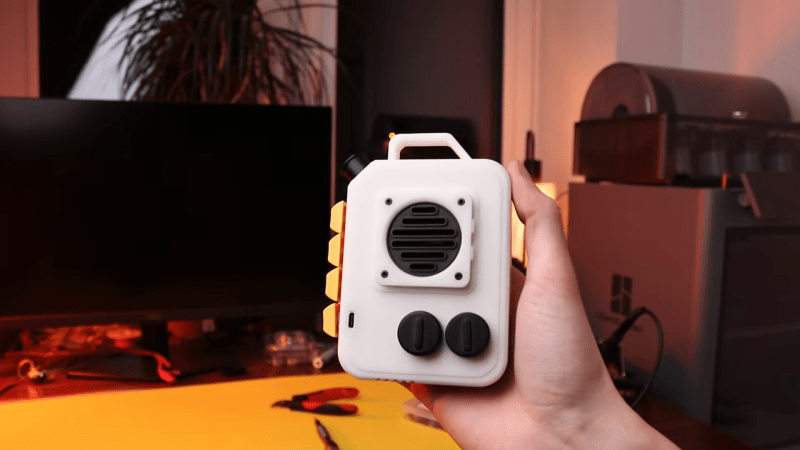
[Nick] came across an awesome Bluetooth speaker online, only, there was a problem. It didn’t really exist—it was just a render of a device that would be nice to have. Of course, there was an obvious solution—[Nick] just had to build the device for real!

The key to the aesthetic of the build is the external case. [Nick] was able to recreate the rough design of the rendered device in SolidWorks, before having the components produced on a resin 3D printer which provided excellent surface finish. Internally, the Bluetooth audio receiver was cribbed from an old pair of wireless headphones. However, a little more oomph was needed to make the speaker really usable, so [Nick] hooked the audio output up to a small MAX98306 amplifier board and a pair of 3 W speakers. The tiny tactile buttons from the headphone PCB wouldn’t do, either. For a nicer feel, [Nick] hacked in a set of four hall effect keyboard switches to control the basic functions.

The result is a Bluetooth speaker that looks as rad as the rendered unit, only you can actually take it outside and bump some tunes! It recalls us of some fine up-cycling work we’ve seen done to vintage 80s radios in a similar vibe.

Continue reading “Building A Rad Bluetooth Speaker That Didn’t Really Exist”

Getting The VIC-20 To Speak Again

The Commodore Amiga was famous for its characteristic Say voice, with its robotic enunciation being somewhat emblematic of the 16-bit era. The Commodore VIC-20 had no such capability out of the box, but [Mike] was able to get one talking with a little bit of work.

The project centers around the Adventureland cartridge, created by Scott Adams (but not the one you’re thinking of). It was a simple game that was able to deliver speech with the aid of the Votrax Type and Talk speech synthesizer box. Those aren’t exactly easy to come by, so [Mike] set about creating a modern equivalent. The concept was simple enough. An Arduino would be used to act as a go between the VIC-20’s slow serial port operating at 300 bps and the Speakjet and TTS256 chips which both preferred to talk at 9600 bps. The audio output of the Speakjet is then passed to an LM386 op-amp, set up as an amplifier to drive a small speaker. The lashed-together TTS system basically just reads out the text from the Adventureland game in an incredibly robotic voice. It’s relatively hard to understand and has poor cadence, but it does work – in much the same way as the original Type and Talk setup would have back in the day!

Text to speech tools have come a long way since the 1980s, particularly when it comes to sounding more natural. Video after the break.

Continue reading “Getting The VIC-20 To Speak Again”

Motorized Faders Make An Awesome Volume Mixer For Your PC

These days, Windows has a moderately robust method for managing the volume across several applications. The only problem is that the controls for this are usually buried away. [CHWTT] found a way to make life easier by creating a physical mixer to handle volume levels instead.

The build relies on a piece of software called MIDI Mixer. It’s designed to control the volume levels of any application or audio device on a Windows system, and responds to MIDI commands. To suit this setup, [CHWTT] built a physical device to send the requisite MIDI commands to vary volume levels as desired. The build runs on an Arduino Micro. It’s set up to work with five motorized faders which are sold as replacements for the Behringer X32 mixer, which makes them very cheap to source. The motorized faders are driven by L293D motor controllers. There are also six additional push-buttons hooked up as well. The Micro reads the faders and sends the requisite MIDI commands to the attached PC over USB, and also moves the faders to different presets when commanded by the buttons.

If you’re a streamer, or just someone that often has multiple audio sources open at once, you might find a build like this remarkably useful. The use of motorized faders is a nice touch, too, easily allowing various presets to be recalled for different use cases.

We love seeing a build that goes to the effort to include motorized faders, there’s just something elegant and responsive about them. Continue reading “Motorized Faders Make An Awesome Volume Mixer For Your PC”

Playing YouTube From The Command Line

Generally, one opens a web browser or an app to use YouTube. However, if you’re looking to just listen to the audio, you can actually do that right from the terminal. You just need Shellbeats from [lalo-space].

Shellbeats is primarily intended for playing music from YouTube, and is well equipped for this task. It allows searching YouTube directly from the terminal, as well as streaming tracks or entire playlists from the command line interface. You can also make and edit playlists from within the tool, and even download the whole lot as MP3s if so desired. It’s all keyboard-operated and nicely lightweight. The overall experience isn’t dissimilar from operating a simple LCD-based MP3 player from 20 years ago.

There’s plenty of other fun stuff you can do in the terminal, too, as we’ve explored previously. If you’re working on your own media player hacks, be sure to notify us on the tipsline!

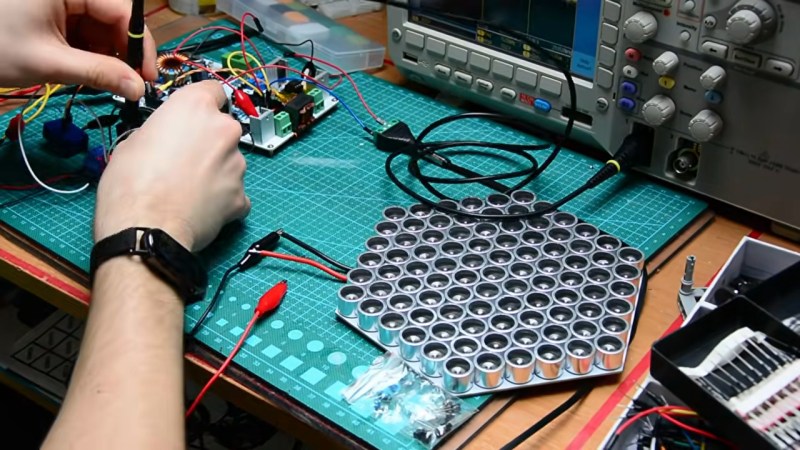
A device rather resembling a megaphone is lying on a table. The handle is made of black plastic. The horn is made of grey plastic, is hexagonal, and is not tapered. At the back of the horn is an array of silver ultrasonic transducers.

Accurately Aiming Audio With An Ultrasonic Array

When [Electron Impressions] used a powerful ultrasonic array to project a narrow beam of sound toward a target, he described it as potentially useful in getting someone’s attention from across a crowded room without disturbing other people. This is quite a courteous use compared to some of the ideas that occur to us, and particularly compared to the crowd-control applications that various militaries and police departments put directional speakers to.

Regardless of how one uses it, however, the physics behind such directional speakers is interesting. Normal speakers tend to disperse their sound widely because the size of the diaphragm is small compared to the wavelength of the sound they produce; just like light waves passing through a pinhole or thin slit, the sound waves diffract outwards in all directions from their source. Audible frequencies have wavelengths too long to make a handheld directional speaker, but ultrasonic waves are short enough to work well; [Electron Impressions] used 40 kHz, which has a wavelength of just eight millimeters. To make the output even more directional, he used an array of evenly-spaced parallel emitters, which interfere constructively to the front and destructively to the sides. Continue reading “Accurately Aiming Audio With An Ultrasonic Array”