FAA Releases Rules Governing Unmanned Aerial Systems

The US Department of Transportation and the FAA have just released their guidelines that require registration of Unmanned Aerial Systems. This is the regulation that covers model aircraft, drones, quadcopters, and flying toys of all kinds. These rules have been anticipated since last month to be in place for the holiday season.

As expected, the FAA is requiring registration for all aircraft, regardless of being ‘model’ aircraft or not, weighing more than 250 grams (0.55 pounds) and less than 55 pounds. The maximum weight is a holdover from previous regulations; model aircraft weighing more than 55 pounds were never really legal without a permit. It should be noted that anyone can build a quadcopter with cameras and video transmitters weighing less than 250 grams. These quadcopters are not ‘toys’ by any means, but are not required to be marked with a registration number and the pilot is not required to actually register. As expected, most rules governing the actual flight of these aircraft remain in place – don’t fly above 400 feet, don’t fly within five miles of an airport.

Registration is by pilot, not aircraft, and costs $5. A registration number must be put on every aircraft the pilot owns, and penalties for not registering can include up to $27,500 in civil penalties and up to $250,000/3 years imprisonment in criminal penalties. The full rules are available in this 200-page PDF. As with most government regulations, there will be a 30-day RFQ period beginning December 21st on regulations.gov. The docket number is FAA-2015-7396.

Aircraft Hackchat This Thursday

This Thursday, December 10th at 5pm PST we will be hosting a live HackChat about aircraft. If it’s man-made and it files, it’s on topic! Full scale and model planes, helicopters, multicopters, gyros, blimps and gliders will be on the agenda. Our host this week will be Hackaday Community Editor [Adam Fabio] who is also the author of this well-written blog entry. In addition to being an electrical engineer, [Adam] brings 30 years of experience as a Radio Control model enthusiast. Over the years he’s worked as a professional R/C Blimp Pilot for the New York Islanders Hockey team and as an aerial photographer. On the full-scale aircraft side, he’s designed radar and air traffic control software used to keep the skies safe over land and sea.

Aircraft HackChat starts Thursday at 5pm PST (here’s a timezone cheat sheet if you need it). Participating in this live chat is very simple. Those who are already part of the Hacker Channel can simply click on theTeam Messaging button. If you’re not part of the channel, just go to the hacker Channel page, scroll to the bottom of the “TEAM” list in the left sidebar and click “Request to join this project”.

HackChat takes place in the Hacker Channel every few weeks and is a friendly place to talk about engineering and the projects you’re working on.

Don’t Be A Drone Noob This Christmas

Traditionally, getting into the hobby of flying model aircraft required spending some serious coin, not to mention hours and hours of building and learning. All of that leading up to a white-knuckled, hair raising maiden flight. If you were extremely lucky, you’d head home with only a slightly damaged plane – but many of us did a nice death spiral straight into the ground – all just so we could go home, and then start all over. Perhaps one of the reasons we’re seeing so many (negative) drone related news stories recently is that the price of admission to join the club of flying machines has never been so low. That, and there always seems to be one kid in the class that wants to ruin it for the rest of us.

This year the FAA expects about a million people to wake up Christmas morning with a drone under the tree.  And that’s a lot of chances for people to mess up. So if you’re planning on taking a drone up this year, you might want to watch the video after the break; Or just forward it to those that you think need to see it. If you’re into any sort of flying models you should already have [FliteTest] in your YouTube subscriptions – they have some really informative video, especially for the beginner wanting to get into the hobby.

This video guide is meant to be just a short introduction of what not to do. Obviously it doesn’t cover everything.  And we wouldn’t be looking out for our readers if we didn’t say that your local laws may vary – so do your homework, stay safe, and don’t be a drone noob.

Continue reading “Don’t Be A Drone Noob This Christmas”

“Who Is John Galt?” Finally Answered

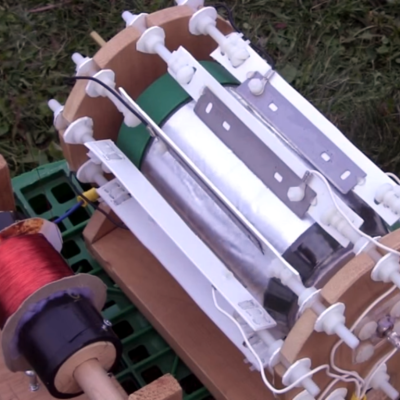
For those who haven’t read [Ayn Rand’s] philosophical tome Atlas Shrugged, there’s a pretty cool piece of engineering stuffed in between the 100-page-long monologues. Although fictional, a character manages to harness atmospheric static electricity and convert it into kinetic energy and (spoilers!) revolutionize the world. Harnessing atmospheric static electricity isn’t just something for fanciful works of fiction, though. It’s a real-world phenomenon and it’s actually possible to build this motor.

who-is-john-galt-thumbAs [Richard Feynman] showed, there is an exploitable electrical potential gradient in the atmosphere. By suspending a tall wire in the air, it is possible to obtain voltages in the tens of thousands of volts. In this particular demonstration, a hexacopter is used to suspend a wire with a set of needles on the end. The needles help facilitate the flow of electrons into the atmosphere, driving a current that spins the corona motor at the bottom of the wire.

There’s not much torque or power generated, but the proof of concept is very interesting to see. Of course, the higher you can go the more voltage is available to you, so maybe future devices such as this could exploit atmospheric electricity to go beyond a demonstration and do useful work. We’ve actually featured the motor that was used in this demonstration before, though, so if you’re curious as to how a corona motor works you should head over there.

Continue reading ““Who Is John Galt?” Finally Answered”

Drones Are Getting A Lot Smarter

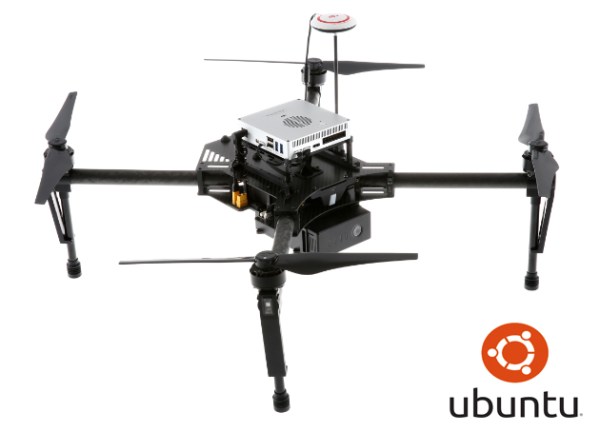
[DJI], everyone’s favorite — but very expensive — drone company just announced the Manifold — an extremely capable high performance embedded computer for the future of aerial platforms. And guess what? It runs Ubuntu.

The unit features a quad-core ARM Cortex A-15 processor with an NVIDIA Keplar-based GPU and runs Canonical’s Ubuntu OS with support for CUDA, OpenCV and ROS. The best part is it is compatible with third-party sensors allowing developers to really expand a drone’s toolkit. The benefit of having such a powerful computer on board means you can collect and analyze data in one shot, rather than relaying the raw output down to your control hub.

And because of the added processing power and the zippy GPU, drones using this device will have new artificial intelligence applications available, like machine-learning and computer vision — Yeah, drones are going to be able to recognize and track people; it’s only a matter of time.

We wonder what this will mean for FAA regulations…

Who Is Responsible When Machines Kill?

This morning I want you to join me in thinking a few paces into the future. This mechanism let’s us discuss some hard questions about automation technology. I’m not talking about thermostats, porch lights, and coffee makers. The things that we really need to think about are the machines that can cause harm. Like self-driving cars. Recently we looked at the ethics behind decisions made by those cars, but this is really just the tip of the iceberg.

A large chunk of technology is driven by military research (the Internet, the space race, bipedal robotics, even autonomous vehicles through the DARPA Grand Challenge). It’s easy to imagine that some of the first sticky ethical questions will come from military autonomy and unfortunate accidents.

Continue reading “Who Is Responsible When Machines Kill?”

BitDrones Are Awesome, Ridiculous At Same Time

At first we thought it was awesome, then we thought it was ridiculous, and now we’re pretty much settled on “ridiculawesome”.

Bitdrones is a prototype of a human-computer interaction that uses tiny quadcopters as pixels in a 3D immersive display. That’s the super-cool part. “PixelDrones” have an LED on top. “ShapeDrones” have a gauzy cage that get illuminated by color LEDs, making them into life-size color voxels. (Cool!) Finally, a “DisplayDrone” has a touchscreen mounted to it. A computer tracks each drone’s location in the room, and they work together to create a walk-in 3D “display”. So far, so awesome.

It gets even better. Because the program that commands the drones knows where each drone is, it can tell when you’ve moved a drone around in space. That’s extremely cool, and opens up the platform to new interactions. And the DisplayDrone is like a tiny flying cellphone, so you can chat hands-free with your friends who hover around your room. Check out the video embedded below the break.

Continue reading “BitDrones Are Awesome, Ridiculous At Same Time”