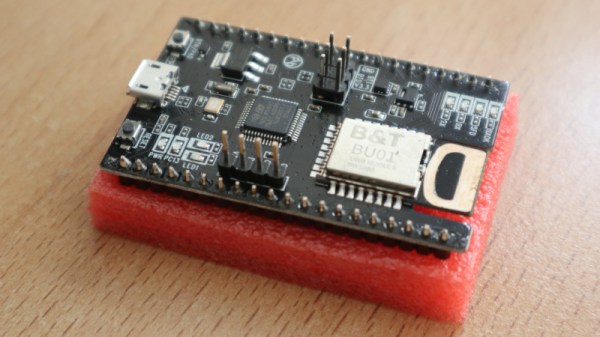
If you’ve been following the world of mobile phone technology of late, you may be aware that Apple’s latest IPhones and AirTag locator tags bring something new to that platform. Ultra wideband radios are the new hotness when it comes to cellphones, so just what are they and what’s in it for those of us who experiment with these things?
Ultra wideband in this context refers to radio signals with a very high bandwidth of over 500 MHz, and a very low overall power density spread over that spectrum. Transmissions are encoded not by modulation of discrete-frequency carriers as they would be in a conventional radio system, but by the emission of wideband pulses of RF energy across that bandwidth. It can exist across the same unlicensed spectrum as narrower bandwidth channelised services, and that huge bandwidth gives it an extremely high short-range data transfer bandwidth capability. The chipsets used by consumer devices use a range of UWB channels between about 3.5 and 6.5 GHz, which in radio terms is an immense quantity of spectrum. Continue reading “What Is Ultra Wideband?”→
The International Space Station is humanity’s most expensive gym membership.
Since the earliest days of human spaceflight, it’s been understood that longer trips away from Earth’s gravity can have a detrimental effect on an astronaut’s body. Floating weightless invariably leads to significantly reduced muscle mass in the same way that a patient’s muscles can atrophy if they spend too much time laying in bed. With no gravity to constantly fight against, an astronauts legs, back, and neck muscles will weaken from disuse in as little as a week. While this may not pose an immediate problem during spaceflight, astronauts landing back on Earth in this physically diminished state are at a higher risk of injury.
Luckily this problem can be largely mitigated with rigorous exercise, and any orbiting vessel spacious enough to hold human occupants for weeks or months will by necessity have enough internal volume to outfit it with basic exercise equipment such as a treadmill or a resistance machine. In practice, every space station since the Soviet Union’s Salyut 1 in 1971 has featured some way for its occupants to workout while in orbit. It’s no replacement for being on Earth, as astronauts still return home weaker than when they left, but it’s proven to be the most practical approach to combating the debilitating aspects of long duration spaceflight.
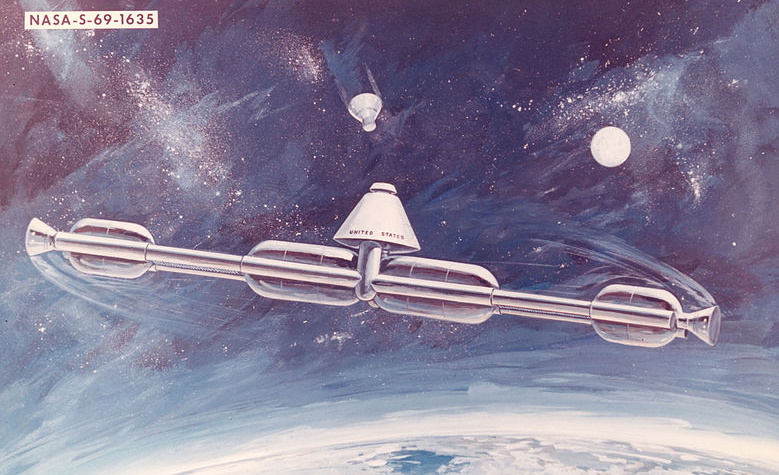
Early NASA concept for creating artificial gravity.
Of course, there’s an obvious problem with this: every hour spent exercising in space is an hour that could be better spent doing research or performing maintenance on the spacecraft. Given the incredible cost of not just putting a human into orbit, but keeping them there long-term, time is very literally money. Which brings us back to my original point: astronauts spending two or more hours each day on the International Space Station’s various pieces of exercise equipment just to stave off muscle loss make it the world’s most expensive gym membership.
The ideal solution, it’s been argued, is to design future spacecraft with the ability to impart some degree of artificial gravity on its passengers through centripetal force. The technique is simple enough: just rotate the craft along its axis and the crew will “stick” to the inside of the hull. Unfortunately, simulating Earth-like gravity in this way would require the vessel to either be far larger than anything humanity has ever launched into space, or rotate at a dangerously high speed. That’s a lot of risk to take on for what’s ultimately just a theory.
But a recent paper from the University of Tsukuba in Japan may represent the first real steps towards the development of practical artificial gravity systems aboard crewed spacecraft. While their study focused on mice rather than humans, the results should go a long way to codifying what until now was largely the stuff of science fiction.
As nation states grapple with the spectre of environmental and economic losses due to climate change, we’ve seen an ever greater push towards renewable energy sources to replace heavier polluters like coal and natural gas. One key drawback of these sources has always been their intermittent availability, spurring interest in energy storage technologies that can operate at the grid level.
With the rise in distributed energy generation with options like home solar power, there’s been similar interest in the idea of distributed home battery storage. However, homeowners can be reluctant to make investments in expensive batteries that take years to pay themselves off in energy savings. But what if they had a giant battery already, just sitting outside in the driveway? Could electric vehicles become a useful source of grid power storage? As it turns out, Ford wants to make their electric trucks double as grid storage batteries for your home.
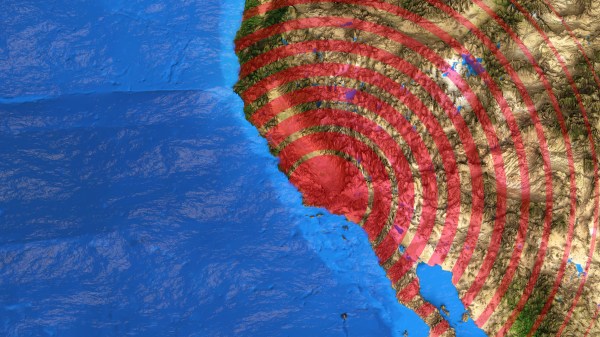
Earthquakes are highly destructive when they strike, and unlike many other natural disasters, they often hit with minimal warning. Unlike hurricanes and floods, and even volcanoes to an extent, earthquakes can be very difficult to predict. However, in recent decades, warning networks have proliferated around the world, aiming to protect affected communities from the worst outcomes in the event of a large tremor.
In the grand scheme of things, it wasn’t all that long ago that the entire body of knowledge of our solar system was built solely with Earth-based observations. Turning first their naked eyes to the heavens, and then a succession of increasingly complex and sensitive optical and radio telescopes gathering light from all across the spectrum, our astronomically curious forbears did a commendable job working out the broad strokes of what’s going on in the neighborhood.
But there’s only so much information that can be gathered by instruments operating at the bottom of a roiling ocean of air, so when the opportunity to send instruments to our planetary neighbors began to be possible some 60 years ago, scientists started planning how to accomplish it. What resulted was the Mariner program, a series of interplanetary probes launched between 1962 and 1973 that performed flyby missions of the inner planets.
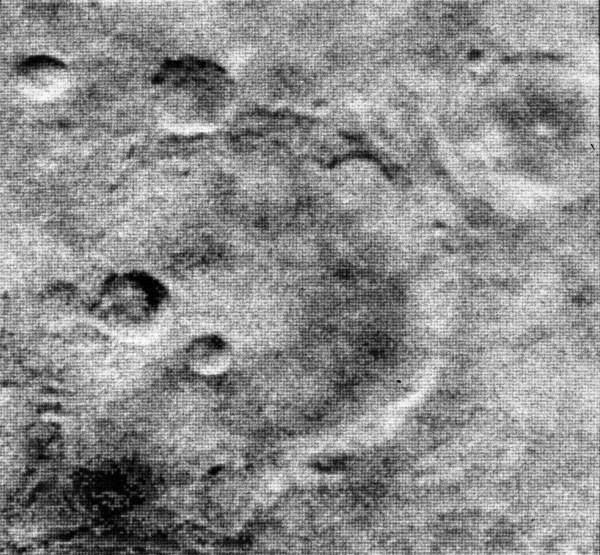
The list of accomplishments of the Mariner program is long indeed, and the number of firsts achieved by its ten spacecraft is impressive. But it is Mariner 4, the first flyby mission of Mars, which set the stage for a lot of the science being done on and around Mars today, and the first mission where NASA wisely took a “pics or it didn’t happen” approach to planetary science. It was the first time a TV camera had traveled to another world, and it was anything but a sure bet that it would pay dividends.
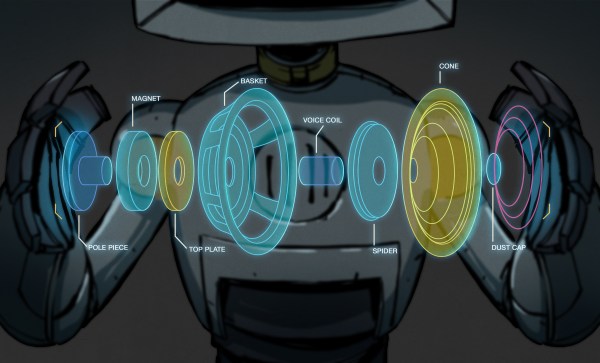
A lot of our projects make noise. It can be something as simple as a microcontroller driving a small speaker or a truly ambitious Hi-Fi project, but common to all of them is the desire to get that sound out in as audible and high-quality a manner as possible. We’ve been known to make fun of the more preposterous side of the Hi-Fi world at times, but behind it all there’s a basis of solid and provable audio engineering that can be brought to bear on almost any project involving sound and electronics. Perhaps it’s time to devote some time to a series exploring the topic, and what better place to start than the ultimate destination for all that sound. Any Hi-Fi is only as good as the ears of the person listening to it, so in out journey through the world of audio that’s where we’ll start. Continue reading “Know Audio: Start At The Very Beginning”→
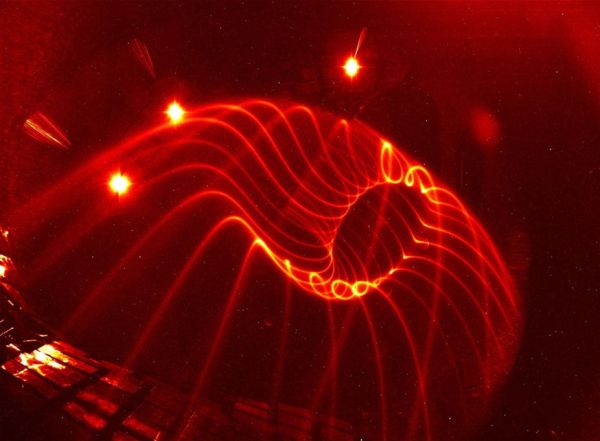
We’ve had nuclear fission reactors in operation all over the world for ages, but nuclear fusion always seems to be a decade or two away. While one cannot predict when we’ll reach the goal of sustained nuclear fusion, the cutting edge in test hardware is advancing at a rapid pace that makes us optimistic. Beginning as soon as this month and extending over a few years, we’re living through a very exciting time for nuclear fusion and plasma physics.
The Mega Ampere Spherical Tokamak (MAST) got a big upgrade to test a new cooled divertor design. JET (Joint European Torus) will be testing the deuterium-tritium fuel mixture that will be powering the ITER (the research project whose name began as an acronym for International Thermonuclear Experimental Reactor but has since been changed to just ITER). And the Wendelstein 7-X stellarator is coming back online with upgraded cooled divertors by next year.
Here the MAST Upgrade’s Super-X divertors have so far shown a ten-fold decrease in the temperature which the divertor is exposed to while carrying thermal energy out of the tokamak reactor. This means a divertor design and ultimately a fusion reactor that will last longer between maintenance sessions. On the stellarator side of things, Wendelstein 7-X’s new divertors may allow it to demonstrate the first continuous operation of a stellarator fusion reactor. Meanwhile, JET’s fuel experiments should allow us to test the deuterium-tritium fuel while ITER is working towards first plasma by 2025.