3D Printed Metal Assembly

New 3D Printing Techniques At AMUG 2015

Sometimes there’s a lot of perks to working for a cutting edge tech company while also being a writer here at Hackaday. This week I had the opportunity to attend AMUG 2015 — the Additive Manufacturing User Group conference in Jacksonville, Florida.

I saw companies big and small, checked out the newest techniques like metal printing and mold making, and met a ton of interesting people. Join me after the break for the rundown and a video summary of my experience.

Continue reading “New 3D Printing Techniques At AMUG 2015”

Extreme Vectrex Multicart Plays Bad Apple

[Sprite_TM] had a Vectrex console that he wanted to play with. Alas, his makeshift multicart had fallen into disrepair. Rolling up his hacking sleeves, he set about making a new one, a better one. His PCB design included his microcontroller of choice: the ST STM32F411, a 32-bit 100Mhz ARM Cortex M4, along with a 16MB SPI flash chip. [Sprite_TM] wanted to make programming games onto the multicart simple. Using the libopencm3 firmware library for the STM in conjunction with Elm-Chans FatFS, the multicart could be plugged into a computer’s USB port and have any game data dragged and dropped onto it like a USB stick. The PCB then connects directly into the Vectrex’s cartridge port. The first cartridge file is a basic menu that lists all of the game ROMs stored in the flash memory. When the user selects the game the STM loads that ROM file which the menu software then boots.

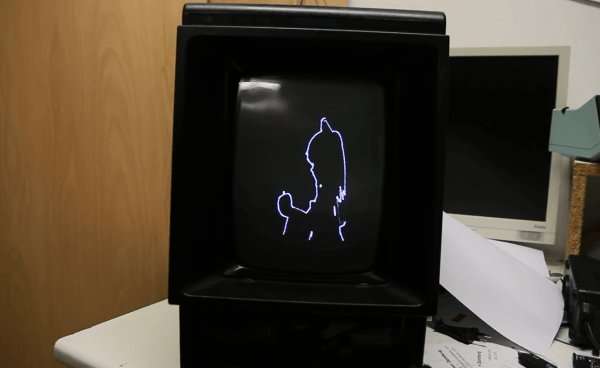
After loading his entire Vectrex ROM library onto the multicart, [Sprite_TM] realized he had far too much space left over – so he decided to add some extras. His first choice was Bad Apple (YouTube link), a music video made by fans of the Touhou Project game series. The video features black and white silhouettes of the many game characters in a shadow art style. Since its debut, Bad Apple has been ported from everything from the Sega Genesis (YouTube link) to laser scanners (YouTube link). It was time for the Vectrex to join the list.

After ripping the video from YouTube, [Sprite_TM] used MPlayer to save each frame as a PNG along with a wave file of the music. Next, he ran Potrace on the PNG files to get vector versions. Using a custom PHP script, the resulting JSON file was post-processed into relative vectors the Vectrex uses. Digital audio was possible by having the Vectrex’s 8-bit DA-converter perform double duty both for the video circuit and the audio. However, the volume must be turned to the max in order to hear the music. Incidentally, the DAC can only output audio in this scenario when vectors are not being drawn, so the event timing needed to be adjusted. The video and audio data was re-parsed after a modified version of VecX was used to get the timing events synchronized before transferring Bad Apple onto the multicart.

You can see the Vectrex version of Bad Apple after the break, along with a 3D-engine based on Doom levels. The engine is written in C and makes use of the Z-buffer, creating the effect of solid 3D-objects in front of each other.  There are no weapons or enemies to dispatch here, but the effect is impressive nonetheless.

Continue reading “Extreme Vectrex Multicart Plays Bad Apple”

Logic Noise: Sequencing In Silicon

In this session of Logic Noise, we’ll combine a bunch of the modules we’ve made so far into an autonomous machine noise box. OK, at least we’ll start to sequence some of these sounds.

A sequencer is at the heart of any drum box and the centerpiece of any “serious” modular synthesizer. Why? Because you just can’t tweak all those knobs and play notes and dance around at the same time. Or at least we can’t. So you gotta automate. Previously we did it with switches. This time we do it with logic pulses.

Continue reading “Logic Noise: Sequencing In Silicon”

FCC Creates Innovation Radio, The Future Of Wireless Broadband

Thirty years ago there was a lot of unused spectrum in the 900MHz,  2.4GHz, and 5.2GHz bands. They were licensed for industrial, scientific, and medical uses since their establishment in 1947. But by the 1980s, these bands were identified as being underused. Spectrum is a valuable resource, and in 1985, the FCC first allowed unlicensed, spread spectrum use of these bands. Anyone who has ever configured a router will know the importance of this slice of spectrum: they’re the backbone of WiFi and 4G. If you’re not connected to the Internet through an Ethernet cable, you have the FCC Commissioners and chairpersons in 1985 to thank for that.

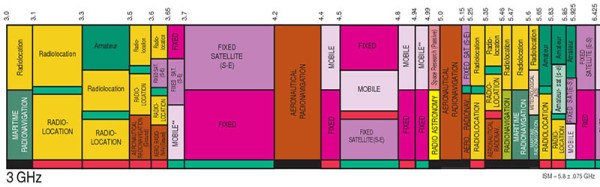
Last week, the FCC unanimously voted to allow the use of spectrum in the 3.5GHz band with the Citizens Broadband Radio Service. This opens up 150 MHz of spectrum from 3550 – 3700MHz for new wireless broadband services. If history repeats itself, you will be connecting to the Internet with the Citizens Broadband Radio Service (CBRS) in a few years.

While the April 17th FCC meeting was the formal creation of the CBRS, this is something that has been in the works for a very long time. The band was originally proposed back in 2012 when portions of spectrum were, like the ISM bands back in the 80s, identified as being underused. Right now, the 3.5GHz band is being used for US military radars and aeronautical navigation, but new advances in frequency management as outlined by commissioner [Clyburn] will allow these to coexist with the CBRS. In the words of Chairman [Wheeler], “computer systems can act like spectrum traffic cops.”

Access to the 3.5GHz spectrum will be divided into three levels. The highest tier, incumbent access, will be reserved for the institutions already using it – military radars and aeronautical radio. The second tier, priority access, will be auctioned and licensed by the FCC for broadband providers via Priority Access Licenses (PALs). The final tier, general authorized access, will be available for you and me, provided the spectrum isn’t already allocated to higher tiers. This is an unprecedented development in spectrum allocation and an experiment to see if this type of spectrum allocation leads to more utilization.

There are, however, unanswered questions. Commissioner [O’Rielly] has said the three-year license with no renewable expectancy could limit commercial uptake of PALs. Some commentors have claimed the protocols necessary for the CBRS to coexist with WiFi devices does not exist.

Still, the drumbeat demanding more and more spectrum marches on, and 2/3rds of the 150MHz made available under this order was previously locked up for the exclusive use of the Defense Department. Sharing spectrum between various users is the future, and in this case has the nice bonus of creating a free citizens band radio service.

You can read the full order here, or watch the stream of the April 17th meeting.

Achievement Unlocked: Global Virtual Hackerspace

We’ve been riding the runaway train that is Hackaday.io for about fourteen months. With over 60k registered user and  hundreds of thousands of visitors a month it’s hard to remember how we got from humble beginnings to where we stand now. But a big part of this is all the suggestions we’ve been hearing from you. On the top of that list have been numerous requests for more collaborative features. This week we’ve pushed an update that will change the way you interact with your fellow hackers.
alt-dot-hackaday-io-chat

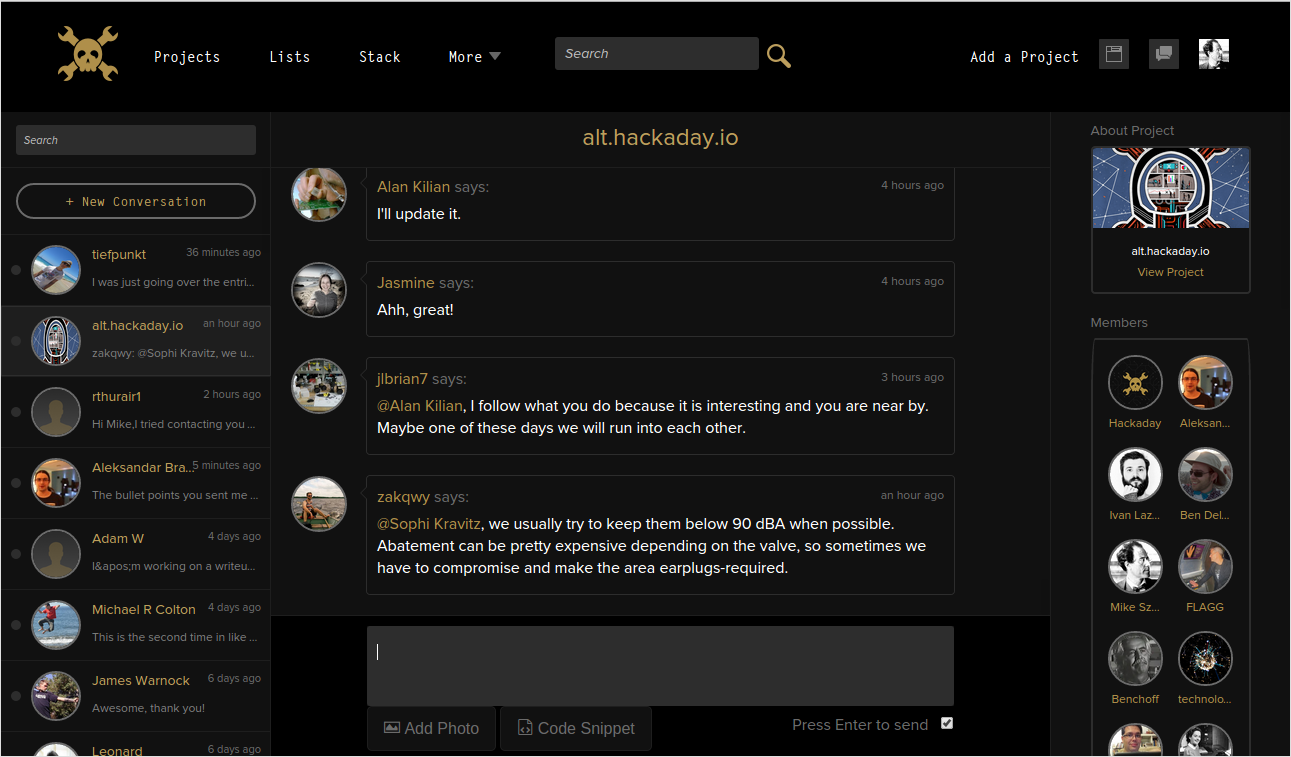
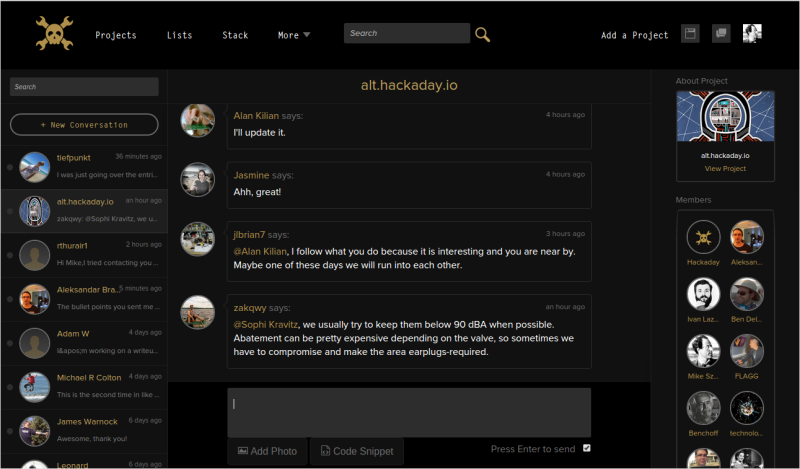
This brand new messaging interface is beyond what we dreamed when we started development. Our goal with Hackaday has long been to form the Virtual Hackerspace, and this is it. Shown above is group messaging for the alt.hackaday.io project. You can see that thread selected on the left among many other threads in progress. On the right is the list of the team collaborators. Each project on Hackaday.io has group messaging availalbe, all you need to do is add your collaborators.
group-messagig-buttonNeed skills that you don’t have to finish the project? Just want to brainstorm the next big project? Jump on Hackaday.io and get into it. Head over to one of your projects, invite some collaborators if you don’t already have them, and click the “Group Messaging” button in the left column.

This is not private messaging and it’s not just chat. This is new. It’s persistent, it’s instant, it’s long, it’s short, it is what you need to work with other hackers. We don’t even know what to call it yet. You can help with that and you can tell us what you find to do with it. We’ve designed it for creative abuse.

Configurable Notifications
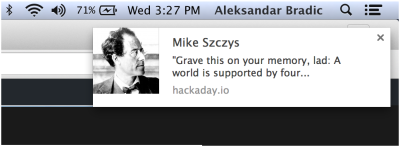
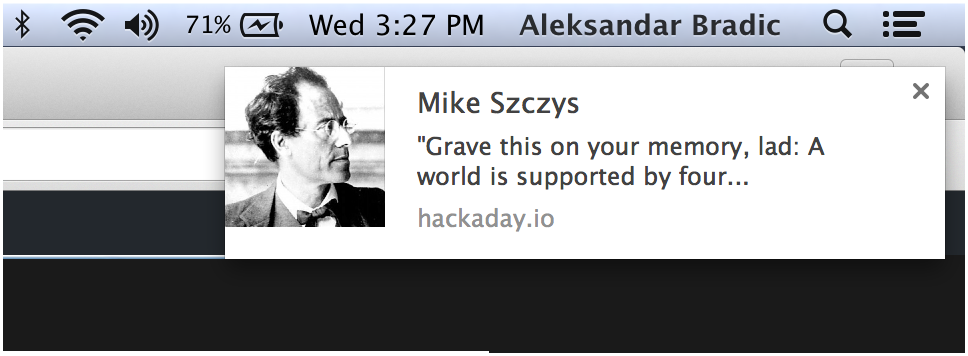
When loading up the message page for the first time you’ll see a bar across the top requesting desktop notification access. This feature gives you a pop-up message when the tab with the messaging interface is not active.

If you don’t have the interface open you will receive an email when new messages come in. This can be toggled globally for all of your chats but we do have plans to configure these emails per-chat thread. Thanks to [jlbrian7] for the tip that users of Firefox on Linux need an extension to enable notifications. I’m using Chrome on Mint and it work just fine without adding packages.

Dude, Mobile
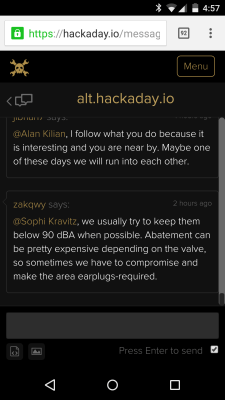
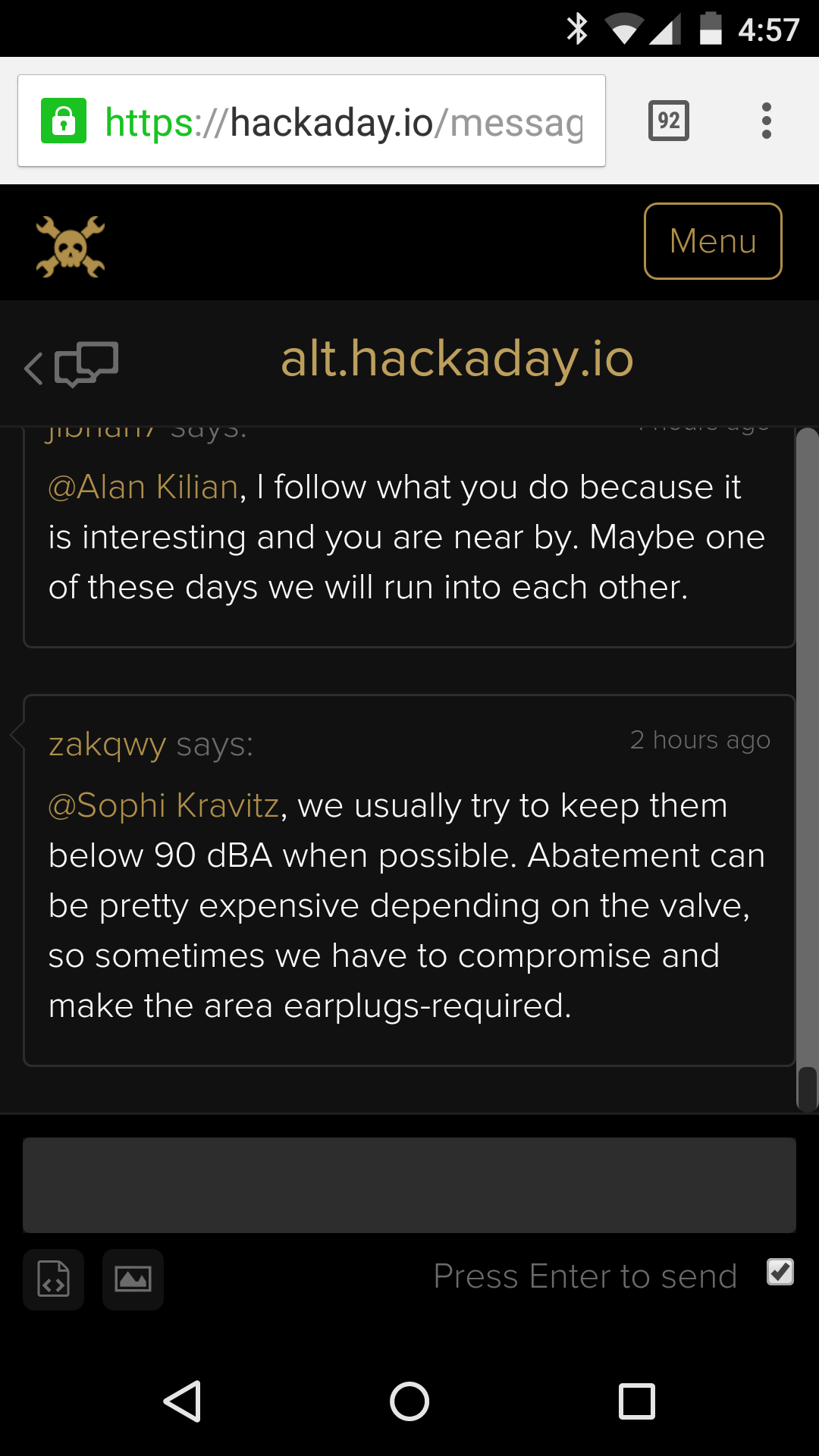
Screenshot_2015-04-21-16-57-07This Virtual Hackerspace goes with you and we’re not just talking out of the house. How many times have you been sitting at the bench wondering what the heck you’re doing wrong? Whip out your phone, snap a picture and post it so the collaborators on your team can help out. Right now it’s rock-solid on iPhone. Android requires a very quick double-tap on the image icon to trigger but we’ll have that fixed in a jiffy.

Of course images work from the computer interface as well, and there’s a code tool to embed snippets in your messages.

Team Invites and Requests

The only part we don’t have working is the ability to talk to yourself but that is coming. For now you must have collaborators to enable group messaging and this update makes that simple.

Each project has a team list in the left hand column. You’ll notice that a text box has been added to invite members. Just type their hacker name and click the invite button. They’ll get a private message with instructions for accepting your invitation.

Give it a Spin Right Now

We’ve set up the official Hackaday Prize Hacker Channel so that you can try it out right away. Casual conversation is welcome, but this is also a great opportunity to find team members for your Hackaday Prize entry. We’ll also be hosting regular events on the channel. More on that soon!

VCF East X: The Mega Mix

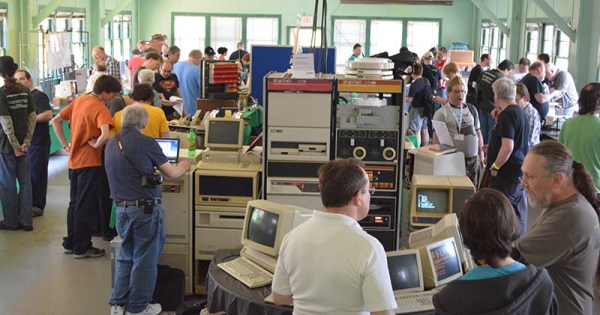
The Vintage Computer Festival East was last weekend, and now it’s time to wrap everything up. We’re going to start this off with a video of the biggest, most intolerable jerk on the planet walking around the boardwalk at Ashbury Park. Thanks to [Fran] for filming it.

That video, despite the wretched casting director, included the reveal of the PDP Straight-8, the 50-year-old minicomputer that was repaired and refurbished by [David Gesswein] just this year. You can see some pictures of that and more below, and a little more on [David]’s website.

Continue reading “VCF East X: The Mega Mix”

Hack With Us In The City That Never Sleeps

We’re hosting one day of hacking in New York City next week. Stretch your skills with the power of deadlines and you can be immortalized in Hackaday history. If that kind of cred doesn’t do it for you, Hackaday is bringing along $1500 in prizes and there’s another $5000 cash prize at stake as well.

Only Hackaday can bring hardware to the TechCrunch NYC Hackathon on May 2nd. We need you to make it happen. Get your free ticket now (UPDATE: Our special tickets are all sold out but you might still be able to get some in the last few ticket releases. Check back often.). From there join the comment thread on our events page to connect with the rest of us who will be there.

Break the Hardware and Software Divide

techcrunch-disrupt-hackathon-2014Check out these pictures of last year’s TechCrunch hackathon. There’s a ton of people, they all seem to be having fun, but when it comes down to the end, they’re pointing to the screens of their Macbooks. This year you need to break that mold and and rise to the top with a hardware product to hold up as you are awarded TechCrunch’s comically large $5000 check.

Holding a hunk of hardware with electrons running through its veins is way more hardcore than software alone. We will end the segregation of software-only and hardware-only hackathons. After all, most hardware hacks these days are also software hacks. Team up with one of the iOS/Android app groups and add hardware to the mix. We want to see at least twenty of those tables strewn with jumper wires, breakout boards, and soldering irons. And we want to see someone from the Hackaday Community win this thing. So here’s the agreement — we’ll get you in, we’ll bring the hardware, you bring the awesome.

All Work and No Play (yeah right)

Ha! Like that has ever been our mantra. This is going to be a blast and because of it the Hackaday crew is flocking to town from all over the country. Confirmed so far are [Adam], [Alek], [Amar], [Brian], [Chris], [Jasmine], [Matt], [Mike], [Rob], [Sophi], and [Theodora]. We’re there to have fun, and you’re invited.

Most of the crew will arrive in town on Thursday night and we’ll definitely be meeting up. Anyone who registers for the Hackathon is invited for these pre-game festivities. Drop a comment on the events page and we’ll PM you details about where and when. But at the event our collective skills will be available to get your project past the sticking points. Of course we also need many hands to distribute all the swag we’re bringing along.