Demonstrate Danger, Safely

Dan Maloney and I were talking about the chess robot arm that broke a child’s finger during the podcast, and it turns out that we both have extreme respect for robot arms in particular. Dan had a story of a broken encoder wheel that lead to out-of-control behavior that almost hit him, and I won’t even get within striking distance of the things unless I know they’re powered off after seeing what programming errors in a perfectly functioning machine can do to two-by-fours.

This made me think of all the dangerous things I’ve done, but moreover about all the intensely simple precautions you can to render them non-risky, and I think that’s extremely important to talk about. Tops of my list are the aforementioned industrial robot arm and high powered lasers.

Staying safe with an industrial robot arm is as easy as staying out of reach when it’s powered. Our procedure was to draw a line on the floor that traced the arm’s maximum radius, and you stay always outside that line when the light is on. It’s not foolproof, because you could hand the ’bot a golf club or something, but it’s a good minimum precaution. And when you need to get within the line, which you do, you power the thing down. There’s a good reason that many industrial robots live in cages with interlocks on the doors.

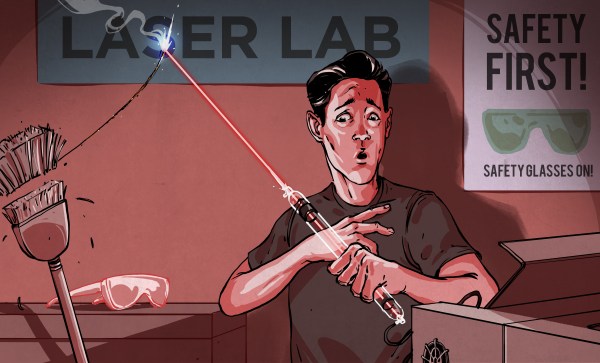
Laser safety is similar. You need to know where the beam is going, make sure it’s adequately terminated, and never take one in the eye. This can be as simple as putting the device in a box: laser stays in box, nobody goes blind. If you need to see inside, a webcam is marvelous. But sometimes you need to focus or align the laser, and then you put on the laser safety glasses and think really hard about where the beam is going. And then you close the box again when you’re done.

None of these safety measures are particularly challenging to implement, or conceptually hard: draw a line on the floor, put it in a box. There were a recent series of videos on making Lichtenberg figures safely, and as a general rule with high voltage projects, a great precaution is a two-button deadman’s switch box. This at least ensures that both of your hands are nowhere near the high voltage when it goes on, at the cost of two switches.

If all of the safety precautions are simple once you’ve heard them, they were nothing I would have come up with myself. I learned them all from other hackers. Same goes with the table saw in my workshop, or driving a car even. But since the more hackery endeavors are less common, the “common-sense” safety precautions in oddball fields are simply less commonly known. It’s our jobs as the folks who do know the secrets of safety to share them with others. When you do something dangerous, show off your safety hacks!


Why Fedora Decided To Give CC0 Licensed Code The Boot

The term “open source” can be tricky. For many people, it’s taken to mean that a particular piece of software is free and that they can do whatever they wish with it. But the reality is far more complex, and the actual rights you’re afforded as the user depend entirely on which license the developers chose to release their code under. Open source code can cost money, open source code can place limits on how you use it, and in some cases, open source code can even get you into trouble down the line.

Which is precisely what the Fedora Project is looking to avoid with their recent decision to reject all code licensed under the Creative Common’s “Public Domain Dedication” CC0 license. It will still be allowed for content such as artwork, and there may even be exceptions made for existing packages on a case-by-case basis, but CC0 will soon be stricken from the list of accepted code licenses for all new submissions.

Fedora turning their nose up at a software license wouldn’t normally be newsworthy. In fact, there’s a fairly long list of licenses that the project deems unacceptable for inclusion. The surprising part here is that CC0 was once an accepted license, and is just now being reclassified due to an evolving mindset within the larger free and open source (FOSS) community.

So what’s the problem with CC0 that’s convinced Fedora to distance themselves from it, and does this mean you shouldn’t be using the license for your own projects?

Continue reading “Why Fedora Decided To Give CC0 Licensed Code The Boot” →

Where Pollution Hits The Road: The Growing Environmental Hazard Of Rubber Tires

As ubiquitous as rubber tires are due to the many practical benefits they offer to cars, trucks, and other conveyances, they do come with a limited lifespan. Over time, the part of the tire that contacts the road surface wears away, until a tire replacement is necessitated. Perhaps unsurprisingly, the material that wears away does not magically vanish, but ends up in the environment.

Because of the materials used to create tires, this worn away material is counted as a microplastic, which is a known environmental pollutant. In addition, more recently it’s been found that one additive commonly found in tires, called 6PPD, is highly toxic to certain species of fish and other marine life.

There are also indications that these fine bits of worn-off tire contribute to PM2.5 particulate matter. This size of particulates is fine enough to penetrate deep into the lungs of humans and other animals, where they can cause health issues and exacerbate COPD and similar conditions. These discoveries raise a lot of questions about our use of tires, along with the question of whether electric vehicles stand to make this issue even worse.

Continue reading “Where Pollution Hits The Road: The Growing Environmental Hazard Of Rubber Tires” →

Electrolytes, They’re What Dehydrated Hackaday Writers Crave!

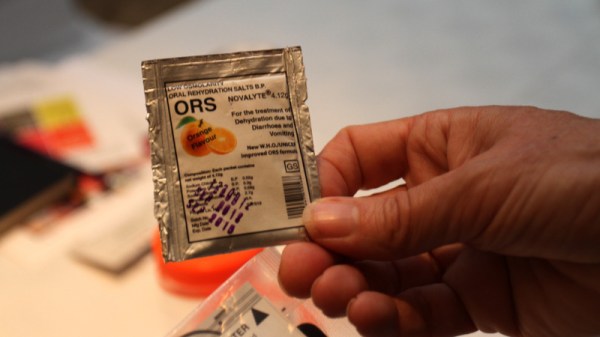
The oddly prophetic 2006 comedy film Idiocracy features an isotonic drink called Brawndo, whose marketing continuously refers to its electrolytes as a miraculous property. Brawndo is revealed in the film to be useless for agricultural irrigation, but yesterday perhaps a couple of Hackaday writers could have used a bottle or two. At the MCH hacker camp, the record heat of a Dutch summer under the influence of global warming caused us to become dehydrated, and thus necessitated a trip to the first aid post for some treatment. We’d done all the right things, staying in the shade, keeping as cool as we could, eating salty foods like crisps, and drinking plenty of liquids, so what had gone wrong?

Perhaps Club-Mate Should Have An Isotonic Version

The answer will probably be obvious to trained observers, we’d become deficient in those electrolytes. Our bodily stocks of sodium and potassium salts had become exhausted by sweat and all that extra water requiring trips to the toilet, so while we weren’t dehydrated in liquid terms we had exhausted some of the essentials to our cellular function.

The symptoms would have been easy to spot given the right training, but at a hacker camp it was too easy to attribute a headache and tiredness to a late night. For me the point at which it became obvious something was significantly wrong came when my thought processes started to slow down and my movement became a lot less easy. I’m a long-distance walker and cyclist, yet here I was walking like an octogenarian. If I’d know what to spot I might also have noticed that I had stopped sweating despite the heat. I found a friend (Thanks Gasman!), and together we made our way to the first aid post. MCH2022 first aiders were very efficient, and I was given a cup of oral rehydration salts which restored me to health in a matter of minutes. Continue reading “Electrolytes, They’re What Dehydrated Hackaday Writers Crave!” →

The Surprisingly Manual Process Of Building Automotive Wire Harnesses

Even from the very earliest days of the automobile age, cars and trucks have been hybrids of mechanical and electrical design. For every piston sliding up and down in a cylinder, there’s a spark plug that needs to be fired at just the right time to make the engine work, and stepping on the brake pedal had better cause the brake lights to come on at the same time hydraulic pressure pinches the wheel rotors between the brake pads.

Without electrical connections, a useful motor vehicle is a practical impossibility. Even long before electricity started becoming the fuel of choice for vehicles, the wires that connect the computers, sensors, actuators, and indicators needed to run a vehicle’s systems were getting more and more complicated by the year. After the engine and the frame, a car’s wiring and electronics are its third most expensive component, and it’s estimated that by 2030, fully half of the average vehicle’s cost will be locked in its electrical system, up from 30% in 2010.

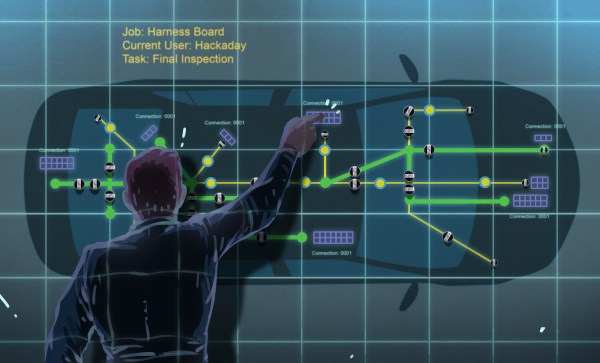
Making sure all those signals get where they’re going, and doing so in a safe and reliable way is the job of a vehicle’s wire harnesses, the bundles of wires that seemingly occupy every possible area of a modern car. The design and manufacturing of wire harnesses is a complex process that relies on specialized software, a degree of automation, and a surprising amount of people-power.

Continue reading “The Surprisingly Manual Process Of Building Automotive Wire Harnesses” →

Biomimetic Surfaces: Copying Nature To Deter Bacteria And Keep Ship Hulls Smooth

You might not think that keeping a boat hull smooth in the water has anything in common with keeping a scalpel clean for surgery, but there it does: in both cases you’re trying to prevent nature — barnacles or biofilm — from growing on a surface. Science has looked to nature, and found that the micro-patterning formed by the scales of certain sharks or the leaves of lotus plants demonstrate a highly elegant way to prevent biofouling that we can copy.

In the case of marine growth attaching to and growing on a ship’s hull, the main issue is that of increased drag. This increases fuel usage and lowers overall efficiency of the vessel, requiring regular cleaning to remove this biofouling. In the context of a hospital, this layer of growth becomes even more crucial. Each year, a large number of hospital patients suffer infections, despite the use of single-use catheters and sterile packaging.

Continue reading “Biomimetic Surfaces: Copying Nature To Deter Bacteria And Keep Ship Hulls Smooth” →

Protecting The Hughes H4 Hercules With… Beach Balls?

Ryan in the Spruce Goose pilot seat

While visiting the Evergreen Aviation & Space Museum in McMinnville, OR, USA over the weekend, I came across a hack.

In addition to the excellent displays on site and an area where one can watch a video on repeat, the museum offers guided tours for a very reasonable price. And it was during this tour that my life as an aviation geek changed forever. Why? I got to visit the flight deck of the H4 and even sit in the pilots seat where Howard Hughes sat when he flew the plane almost 75 years ago.

It was later in the tour, after I’d had a moment to take in the enormity of sitting in the seat, that I found a wonderful hack to share with you all: and it’s all about beach balls. Continue reading “Protecting The Hughes H4 Hercules With… Beach Balls?” →