This Week In Security: IPhone Unpowered, Python Unsandboxed, And Wizard Spider Unmasked

As conspiracy theories go, one of the more plausible is that a cell phone could be running malicious firmware on its baseband processor, and be listening and transmitting data even when powered off. Nowadays, this sort of behavior is called a feature, at least if your phone is made by Apple, with their Find My functionality. Even with the phone off, the Bluetooth chip runs happily in a low-power state, making these features work. The problem is that this chip doesn’t do signed firmware. All it takes is root-level access to the phone’s primary OS to load a potentially malicious firmware image to the Bluetooth chip.

Researchers at TU Darmstadt in Germany demonstrated the approach, writing up a great paper on their work (PDF). There are a few really interesting possibilities this research suggests. The simplest is hijacking Apple’s Find My system to track someone with a powered down phone. The greater danger is that this could be used to keep surveillance malware on a device even through power cycles. Devices tend to be secured reasonably well against attacks from the outside network, and hardly at all from attacks originating on the chips themselves. Unfortunately, since unsigned firmware is a hardware limitation, a security update can’t do much to mitigate this, other than the normal efforts to prevent attackers compromising the OS.
Continue reading “This Week In Security: IPhone Unpowered, Python Unsandboxed, And Wizard Spider Unmasked” →

The Little Big Dogs Of Invention

This is a story about two dogs I know. It is also a story of the U.S. Navy, aviation, and nuclear weapons. Sometimes it is easy to see things in dogs or other people, but hard to see those same things in ourselves. It’s a good thing that dogs can’t read (that we know of) because this is a bit of an embarrassing story for Doc. He’s a sweet good-natured dog and he’s a rather large labradoodle. He occasionally visits another usually good-natured dog, Rocky — a sheltie who is much smaller than Doc.

I say Rocky is good-natured and with people, he is. But he doesn’t care so much for other dogs. I often suspect he doesn’t realize he’s a dog and he is puzzled by how other dogs behave. You would think that when Doc comes to visit, the big dog would lord it over the little dog, right? Turns out, Doc doesn’t realize he’s way bigger than Rocky and — apparently — Rocky doesn’t realize he should be terrified of Doc. So Rocky bullies Doc to the point of embarrassment. Rocky will block him from the door, for example, and Doc will sit quaking unable to muster the courage to pass the formidable Rocky.

It makes you wonder how many times we could do something except for the fact that we “know” we can’t do it. Or we believe someone who tells us we can’t. Doc could barge right past Rocky if he wanted to and he could also put Rocky in his place. But he doesn’t realize that those things are possible.

You see this a lot in the areas of technology and innovation. Often big advances come from people who don’t know that the experts say something is impossible or they don’t believe them. Case in point: people were anxious to fly around the start of the 1900s. People had dreamed of flying since the dawn of time and it seemed like it might actually be possible. People like Alberto Santos-Dumont, the Wright brothers, Clément Ader, and Gustave Whitehead all have claimed that they were the first to fly. Others like Sir George Cayley, William Henson, Otto Lilienthal, and Octave Chanute were all experimenting with gliders and powered craft even earlier with some success.

Continue reading “The Little Big Dogs Of Invention” →

Natural Language AI In Your Next Project? It’s Easier Than You Think

Want your next project to trash talk? Dynamically rewrite boring log messages as sci-fi technobabble? Happily (or grudgingly) answer questions? Doing that sort of thing and more can be done with OpenAI’s GPT-3, a natural language prediction model with an API that is probably a lot easier to use than you might think.

In fact, if you have basic Python coding skills, or even just the ability to craft a curl statement, you have just about everything you need to add this ability to your next project. It’s not free in the long run, although initial use is free on signup, but for personal projects the costs will be very small.

Basic Concepts

OpenAI has an API that provides access to GPT-3, a machine learning model with the ability to perform just about any task that involves understanding or generating natural-sounding language.

OpenAI provides some excellent documentation as well as a web tool through which one can experiment interactively. First, however, one must create an account and receive an API key. After that is done, the doors are open.

Creating an account also gives one a number of free credits that can be used to experiment with ideas. Once the free trial is used up or expires, using the API will cost money. How much? Not a lot, frankly. Everything sent to (and received from) the API is broken into tokens, and pricing is from $0.0008 to $0.06 per thousand tokens. A thousand tokens is roughly 750 words, so small projects are really not a big financial commitment. My free trial came with 18 USD of credits, of which I have so far barely managed to spend 5%.

Let’s take a closer look at how it works, and what can be done with it!

Continue reading “Natural Language AI In Your Next Project? It’s Easier Than You Think” →

Kindle, EPUB, And Amazon’s Love Of Reinventing Wheels

Last last month, a post from the relatively obscure Good e-Reader claimed that Amazon would finally allow the Kindle to read EPUB files. The story was picked up by all the major tech sites, and for a time, there was much rejoicing. After all, it was a feature that owners have been asking for since the Kindle was first released in 2007. But rather than supporting the open eBook format, Amazon had always insisted in coming up with their own proprietary formats to use on their readers. Accordingly, many users have turned to third party programs which can reliably convert their personal libraries over to whatever Amazon format their particular Kindle is most compatible with.

Native support for EPUB would make using the Kindle a lot less of a hassle for many folks, but alas, it was not to be. It wasn’t long before the original post was updated to clarify that Amazon had simply added support for EPUB to their Send to Kindle service. Granted this is still an improvement, as it represents a relatively low-effort way to get the open format files on your personal device; but in sending the files through the service they would be converted to Amazon’s KF8/AZW3 format, the result of which may not always be what you expected. At the same time the Send to Kindle documentation noted that support for AZW and MOBI files would be removed later on this year, as the older formats weren’t compatible with all the features of the latest Kindle models.

If you think this is a lot of unnecessary confusion just to get plain-text files to display on the world’s most popular ereader, you aren’t alone. Users shouldn’t have to wade through an alphabet soup of oddball file formats when there’s already an accepted industry standard in EPUB. But given that it’s the reality when using one of Amazon’s readers, this seems a good a time as any for a brief rundown of the different ebook formats, and a look at how we got into this mess in the first place.

Continue reading “Kindle, EPUB, And Amazon’s Love Of Reinventing Wheels” →

Striping A Disk Drive The 1970 Way

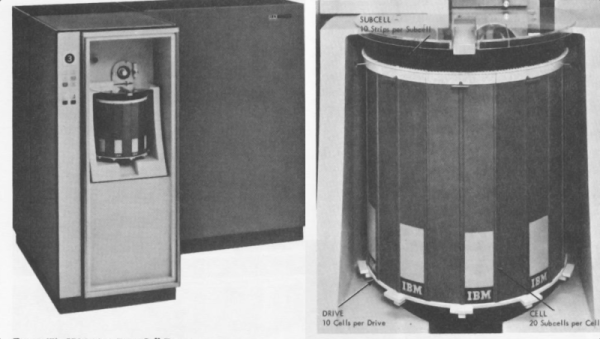
These days, mass storage for computers is pretty simple. It either uses a rotating disk or else it is solid state. There are a few holdouts using tape, too, but compared to how much there used to be, tape is all but dead. But it wasn’t that long ago that there were many kinds of mass storage. Tapes, disks, drums, punched cards, paper tape, and even stranger things. Perhaps none were quite so strange though as the IBM 2321 Data Cell drive — something IBM internally called MARS.

What is a data cell you might ask? A data cell was a mass storage device from IBM in 1964 that could store about 400 megabytes using magnetic strips that looked something like about a foot of photographic film. The strips resided inside a drum that could rotate. When you needed a record, the drum would rotate the strip you needed to the working part and an automated process would remove the strip in question, wrap it around a read/write head and then put it back when it was done.

Continue reading “Striping A Disk Drive The 1970 Way” →

Silence Of The IPods: Reflecting On The Ever-Shifting Landscape Of Personal Media Consumption

On October 23rd of 2001, the first Apple iPod was launched. It wasn’t the first Personal Media Player (PMP), but as with many things Apple the iPod would go on to provide the benchmark for what a PMP should do, as well as what they should look like. While few today remember the PMP trailblazers like Diamond’s Rio devices, it’s hard to find anyone who doesn’t know what an ‘iPod’ is.

Even as Microsoft, Sony and others tried to steal the PMP crown, the iPod remained the irrefutable market leader, all the while gaining more and more features such as video playback and a touch display. Yet despite this success, in 2017 Apple discontinued its audio-only iPods (Nano and Shuffle), and as of May 10th, 2022, the Apple iPod Touch was discontinued. This marks the end of Apple’s foray into the PMP market, and makes one wonder whether the PMP market of the late 90s is gone, or maybe just has transformed into something else.

After all, with everyone and their pet hamster having a smartphone nowadays, what need is there for a portable device that can ‘only’ play back audio and perhaps video?

Continue reading “Silence Of The IPods: Reflecting On The Ever-Shifting Landscape Of Personal Media Consumption” →

Hackaday Links Column Banner

Hackaday Links: May 15, 2022

It may be blurry and blotchy, but it’s ours. The first images of the supermassive black hole at the center of the Milky Way galaxy were revealed this week, and they caused quite a stir. You may recall the first images of the supermassive black hole at the center of the M87 galaxy from a couple of years ago: spectacular images that captured exactly what all the theories said a black hole should look like, or more precisely, what the accretion disk and event horizon should look like, since black holes themselves aren’t much to look at. That black hole, dubbed M87*, is over 55 million light-years away, but is so huge and so active that it was relatively easy to image. The black hole at the center of our own galaxy, Sagittarius A*, is comparatively tiny — its event horizon would fit inside the orbit of Mercury — a much closer at only 26,000 light-years or so. But, our black hole is much less active and obscured by dust, so imaging it was far more difficult. It’s a stunning technical achievement, and the images are certainly worth checking out.

Another one from the “Why didn’t I think of that?” files — contactless haptic feedback using the mouth is now a thing. This comes from the Future Interfaces Group at Carnegie-Mellon and is intended to provide an alternative to what ends up being about the only practical haptic device for VR and AR applications — vibrations from off-balance motors. Instead, this uses an array of ultrasonic transducers positioned on a VR visor and directed at the user’s mouth. By properly driving the array, pressure waves can be directed at the lips, teeth, and tongue of the wearer, providing feedback for in-world events. The mock game demonstrated in the video below is a little creepy — not sure how many people enjoyed the feeling of cobwebs brushing against the face or the splatter of spider guts in the mouth. Still, it’s a pretty cool idea, and we’d like to see how far it can go.

Continue reading “Hackaday Links: May 15, 2022” →