Ask Hackaday: Would A Scooter Get You Back To The Office?

So we’re two plus years into the pandemic at this point. Are you still working from home in the most comfortable clothes ever sewn? We figure that of the lot of you who said goodbye to that drab, tiled carpet in 2020, most have probably heard rumblings about returning to the office. And probably a good portion have at least been forced into a hybrid schedule.

Lots of companies would love to see their employees once again milling about all those glass and steel observation tanks office buildings they pay so much for. And while some are likely just forcing employees to come back, others are offering incentives, such as Google. The tech giant recently partnered with electric scooter manufacturer Unagi to provide a “Ride Scoot” program designed to lure many of Google’s US-based employees back to those brightly-colored code playgrounds they call offices with a fun mode of private transportation. The plan is to offer a full reimbursement of the monthly subscription fee for Unagi’s Model One folding scooter, which retails for $990.

The subscription is normally $49 a month plus a one-time $50 sign-up fee, but this amount will be slightly discounted (and waived) for eligible Google employees. There is one caveat to the system: an employee must use the scooter for a minimum of nine commutes to the office per month, although Google says they’re gonna be a bro about it and use the honor system.

Continue reading “Ask Hackaday: Would A Scooter Get You Back To The Office?” →

Movie Prop Electronics Hack Chat

Join us on Wednesday, April 20 at noon Pacific for the Movie Prop Electronics Hack Chat with Ben Eadie!

It wasn’t too long after the invention of cinema that the need for special effects became apparent. If you want to tell stories, especially the science fiction type of story, you need to build a plausible universe, including all the gadgets and gizmos within it. And so right from the start, propmakers and set designers have had the challenge of making things look futuristic using the technology of the present day.

join-hack-chatAll too often, the realities of budgets and time constraints have reduced this crucial world-building to an exercise in blinkenlights. But not always. Ben Eadie is a maker and inventor who works in the world of movie magic, specializing in props and practical effects. While he’s certainly as much in love with blinkenlights as any of us, there’s more than that to making a movie look good. He’ll stop by the Hack Chat to talk about how he incorporates electronics into his practical effect builds, and perhaps even reveal some of the movie magic for us.

Our Hack Chats are live community events in the Hackaday.io Hack Chat group messaging. This week we’ll be sitting down on Wednesday, April 20 at 12:00 PM Pacific time. If time zones have you tied up, we have a handy time zone converter.

Continue reading “Movie Prop Electronics Hack Chat” →

Mercury Thrusters: A Worldwide Disaster Averted Just In Time

The field of space vehicle design is obsessed with efficiency by necessity. The cost to do anything in space is astronomical, and also heavily tied to launch weight. Thus, any technology or technique that can bring those figures down is prime for exploitation.

In recent years, mercury thrusters promised to be one such technology. The only catch was the potentially-ruinous environmental cost. Today, we’ll look at the benefits of mercury thrusters, and how they came to be outlawed in short order.

Continue reading “Mercury Thrusters: A Worldwide Disaster Averted Just In Time” →

Hackaday Links Column Banner

Hackaday Links: April 17, 2022

There are plenty of stories floating around about the war in Ukraine, and it can be difficult to sort out which ones are fact-based, and which are fabrications. Stories about the technology of the war seem to be a little easier to judge, and so stories about an inside look at a purported Russian drone reveal a lot of interesting technical details. The fixed-wing UAV, reported to be a Russian-made “Orlan,” looks quite the worse for wear as it’s given a good teardown by someone wearing Ukraine military fatigues. In fact, it looks downright homemade, with a fuel tank made from what looks like an old water bottle, liberal use of duct tape to hold things together, and plenty of hot glue sprinkled around — field-expedient repairs, perhaps? The big find, though, is that the surveillance drone carried a rather commonplace — and cheap — Canon EOS Rebel camera. What’s more, the camera is nestled into a 3D printed cradle, strapped in with some hook-and-loop tape, and its controls are staked in place with globs of glue. It’s an interesting collection of hardware for a vehicle said to cost the Russian military something like $100,000 to field. The video below shows a teardown of a different Orlan with similar results, plus a lot of dunking on the Russians by a cheery bunch of Ukrainians.

Continue reading “Hackaday Links: April 17, 2022” →

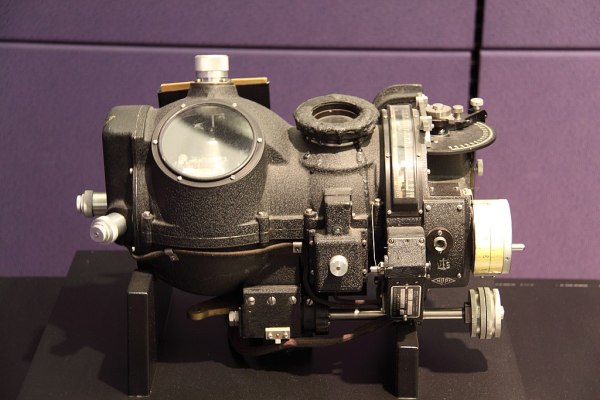
Less Is More — Or How To Replace A $25,000 Bomb Sight For 20 Cents

Depending on who you ask, the Norden bombsight was either the highest of high tech during World War II, or an overhyped failure that provided jobs and money for government contractors. Either way, it was super top secret in its day. It was also expensive. They cost about $25,000 each and the whole program came in at well over a billion dollars. The security was over the top. When not flying, the bombsight was removed from the plane and locked in a vault. There was a pyro device that would self-destruct the unit if it were in danger of being captured. So why did one of the most famous missions of World War II fly with the Norden replaced by 20 cents worth of machined metal? Good question.

You often hear the expression “less is more” and, in this case, it is an accurate idea. I frequently say, though, that “just enough is more.” In this case, though, less was actually just enough. There were three reasons that one famous mission in the Pacific theater didn’t fly the Norden. It all had to do with morale, technology, and secrecy.

Continue reading “Less Is More — Or How To Replace A $25,000 Bomb Sight For 20 Cents” →

Noor III Solar Tower of the Ouarzazate Power Station, at dusk. (Credit: Marc Lacoste)

The Future Of Energy Storage On Both Sides Of The Meter

That energy storage is a hot topic is hardly a surprise to anyone these days. Even so, energy storage can take a lot of different forms, some of which are more relevant to the utility provider (like grid-level storage), while others are relevant to business and home owners (e.g. whole-house storage), and yet other technologies live in this tense zone between utility and personal interest, such as (electric) vehicle-to-grid.

For utilities a lot of noise is being made about shiny new technologies, such as hydrogen-based storage, while home- and business owners are pondering on the benefits of relying solely on the utility’s generosity with feed-in tariffs, versus charging a big battery from the solar panels on the roof and using the produced power themselves. Ultimately the questions here are which technologies will indeed live up to their promises, and which a home owner may want to invest in.

Continue reading “The Future Of Energy Storage On Both Sides Of The Meter” →

Arming With An OS

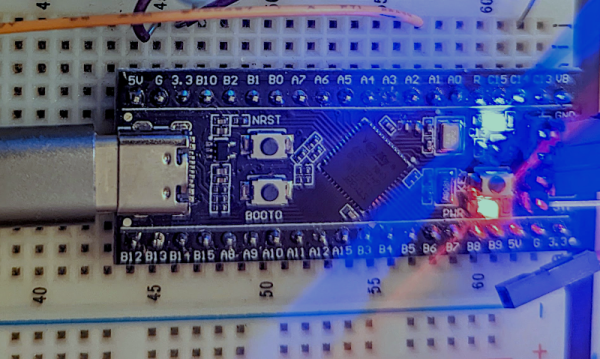
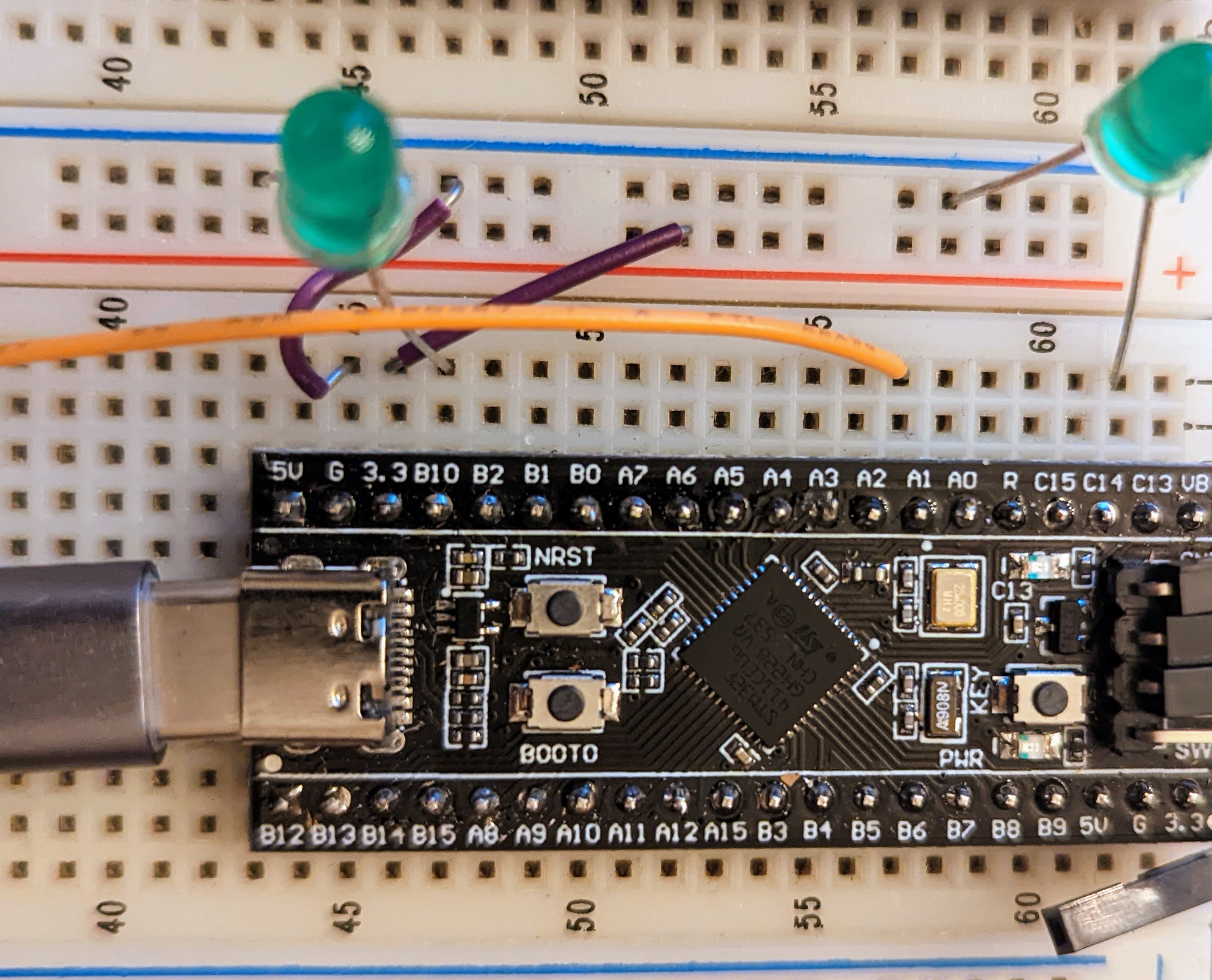
We see tons of projects with the infamous “Blue Pill” STM32 boards. They are cheap and plentiful and have a lot of great features, or at least they were before the chip shortage. I recently picked up a “Black Pill”, which is very similar but has an even more powerful processor. For a few bucks, you get an ARM CPU that can run at 100 MHz (but with USB, probably 96 MHz). There’s 512 kB of flash and 128 kB of RAM. There’s a USB type C port, and even a button and an LED onboard. The thing fits on a breadboard and you can program it with a cheap STLink dongle which costs about $10.

The Black Pill module on a breadboard.

Of course, you then have to consider the software. The STM32Cube stuff is a lot to set up and learn but it does let you do just about anything you can imagine. Then there is the STM32Duino plug-in that lets you use it as a beefy Arduino. That works and is easy enough to set up. However, there’s also Mbed. The only problem is that Mbed doesn’t work right out of the box. Turns out, though, it isn’t that hard to set up. I’ll show you how easy it is to get things going and, next time, I’ll show you a practical example of a USB peripheral that uses the mBed RTOS features.

First Steps

Obviously, you are going to need a Black Pill. There are at least two choices but for as cheap as they are there is little reason not to get the STM32F411 version that has more memory. The DIP form factor will fit in whatever breadboard you happen to have and a USB C cable will power the board so unless you are driving a lot of external circuitry, you probably don’t need an external supply.

Continue reading “Arming With An OS” →