Ask Hackaday: Is It Time For Waste Heat And Cold Area Heating To Shine?

It’s difficult to escape the topic of energy supply at the moment, with the geopolitical situation surrounding the invasion of Ukraine leaving the natural gas supply to an entire continent in jeopardy. Fortunately we’re watching the green shoots of an early spring here in the Northern hemisphere so the worst of the winter weather is behind us, but industrial customers can take no such solace from the season and will have to weather whatever price hikes are to come. Every alternative idea for energy supply is on the table, and with the parallel imperative of decarbonising the economy this goes beyond the short term into a future without so much need to rely on gas.

The Future is Cloudy

A district heating plant in Vienna, Austria.
A district heating plant in Vienna, Austria. Joadl, CC BY-SA 3.0 AT

A collaboration between a Finnish district heating network and Microsoft caught our eye because the location of a new data centre for the tech giant was chosen specifically to supply waste heat to the network, rather than releasing it to the environment. It’s not uncommon at all for European cities to use district heating networks but they are normally supplied by waste incinerators, boilers, or combined heat and power stations. The use of data centre waste heat is a novelty, as is in particular the siting of the data centre being dictated by the network.
Continue reading “Ask Hackaday: Is It Time For Waste Heat And Cold Area Heating To Shine?” →

Scientists Are Now Declaring New Species Via Photos And Video

Identifying new species is key to the work of zoologists around the world. It’s an exciting part of research into the natural world, and being the first to discover a new species often grants a scientists naming rights that can create a legacy of one’s work that lasts long into the future.

Traditionally, the work of taxonomy involved capturing and preserving an example of the new species. This is such that it could be classified properly and studied in detail by scientists working now and in the future. However, times are changing, and scientists are beginning to identify new species on the basis of videos and photos instead.

Continue reading “Scientists Are Now Declaring New Species Via Photos And Video” →

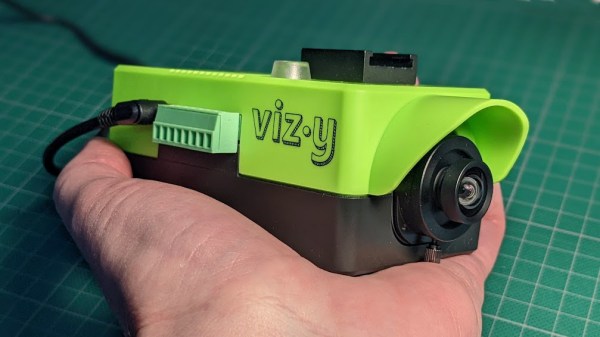
Camera held in hand

Review: Vizy Linux-Powered AI Camera

Vizy is a Linux-based “AI camera” based on the Raspberry Pi 4 that uses machine learning and machine vision to pull off some neat tricks, and has a design centered around hackability. I found it ridiculously simple to get up and running, and it was just as easy to make changes of my own, and start getting ideas.

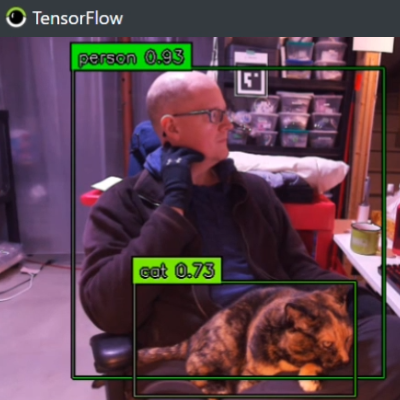
Person and cat with machine-generated tags identifying them
Out of the box, Vizy is only a couple lines of Python away from being a functional Cat Detector project.

I was running pre-installed examples written in Python within minutes, and editing that very same code in about 30 seconds more. Even better, I did it all without installing a development environment, or even leaving my web browser, for that matter. I have to say, it made for a very hacker-friendly experience.

Vizy comes from the folks at Charmed Labs; this isn’t their first stab at smart cameras, and it shows. They also created the Pixy and Pixy 2 cameras, of which I happen to own several. I have always devoured anything that makes machine vision more accessible and easier to integrate into projects, so when Charmed Labs kindly offered to send me one of their newest devices, I was eager to see what was new.

I found Vizy to be a highly-polished platform with a number of truly useful hardware and software features, and a focus on accessibility and ease of use that I really hope to see more of in future embedded products. Let’s take a closer look.

Continue reading “Review: Vizy Linux-Powered AI Camera” →

Mothballing Rosalind: How To Put A Space Mission In Storage

In planetary exploration circles, Mars has quite a bad reputation. The Red Planet has a habit of eating spacecraft sent there to explore it, to the degree that nearly half of the missions we’ve thrown at it have failed in one way or another. The “Mars Curse” manifests itself most spectacularly when landers fail to negotiate the terminal descent and new billion-dollar craters appear on the Martian regolith, while some missions meet their doom en route to the planet, and an unlucky few have even blown up on the launchpad.

But the latest example of the Mars Curse, the recent cancellation of the second half of the ExoMars mission, represents a new and depressing failure mode: war — specifically the Russian invasion of Ukraine. The international outrage over the aggression resulted in economic sanctions and diplomatic isolation of Russia, which retaliated by ending its partnership with the European Space Agency (ESA), depriving the mission of its launch vehicle and dooming the mission that would have landed the rover Rosalind Franklin on Oxia Planum near the Martian Equator in 2023.

While there’s still a chance that administrators and diplomats will work things out, chances are slim that it will be in time for the narrow launch window that the mission was shooting for in September of 2022. That means the Rosalind Franklin, along with all the other flight hardware that was nearly ready to launch, will have to be put in storage at least until the next launch window opens in 2024. That begs the question: how does one put a complex spacecraft into storage? And could such mothballing have unintended consequences for the mission when it eventually does fly?

Continue reading “Mothballing Rosalind: How To Put A Space Mission In Storage” →

Hackaday Links Column Banner

Hackaday Links: April 10, 2022

A funny thing happened on the way to the delta. The one on Jezero crater on Mars, that is, as the Perseverance rover may have captured a glimpse of the parachute that helped deliver it to the Red Planet a little over a year ago. Getting the rover safely onto the Martian surface was an incredibly complex undertaking, made all the more impressive by the fact that it was completely autonomous. The parachute, which slowed the descent vehicle holding the rover, was jettisoned well before the “Sky Crane” deployed to lower the rover to the surface. The parachute wafted to the surface a bit over a kilometer from the landing zone. NASA hasn’t confirmed that what’s seen in the raw images is the chute; in fact, they haven’t even acknowledged the big white thing that’s obviously not a rock in the picture at all. Perhaps they’re reserving final judgment until they get an overflight by the Ingenuity helicopter, which is currently landed not too far from where the descent stage crashed. We’d love to see pictures of that wreckage.

Continue reading “Hackaday Links: April 10, 2022” →

The Virtue Of Wires In The Age Of Wireless

We ran an article this week about RS-485, a noise resistant differential serial multidrop bus architecture. (Tell me where else you’re going to read articles like that!) I’ve had my fun with RS-485 in the past, and reading this piece reminded me of those days.

You see, RS-485 lets you connect a whole slew of devices up to a single bundle of Cat5 cable, and if you combine it with the Modbus protocol, you can have them work together in a network. Dedicate a couple of those Cat5 lines to power, and it’s the perfect recipe for a home, or hackerspace, small-device network — the kind of things that you, and I, would do with WiFi and an ESP8266 today.

Wired is more reliable, has fewer moving parts, and can solve the “how do I get power to these things” problem. It’s intrinsically simpler: no radios, just serial data running as voltage over wires. But nobody likes running cable, and there’s just so much more demo code out there for an ESP solution. There’s an undeniable ease of development and cross-device compatibility with WiFi. Your devices can speak directly to a computer, or to the whole Internet. And that’s been the death of wired.

Still, some part of me admires the purpose-built simplicity and the bombproof nature of the wired bus. It feels somehow retro, but maybe I’ll break out some old Cat5 and run it around the office just for old times’ sake.

Remoticon 2021 // Rob Weinstein Builds An HP-35 From The Patent Up

Fifty years ago, Hewlett-Packard introduced the first handheld scientific calculator, the HP-35. It was quite the engineering feat, since equivalent machines of the day were bulky desktop affairs, if not rack-mounted. [Rob Weinstein] has long been a fan of HP calculators, and used an HP-41C for many years until it wore out. Since then he gradually developed a curiosity about these old calculators and what made them tick. The more he read, the more engrossed he became. [Rob] eventually decided to embark on a three year long reverse-engineer journey that culminated a recreation of the original design on a protoboard that operates exactly like the original from 1972 (although not quite pocket-sized). In this presentation he walks us through the history of the calculator design and his efforts in understanding and eventually replicating it using modern FPGAs.

The HP patent ( US Patent 4,001,569 ) contains an extremely detailed explanation of the calculator in nearly every aspect. There are many novel concepts in the design, and [Rob] delves into two of them in his presentation. Early LED devices were a drain on batteries, and HP engineers came up with a clever solution. In a complex orchestra of multiplexed switches, they steered current through inductors and LED segments, storing energy temporarily and eliminating the need for inefficient dropping resistors. But even more complicated is the serial processor architecture of the calculator. The first microprocessors were not available when HP started this design, so the entire processor was done at the gate level. Everything operates on 56-bit registers which are constantly circulating around in circular shift registers. [Rob] has really done his homework here, carefully studying each section of the design in great depth, drawing upon old documents and books when available, and making his own material when not. For example, in the course of figuring everything out, [Rob] prepared 338 pages of timing charts in addition to those in the patent. Continue reading “Remoticon 2021 // Rob Weinstein Builds An HP-35 From The Patent Up” →