Slot Machine Has A Handle On Fun

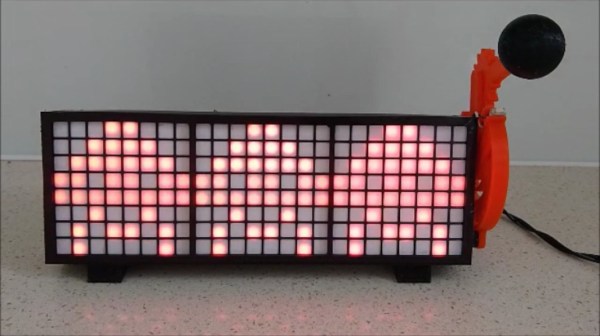
For some reason, when slot machines went digital, they lost their best feature — the handle. Who wants to push a button on a slot machine, anyway? Might as well just play video poker. [John Bradnam] seems to agree, and has built an open-source three-color matrix slot machine complete with handle.

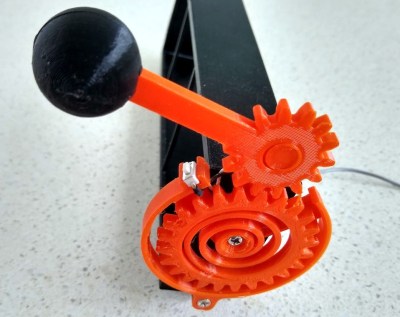
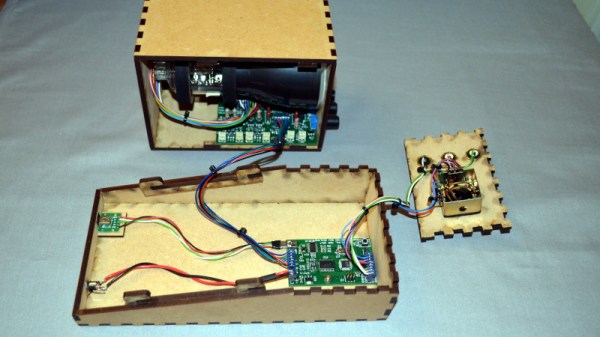
In this case, you’ll be losing all of your nickels to an Arduino Pro Mini. The handle is an upgrade to an earlier slot machine project that uses three 8×8 matrices and a custom driver board. When the spring-loaded handle is pulled, it strikes a micro switch to spins the reels and then snaps back into place. Between each pull, the current score is displayed across the matrix. There’s even a piezo buzzer for victory squawks. We only wish the button under the handle were of the clickier variety, just for the feels. Check out the short demo video after the break.
If you’re not a gambler, you could always turn your slot machine into a clock.

Continue reading “Slot Machine Has A Handle On Fun”

Clone Console Cribs Ben Heck’s Classic SNES Caché

“I don’t get mad when people rip me off. I actually think its kinda cool, because imitation is the sincerest form of flattery.” — Ben Heckendorn

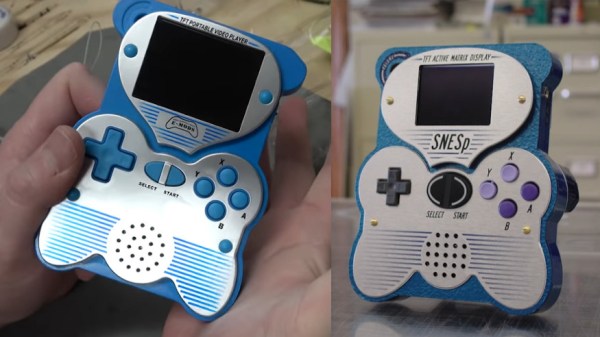
For some “hacking things together” can mean heavily borrowing from other’s work in order to make a new, derivative work. Though longtime hardware hacker, Ben Heckendorn, didn’t expect one of his early SNES handheld projects to become the inspiration for a Famicom-style clone console. There have been a number of clone consoles available online for years, and all have been made to varying levels of build quality. The subject clone console in question is called the Easegmer 12-bit Retro Console, so [Ben] decided to record his teardown of the handheld borrowing from his original design. (Video, embedded below.)

The Easegmer handheld has a “surprising” list of features according to its packaging including: sports games, logic games, memoyr games, USB charger management, double power supply option, and dirunal double backlight option. All big (and slightly misspelled) promises though the most egregious claim has to be that, “No violent games, your child’s body and mind get full exercise.”. The statement may have a modicum of truth to it, except for the fact that game 84 of 220 is literally named “Violent”. Dunking aside, the handheld does feature a standard size rechargeable battery in addition to the option of powering the device with three AAA batteries. There’s even a “fun size” screwdriver and a few replacement screws included which is more than you can say for most modern electronics.

It has been almost twenty years after [Ben] originally published his SNES portable project on his website. So as a long awaited follow-up, [Ben] plans to make a “meta-portable”. This meta portable will start with the Adobe Illustrator files he kept from that SNES portable in 2001 and incorporate pieces of the Easegmer clone console. Thus spawning a new clone of the clone of his clone…or whatever that project ends up being its sure to be worth repeating.

Continue reading “Clone Console Cribs Ben Heck’s Classic SNES Caché”

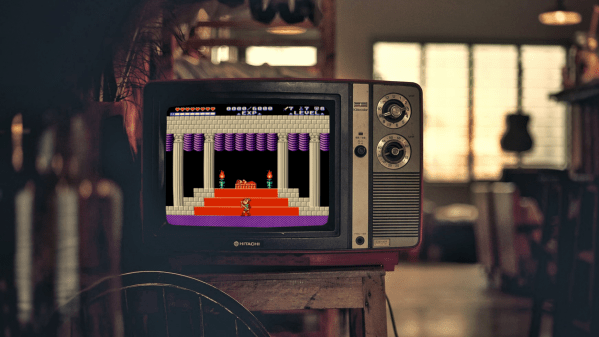
Zelda II Redux CRT Header Image

Zelda II Redux ROM Hack Plays How You Remember The Original

Going back to classic games can be a difficult experience. The forward passage of time leaves technology to stagnate, while the memories attached to those old games can morph in mysterious ways. Therein lies the problem with how you remember a game playing versus the reality of how it actually does. Developer [Jorge] saw that situation arising around Zelda II: The Adventure of Link, and it inspired him to create the Zelda II Redux ROM hack.

Years in the making, Zelda II Redux takes a relatively light-handed approach to revising the original NES game. Graphical enhancements include: a reworked HUD complete with the series’ tradition of hearts, animated enemy icons in the over world, a new title screen, and giving Link the shield from the Famicom Disk System release’s box art. Text speed has been increased and a revised translation of the Japanese script has been incorporated. Under the hood, all sorts of boss battles have been re-balanced while casting magic spells doesn’t require multiple return trips to the pause menu. Though Zelda II Redux’s most important feature may be the inclusion of manual saving via “Up + A” on the pause menu. There are also a whole host of other changes Zelda II Redux incorporates in order to bring Link’s second adventure more inline with the rest of the Legend of Zelda series that can be found on the project’s change log.

To play Zelda II Redux requies an IPS patching program, like LunarIPS, along with a clean dumped image of Zelda II: The Adventure of Link. Dumping NES cartridges is easier than ever these days due to many cartridge dumper devices being plug-and-play over USB. A successfully patched ROM file can be played in an emulator or on actual NES hardware through a flash cart. A video of a tool-assisted speedrun has been included below, so there may be some new strategies to employ.
Continue reading “Zelda II Redux ROM Hack Plays How You Remember The Original”

Building A Vector Graphics Machine From Scratch Including The CRT

Over the years we’ve seen quite a few projects involving vector graphics, but the spaceship game created by [Mark Aren] especially caught our eye because in it he has tackled building a vector display from scratch rather than simply using a ready-made one such as an oscilloscope. As if the vector game itself wasn’t interesting enough, the process of designing the electronics required to drive a CRT is something that might have been commonplace decades ago but which few electronics enthusiasts in 2020 will have seen.

In his write-up he goes into detail on the path that took him to his component choices, and given the unusual nature of the design for 2020 it;s a fascinating opportunity to see the job done with components that would have been unheard of in the 1950s or 1960s. He eventually settled on a high voltage long-tailed pair of bipolar transistors, driven by a single op-amp to provide the differential signal required by the deflection electrodes. The mix of old and new also required a custom-fabricated socket for the CRT. On the game side meanwhile, an ATmega328 does the heavy lifting, through a DAC. He goes into some detail on DAC selection, having found some chips gave significant distortion.

All in all this is an impressive project from all angles, and we’re bowled over by it. Of course, if you fancy a play with vector graphics, perhaps there’s a simpler way.

Chess Computer Retires To Play Jazz

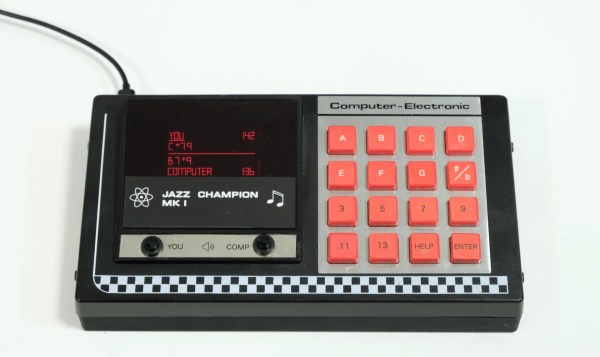
Years ago, [Leo Neumann]’s girlfriend gave him a 1970s chess computer game that was missing almost everything but the super cool clicky keyboard. Noting the similarity of chess move labeling to chord notation, [Leo] decided to turn it into something even nerdier — a jazz chord game where you jam with the computer.

To play the game, you and the computer take turns entering jazz chords that progress musically from the last one played. The hardware is simple — a Raspberry Pi Zero and a WM8960 audio hat with amplifier in speakers. [Leo] also put in a slightly larger display than the original and printed a new bottom half for the case. We love the look of this build, especially the groovy custom line font [Leo] designed.

On the software side, [Leo] made a Python prototyping environment using PYO Module and Kivy UI. Not content with other approaches to tonal consonance, [Leo] played a couple thousand chords and rated them according to their progressive harmony. Shake out those jazz hands and check it out after the break.

Want to play chess with computers? Make Alexa your go-between.

Continue reading “Chess Computer Retires To Play Jazz”

Cornhole Boards Play Victory Songs

How do you instantly make any game better? By lighting it up and playing at night. We would normally say ‘drinking’, but we’re pretty sure that drinking is already a prerequisite for cornhole — that’s the game where you toss bean bags at holes in angled boards.

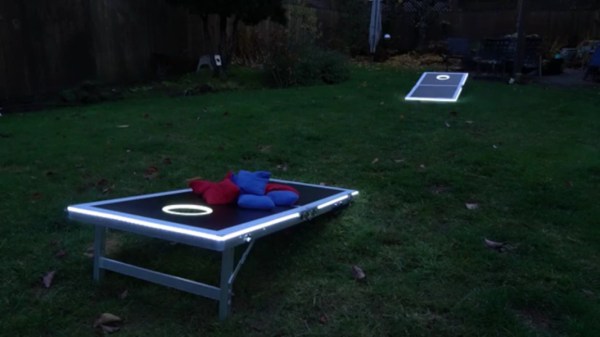
[Hardware Unknown] loves cornhole, and was gifted a set of portable, folding boards that light up around the ring for nighttime action. These turned out to be the perfect basis for reactive boards that light up and play sound whenever points are scored. Both boards have a vibration sensor to detect bags hitting the top, and an IR break-beam sensor pair across the hole. An Arduino Nano reads from the sensors and controls an amplifier and a DF Player for sound.

Players get a point and a song for landing a bag on top of the board, and three points and a different song for making it in the hole. We love the Easter egg — anyone who manages to trip both the vibration sensor and the break-beam detector at the same time will be treated to the sound of a flock of honking geese. Check out the build journey after the break.

No good at cornhole? This one doesn’t let you miss.

Continue reading “Cornhole Boards Play Victory Songs”

The Most Annoying Among Us Tasks Created In Real Life

Among Us is a hit game of deception and intrigue. Those who have played it know the frustration of trying to complete some of the intentionally difficult tasks onboard the Skeld. [Zach Freedman] decided to recreate some of these in real life.

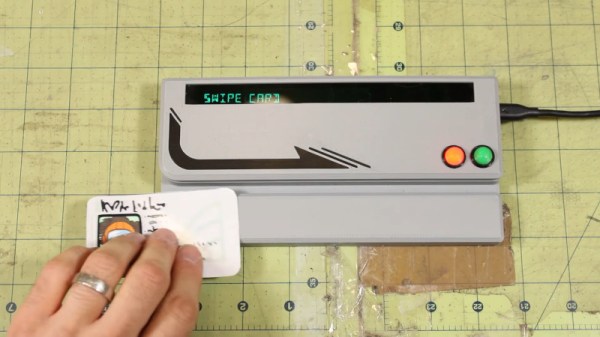
[Zach] built what are arguably the three most frustrating tasks from the game. There’s the excruciatingly slow upload/download station built out of an old Samsung tablet and an NFC tag, and the reactor start console created using a Raspberry Pi 3B, Teensy 3.2, and a custom mechanical keyboard. But perhaps most annoying of all is the infamous card reader. Built with another Teensy, it requires the user to swipe their ID card at just the right speed, except that speed is randomly generated for every swipe. Also, the machine fails 20% of good swipes just because. Perhaps what we love most is the way [Zach] recreated the classic VFD look by putting an OLED display behind bottle-green plastic and using a 14-segment font.

It’s a fun homage to a wildly successful indie game, and we could imagine these props would be a hit at a makerspace party. We’ve featured other Among Us themed builds before, too. Video after the break.

Continue reading “The Most Annoying Among Us Tasks Created In Real Life”