Friday Hack Chat: Control Schemes For Robotics

The Hackaday Prize is in full swing if you haven’t heard. It’s the Academy Awards of Open hardware, and the chance for you — yes, you — to create the next great piece of hardware and a better future for everyone. Right now, we’re in the Robotics Module Challenge portion of the prize. This is your chance to build a module that could be used in robotics projects across the world! Show off your mechatronic skills and build a robotics module that’s transferable to other builds!
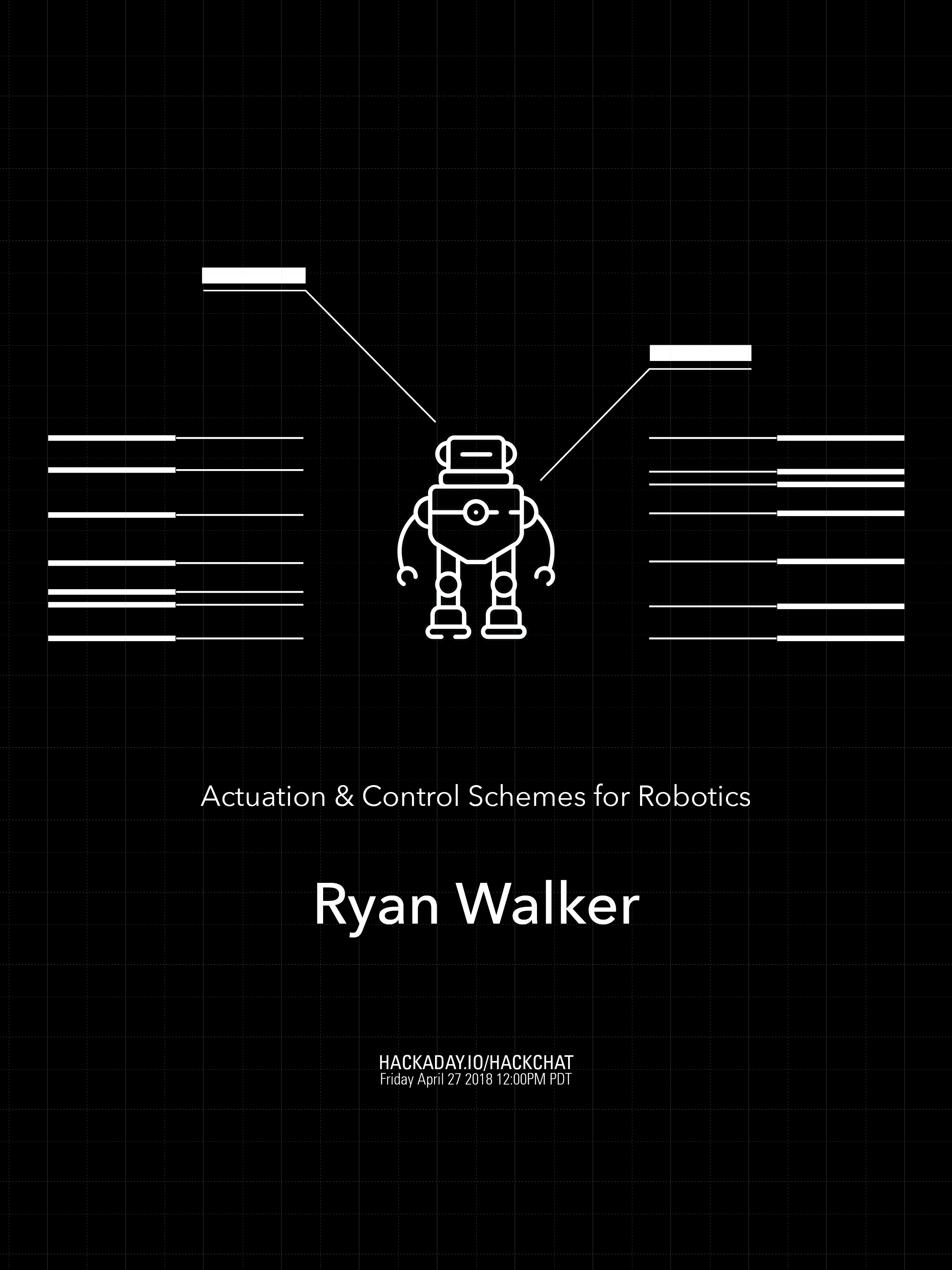
Not coincidentally, for this week’s Hack Chat, we’re talking all about Robotics Modules. We’re taking a deep dive into actuation and control schemes for robotics, and you’re invited to take part. Everyone wants affordable robotics, and stepper and servo motors are no longer the domain of high-budget industrial robots. Everyone can build a robot, but how do you do that? That’s what we’re going to find out this Friday in the Hack Chat!

Our guest for this week’s Hack Chat is [Ryan Walker]. He holds a diploma in Mechatronics and Robotics from BCIT. He’s worked on everything from prosthetics to industrial automation, and his current hobbies include designing and building control algorithms that drive electronics and enable cheap hardware to excel! If you want to learn about robotics, this is the Hack Chat for you.

In this chat, we’ll be talking about:

  • Control schemes
  • How to actuate your projects
  • Wheels, tweels, and ways to make your project move
  • Automating robotics

You are, of course, encouraged to add your own questions to the discussion. You can do that by leaving a comment on the Hack Chat Event Page and we’ll put that in the queue for the Hack Chat discussion.join-hack-chat

Our Hack Chats are live community events on the Hackaday.io Hack Chat group messaging. This week is just like any other, and we’ll be gathering ’round our video terminals at noon, Pacific, on Friday, April 27th.  Here’s a clock counting down the time until the Hack Chat starts.

Click that speech bubble to the right, and you’ll be taken directly to the Hack Chat group on Hackaday.io.

You don’t have to wait until Friday; join whenever you want and you can see what the community is talking about.


Robotics Module Challenge: Build Robot, Win Prizes

Brand new today, we’re going to go all in with the Robotics Module Challenge! This is the newest part of the 2018 Hackaday Prize which is only six weeks old, and already we’ve seen almost six hundred incredible entries. But a new challenge means a fresh start and a perfect time for you to begin your entry.

This is your call to build a module that can be used in robotics projects across the world. Twenty module designs will be awarded $1,000 and and chance at the five top prizes including the $50,000 grand prize!

Robotics is the kitchen sink of the world of electronics. You have to deal with motors, sensors, spinny lidar doohickies, computer vision, mechatronics, and unexpected prototyping issues accounting for the coefficient of friction of 3D printed parts. Robotics is where you show your skills, and this is your chance to show the world what you’ve got.

Wouldn’t it be great if there were some more ways to skip around the hard parts? That is the Robotics Module Challenge in a nutshell. We want to see great modular Open Hardware designs that can be used by roboticists all over the world. This might be a motor controller, a chassis or limb design system, a sensor network scheme, a communications system, data collection and delivery — basically anything related to robotics. Build a prototype that shows how your module is used and document all the info needed to incorporate and riff on your design in other robot builds.

Start your entry now and show us your take on a great bit of Open Hardware.

Continue reading “Robotics Module Challenge: Build Robot, Win Prizes”

Hackaday Links Column Banner

Hackaday Links: April 22, 2018

Eagle 9 is out. Autodesk is really ramping up the updates to Eagle, so much so it’s becoming annoying. What are the cool bits this time? Busses have been improved, which is great because I’ve rarely seen anyone use busses in Eagle. There’s a new pin breakout thingy that automagically puts green lines on your pins. The smash command has been overhauled and now moving part names and values is somewhat automatic. While these sound like small updates, Autodesk is doing a lot of work here that should have been done a decade ago. It’s great.

Crypto! Bitcoin is climbing up to $9,000 again, so everyone is all-in on their crypto holdings. Here’s an Arduino bitcoin miner. Stats of note: 150 hashes/second for the assembly version, and at this rate you would need 10 billion AVRs to mine a dollar a day. This array of Arduinos would need 2 Gigawatts, and you would be running a loss of about $10 Million per day (minus that one dollar you made).

Are you going to be at Hamvention? Hamvention is the largest amateur radio meetup in the Americas, and this year is going to be no different. Unfortunately, I’ll be dodging cupcake cars that weekend, but there is something of note: a ‘major broadcaster’ is looking for vendors for a ‘vintage tech’ television series. This looks like a Canadian documentary, which adds a little bit of respectability to this bit of reality television (no, really, the film board of Canada is great). They’re looking for weird or wacky pieces of tech, and items that look unique, strange, or spark curiosity. Set your expectations low for this documentary, though; I think we’re all several orders of magnitude more nerd than what would be interesting to a production assistant. ‘Yeah, before there were pushbutton phones, they all had dials… No, they were all attached to the wall…”

The new hotness on Sparkfun is a blinky badge. What we have here is a PCB, coin cell holder, color changing LED, and a pin clasp. It’s really not that different from the Tindie Blinky LED Badge. There is, however, one remarkable difference: the PCB is multicolored. The flowing unicorn locks are brilliant shades of green, blue, yellow, pink, purple, and red. How did they do it? We know full-color PCBs are possible, but this doesn’t look like it’s using a UV printer. Pad printing is another option, but it doesn’t look like that, either. I have no idea how the unicorn is this colorful. Thoughts?

Defcon is canceled, but there’s still a call for demo labs. They’re looking for hackers to show off what they’ve been working on, and to coax attendees into giving feedback on their projects.

Fail Of The Week: The Spot Welder Upgrade That Wasn’t

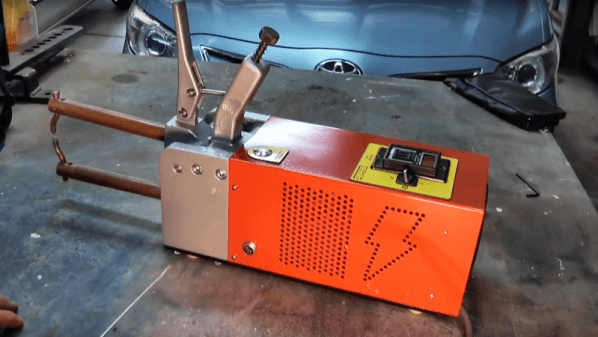
Even when you build something really, really nice, there’s always room for improvement, right? As it turns out for this attempted upgrade to a DIY spot welder, not so much.

You’ll no doubt recall [Mark Presling]’s remarkably polished and professional spot welder build that we featured some time ago. It’s a beauty, with a lot of thought and effort put into not only the fit and finish but the function as well. Still, [Mark] was not satisfied; he felt that the welder was a little underpowered, and the rewound microwave oven transformer was too noisy. Taking inspiration from an old industrial spot welder, he decided to rebuild the transformer by swapping the double loop of battery cable typically used as a secondary with a single loop of thick copper stock. Lacking the proper sized bar, though, he laminated multiple thin copper sheets together before forming the loop. On paper, the new secondary’s higher cross-sectional area should carry more current, but in practice, he saw no difference in the weld current or his results. It wasn’t all bad news, though — the welder is nearly silent now, and the replaced secondary windings were probably a safety issue anyway, since the cable insulation had started to melt.

Given [Mark]’s obvious attention to detail, we have no doubt he’ll be tackling this again, and that he’ll eventually solve the problem. What suggestions would you make? Where did the upgrade go wrong? Was it the use of a laminated secondary rather than solid bar stock? Or perhaps this is the best this MOT can do? Sound off in the comments section.

Continue reading “Fail Of The Week: The Spot Welder Upgrade That Wasn’t”

Life On Contract: Lowering Your Cost Without Dropping Your Price

Last time in Life on Contract, I discussed ways to figure out a starting point on how much to charge for your services. However, sometimes you and a client may wish to work together but for some reason they cannot (or do not wish to) pay what you have decided to charge. If you are inexperienced, it can be tempting to assume you have overpriced yourself and discount down to what they are willing to pay. But if your price is a number you have chosen for reasons you can explain, dropping it is not something you should do unless you have thought about it carefully.

Instead of just agreeing to do the same work but for less money, it is often possible to offer a lower overall cost without cheapening the value of your work. I’ll share a process I use to find opportunities to make this happen.

It Should be Win-Win, Not Hard Sell

The best case scenario is a client wants your service, your cost is within their budget, and everyone agrees to work together. Tragically, the process isn’t always that smooth. If cost is an issue, the alternative to lowering your price is to fine-tune what you provide to better fit the actual needs. To do that, you will need two things:

  1. A detailed understanding of your own time and costs for the work.
  2. Knowledge of what things your client considers most important.

By intimately knowing your own costs, you can figure out where to make savings without scrimping on the things your client considers important.
Continue reading “Life On Contract: Lowering Your Cost Without Dropping Your Price”

Mechanisms: Hook And Loop Fasteners

As a species, we’ve done a pretty good job at inventing some useful devices. But as clever as we think we are, given sufficient time, natural selection will beat us at our game at almost every turn. So it makes sense that many of our best inventions are inspired by nature and the myriad ways life finds to get DNA from one generation to the next.

Hook and loop fasteners are one such design cribbed from nature, and the story behind this useful mechanism is a perfect example that a prepared mind, good observation skills, and a heck of a lot of perseverance are what it takes to bring one of Mother Nature’s designs to market.

Editor’s Note: As some predicted in the comments section, we were contacted by representatives of Velcro Companies and asked to change all mentions in this article to either VELCRO® Brand Fastener or to use the generic “Hook and Loop” term. If it seems weird that we’re calling this hook and loop, now you know why.

Continue reading “Mechanisms: Hook And Loop Fasteners”

When Hackerspace Directors Burn Out

A friend of mine once suggested that there should be a support group for burned-out former hackerspace directors. We could have our own Village of the Damned at summer camps, where we’d sit moodily in the gathering twilight sipping our bourbon and Club Mate and decrying whatever misfortunes came to our space to leave such visible mental scars, or gazing hollow-eyed into the laser-tinged haze and moving gently to the pulse of the chiptune music. “See that’s Jenny over there, she don’t say much“. Hackerspace noir, where the only entry criterion is being crazy enough to stand for election to your space’s board.

You can tell [Dr. Seuss] is thinking about his next volume: <em>How The Grinch Stole Whoville Hackspace</em>. Al Ravenna, World Telegram [Public domain].
You can tell [Dr. Seuss] is thinking about his next volume: How The Grinch Stole Whoville Hackspace. Al Ravenna, World Telegram [Public domain].
There must be spaces somewhere that live in such perfect harmony, in which a happy membership support a board for whom everything falls into place. Maybe the makerspace in [Dr. Seuss]’s Whoville would have that kind of atmosphere, but the reality of life is that every group is made up of both Grinch and Who. Keeping a diverse group of people harmonious is a huge challenge, but that’s what hackerspaces are really about — the people make the space.

There are several defined periods in the gestation of a hackerspace, and at least from where I’m sitting they relate to its member count. Some spaces pass through them all as they grow, while others are lucky enough to reach an equilibrium and spare themselves some of the drama.

If you recognise yourselves in some of the following then you have my commiserations, while if your space hasn’t got there yet or has managed to dodge some of the bullets then consider yourselves lucky.

Continue reading “When Hackerspace Directors Burn Out”