Friday Hack Chat: Mechanical Manufacturing

Join [Sylvia Wu], a Senior Manufacturing Engineer at Fictiv, for this week’s Hack Chat. [Sylvia’s] work at Fictiv gives her a unique viewpoint for modern manufacturing. The company connects engineers with rapid manufacturing by taking in a design and routing it to a shop that has the tools and time to fabricate the part quickly. This means seeing the same silly mistakes over and over again, but also catching the coolest new tricks as they pass by. She also spends time tearing apart consumer products to see how they have been manufactured, adding to their arsenal of available processes, both time-tested and newfangled.

Anyone interested manufacturing needs to get in on this Hack Chat. Mark your calendar for this Friday, 3/10 at noon PST (20:00 UTC)

Here’s How To Take Part:

join-hack-chatOur Hack Chats are live community events on the Hackaday.io Hack Chat group messaging.

Log into Hackaday.io, visit that page, and look for the ‘Join this Project’ Button. Once you’re part of the project, the button will change to ‘Team Messaging’, which takes you directly to the Hack Chat.

You don’t have to wait until Friday; join whenever you want and you can see what the community is talking about.

Upcoming Hack Chats

On Friday March 17th the Hack Chat features chip design for oscilloscopes with engineers from Keysight.

Saved By The Bel — Understanding Decibels

If you’ve hung around electronics for any length of time, you’ve surely heard of the decibel (often abbreviated dB). The decibel is a measure of a power ratio. Actually, the real measure is a bel, but you almost never see that in practice. If you are versed in metric, you won’t be surprised to learn a decibel is 1/10 of a bel. Sometimes in electronics, we deal with really large ratios, so the decibel is logarithmic to cope with this. Doubling the number of decibels doesn’t double the ratio, as you will soon see. It’s all about logarithms, and this ends up being extremely useful when measuring something like antenna or amplifier gain.

Besides antennas, decibels are often used to measure sound and light. The reason is that human ears and eyes have a logarithmic response to those quantities. Your ear, for example, has a huge dynamic range. That is to say, you can hear a whisper or a space shuttle launch. That ratio is about 1 trillion to 1, but that’s only 120 dB. This is also why potentiometers made for volume controls have a logarithmic taper. A linear pot would seem off because, for example, a tenth of a turn at one extreme will affect the apparent volume much more than a tenth of a turn at the other extreme. This holds true whether or not those knobs go up to eleven.

Continue reading “Saved By The Bel — Understanding Decibels”

Los Angeles Hackaday Unconference Happening On 3/18

Reserve your spot at the Los Angeles Hackaday Unconference on Saturday, March 18th. The Hackaday community is huge in LA and this event will fill up, so don’t delay.

The Unconference is a unique opportunity to decide the course of the day as it happens. Everyone who attends should be ready to stand and deliver at least eight minutes on a topic they find exciting right now. The energy this creates is the key to a level of involvement that can’t be matched at traditional conferences that have a divide between those presenting and those attending.

LA Joins Chicago and San Francisco

This announcement of the Los Angeles Hackaday Unconference joins two others happening the same day. Last week we announced San Francisco as a host location and the event is now full… but anyone in the area should still get their name on the waiting list. Four days ago we announced Chicago as the second location and that event will likely reach capacity today. [Shulie Tornel] and [Jasmine Brackett] are organizing things at the LA event which is being held at the Supplyframe Design Lab from 1 – 8 pm on 3/18.

Build Something that Matters

You can speak on any topic you want, but sometimes having a theme helps to get the ideas flowing. When considering your topic, keep Build Something that Matters in mind. Have you been looking into a technology, project, or idea that can make life a little (or a lot) better for the world? That would be an exquisite topic.

At the beginning of the day we’ll go around the room and get the talk title or subject from everyone there, then as a group we’ll hammer out a schedule for the day. As presentations progress, we encourage new impromptu talks to spring up, and can even split those off into a second talk space or discussion group. We’ll have food and drink on hand, as well as some interesting hardware to give out as door prizes.

The Hackaday Unconference is the ultimate idea and energy exchange in a crowd of your peers. You’ll have a hard time finding a cooler way to spend a Saturday this year. See you there!

Ask Hackaday: How Should Hackers Handle IP Agreements?

My buddy Harold recently landed a new job at a great technology company. It came at a perfect time for him, having just been laid off from the corporate behemoth where he’d toiled away as an anonymous cog for 19 years. But the day before he was to start, the new company’s HR folks sent him some last-minute documents to sign. One was a broad and vaguely worded non-compete agreement which essentially said he was barred from working in any related industry for a year after leaving the company.

Harold was tempted not to sign, but eventually relented because one needs to put food on the table. Thankfully he’s now thriving at the new company, but his experience got me thinking about all the complications hackers face with the day jobs that so many of us need to maintain. Non-competes and non-disclosures are bad enough, but there’s one agreement that can really foul things up for a hacker: the Intellectual Property Agreement.

Continue reading “Ask Hackaday: How Should Hackers Handle IP Agreements?”

Record Players Explained For The Streaming Generation

How do you consume your music, these days? Aside from on the radio, that is. Do you play MP3 or other files on your phone and computer, or perhaps do you stream from an online service? If you’re really at the cutting edge though you’ll do none of those things, because you’ll be playing it on vinyl.

The legendary Technics SL1200 direct-drive turntable, as used by countless DJs. Dydric [CC BY-SA 2.5)], via Wikimedia Commons.
The legendary Technics SL1200 direct-drive turntable, as used by countless DJs. Photo by Dydric CC-BY-SA 2.5
A few years ago reporting on a resurgence of sales of vinyl records was something you would never have expected to see, but consumer tastes are unpredictable. Our red-trousered and extravagantly bearded hipster friends have rediscovered the glories of the format, and as a result it’s popping up everywhere. For those of us who are old enough to have genuinely been into the format before it was cool again, the sight of Sergeant Pepper and Led Zeppelin II on 12″ at outrageous prices on a stand at the local supermarket is a source of amusement. It’s good to see your first love back in vogue again, but is it really the £20($25) per album kind of good?

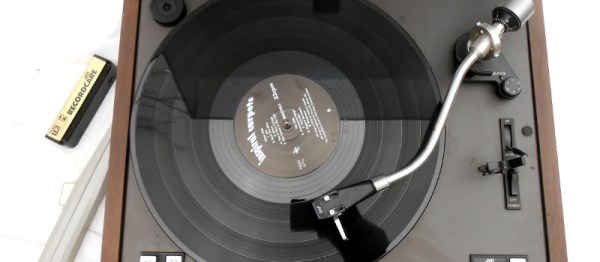
With the turntable having disappeared as an integral part of the typical hi-fi setup the new vinyl enthusiast is faced with a poor choice of equipment. Often the best available without spending serious money at an audiophile store is a USB device with the cheapest possible manufacture, from which the playback will be mediocre at best. We’ve lost the body of collective knowledge about what makes a good turntable to almost thirty years of CDs and MP3s, so perhaps it’s time for a quick primer.

Continue reading “Record Players Explained For The Streaming Generation”

Chicago To Host Hackaday Unconference

We’re excited to announce that Chicago will play host to the Hackaday Unconference on March 18th. We are happy to expand our unconference plans to include this event at Pumping Station One from 1-8pm on 3/18.

Astute readers will notice that this is the second location we have announced this week. On Monday we shared the news that San Francisco would host an unconference. Hackaday’s [Sophi Kravitz] and [Jordan Bunker] are organizing things in SF. [Brian Benchoff], [Bob Baddeley], and [Mike Szczys] will be in Chicago for this event that takes shape based on what you find most interesting.

We’re excited that PS:One is opening their doors for us. We’ll make sure there’s food, beverage, some exciting hardware-based door prizes, and other select swag.

Hackaday Unconference is Based on You

The Hackaday Unconference is all about finding interesting talks from anyone who attends. If you go, and you definitely should, be ready to stand up and deliver eight minutes on something that you find interesting right now. The day will start by going around and asking everyone for a talk title or topic. We’ll all make a collective decision on the schedule for the day and roll with it as talks are bound to spawn extemporaneous discussion and follow up presentations that build on the most exciting of concepts. Unconferences are interactive and not bound by the traditional presenter/audience divide of a conference.

You may speak about anything you like, but it sometimes deciding what to talk about is easier if there are some constraints. Consider the theme of the Hackaday Unconference to be Build Something That Matters. You hear this a lot from us because we think it is important. There is immense talent and incredible experience found in the Hackaday community and we like to take some time in life to direct that for the good of all people. If you have an idea to direct creative energy toward high ideal, it’s likely to make a great presentation.

Soak Up the Excitement to Propel Your Next Project

Pressure is low, excitement is high, and the potential for something spontaneous and awesome to happen is palpable. The ‘here and now’ aspect of an unconference sets it apart from events where speakers, talk subjects, and slide decks are decided upon weeks ahead of time. RSVPs will fill up. Don’t miss out on this chance to jumpstart your excitement for a current project, or to discover the direction of your next adventure.

That Time I Spent $20 For 25 .STL Files

Last weekend I ran out of filament for my 3D printer midway through a print. Yes, it’s evidence of poor planning, but I’ve done this a few times and I can always run over to Lowe’s or Home Depot or Staples and grab an overpriced spool of crappy filament to tide me over until the good, cheap filament arrives via UPS.

The Staples in my neck of the woods was one of the few stores in the country to host a, ‘premium, in-store experience’ featuring MakerBot printers. Until a few months ago, this was a great place to pick up a spool of filament that could get you through the next few hours of printing. The filament cost about three times what I would usually pay, but it was still good quality filament and they usually had the color I needed.

This partnership between MakerBot and Staples fell through a few months ago, the inventory was apparently shipped back to Brooklyn, and now Robo3D has taken MakerBot’s space at the endcap in Staples. Last weekend, I picked up a 1kg spool of red PLA for $40. What I found next to this filament left me shocked, confused, and insatiably curious. I walked out of that store with a spool of filament and a USB thumb drive loaded up with twenty-five STL files. This, apparently, is the future of 3D printing.

Continue reading “That Time I Spent $20 For 25 .STL Files”