The Continuing Adventures Of A Project That Will Be Stolen

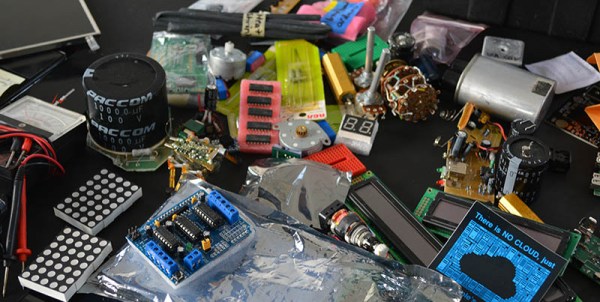
Imagine if the Snap-on tool truck wasn’t filled with hand tools. Imagine if that Snap-on truck was a mobile electronics surplus shop. That’s the idea behind the Travelling Hacker Box. It’s a box, shipped from hacker to hacker, filled with weird and esoteric components, enough parts to build a 3D printer, and enough capacitors to stop an elephant’s heart.

If this is the first time you’ve heard about the Travelling Hacker Box, here’s the quick FAQ to get you up to speed. Has this been done before? Yes, yes it has. The Great Internet Migratory Box of Electronics Junk was a ‘thing’ done by Evil Mad Scientist back in the ‘aughts. Hackaday (or rather the old commander in chief Eliot) received one of these boxes, and sent it off to [Bre Pettis]. Keep in mind, this was in 2008. Is there more than one Travelling Hacker Box actively travelling? No. Because I don’t want to organize a second. Either way, the Travelling Hacker Box has two goals: distance travelled and number of people visited. With just one box, we can maximize both objectives. What are the current travel plans? That’s the next paragraph.

US-Trips
The travels of the Travelling Hacker Box Mk. 2

As of right now, the second version of the Travelling Hacker Box – the first box was stolen by some waste of oxygen in Georgia – has travelled at least 21,838 miles around the United States, visiting 11 prolific hackaday.io contributors in Wyoming, New York, Alaska, Hawaii, New Hampshire, Florida, Wisconsin, Maine, and California. The goal for the first dozen or so trips across the United States was to put miles on the box. 25,000 miles would be equivalent to a trip around the world using only US Postal Service flat rate boxes. Thanks to [Lloyd T Cannon]’s reinforcement of a medium flat rate box with canvas, foam, Kevlar, and custard, this iteration of the Travelling Hacker Box has held up spectacularly.

The goal for the next two months is to make a trip around the United States to maximize the number of US hackers who contributed to the box. This trip will start in Pasadena, CA, go up the west coast to Seattle, loop around the Canadian border to New England, go down the Eastern seaboard, across to Texas, over the desert, and land back at Home Base in Pasadena. From there, the Travelling Hacker Box is off to England, the EU, Asia, India, maybe Africa, and Australia.

While there are already a few people scheduled for this last trip around the US, more are needed. If you’re interested, check out the project on hackaday.io, request to join the project, send a message on the team chat, and generally bug me on the hackaday.io chat. There are plenty of spaces to fill in this last trip around the US and the current inventory is quite a haul. Not bad for a project that will eventually be stolen.


Retrotechtacular: Rein-Operated Tractors

It’s not unusual for new technologies to preserve vestiges of those that preceded them. If an industry has an inertia of doing things in a particular way then it makes commercial sense for any upstarts to build upon those established practices rather than fail to be adopted. Thus for example some industrial PLCs with very modern internals can present interfaces that hark back to their relay-based ancestors, or deep within your mobile phone there may still be AT commands being issued that would be familiar from an early 1980s modem.

Just occasionally though an attempt to marry a new technology to an old one becomes an instant anachronism, something that probably made sense at the time but through the lens of history seems just a bit crazy. And so we come to the subject of this piece, the rein-operated agricultural tractor.

Continue reading “Retrotechtacular: Rein-Operated Tractors” →

Hackaday World Create Day: April 23rd

It’s time to get out and have some fun with other Hackaday people in your area and we have the perfect opportunity. Be part of Hackaday World Create Day on Saturday, April 23rd. This is all about meeting others for an afternoon of creativity.  You might even find your engineering dream team! As part of World Create Day you’ll and brainstorm an amazing creation and connect with the people in your area that round out your own skills (electrical, mechanical, design, etc.).

This is the first ever worldwide event Hackaday has organized, and it’s made possible by all of the people who volunteered to organize a Hackaday Meetup in their area. We have heard from more than 100 of you so far and [Liz Krane] has done an amazing job following up with each organizer to get everything set up. You can still sign up to host (or co-host) and use the map to join a meetup already organized in your area.

We’re just getting started but the first added are in Ottawa Canada, Lagos Nigeria, Lynchburg, Virginia, and Puducherrry, India. We have more on the way in Malaysia, Greece, South Africa, India, Cyprus, New Zealand, France, Mexico, China, and many locations in the USA.

We’re sending out World Create Day sticker packs — created by [Joe Kim] and [Michael Guilfoil] — as fast as we can set up the Meetup pages. We will be on the lookout for Hackaday Meetups and World Create Day projects to feature right here on the Hackaday front page. Carve out 4/23 from your calendar and get excited, you don’t want to miss this!

Tiny BLE UART Makes Bluetooth Low Energy Simple

Last time I talked about the internals of how Bluetooth Low Energy (BLE) handles data. I mentioned that the way it is set up is meant to conserve power and also to support common BLE devices like heart rate monitors. On the other hand, I also mentioned that you often didn’t need to deal with that because you’d use an abstraction layer.

This time, I want to show you how I used the Hackaday special edition Tiny BLE (from Seeed Studios) and its mbed library to do a quick simple BLE project. If you didn’t read the first part, don’t worry. The abstraction is so good, you probably won’t have to unless you want to circle back around later and get a more detailed understanding of what’s happening under the covers.

I wanted something simple for an example so you could build on it without having to remove much code. For that reason, I decided to allow my phone to control the state of a three-color LED via BLE. To do that, I’m going to use a virtual UART and some off-the-shelf phone software. The whole thing won’t take much code, but that’s the point: the abstraction makes BLE relatively simple.

Continue reading “Tiny BLE UART Makes Bluetooth Low Energy Simple” →

Fail Of The Week: Always Check The Fuse

[Tomas] at Umeå Hackerspace in Sweden had some broken audio equipment, including a Sharp CD player/amplifier. What went wrong when he tried to fix it is a fail story from which we can all learn.

The device worked – for about a second after being turned on, before turning itself off. That’s a hopeful sign, time to start debugging. He took the small-signal and logic boards out of the circuit, leaving only power supply and amplifier, and applied the juice.

Magic blue smoke ensued, coming from the amplifier. Lacking a suitable replacement part, that was it for the Sharp.

On closer inspection it emerged that the previous owner had bypassed the power supply fuse with a piece of copper wire, Evidently they had found the fuse to be blowing too often and instead of trying to fix the problem simply shot the messenger.

We have all probably done it at some time or other. In the absence of a replacement fuse we may have guestimated the number of single strands required to take the current, or used a thin strip of foil wrapped around the fuse body. And we’ll all have laughed at that meme about using a spanner or a live round as a fuse.

So if there’s a moral to this story, it’s to always assume that everyone else is as capable as you are of doing such a dodgy fix, and to always check the fuse.


2013-09-05-Hackaday-Fail-tips-tileFail of the Week is a Hackaday column which celebrates failure as a learning tool. Help keep the fun rolling by writing about your own failures and sending us a link to the story — or sending in links to fail write ups you find in your Internet travels.

The State Of 3D Printing At MRRF

Only a few days ago, a significant proportion of the Hackaday crew was leaving Goshen, Indiana after the fourth annual Midwest RepRap Festival. We go to a lot of events every year, and even when you include DEF CON, security conferences, ham swap meets, and Maker Faires, MRRF is still one of the best. The event itself is an odd mix of people rallying under a banner of open source hardware and dorks dorking around with 3D printer. It’s very casual, but you’re guaranteed to learn something from the hundreds of attendees.

Hundreds of people made the trek out to Goshen this year, and a lot of them brought a 3D printer. Most of these printers aren’t the kind you can buy at a Home Depot or from Amazon. These are customized machines that push the envelope of what consumer 3D printing technology. If you want to know what 3D printing will be like in two or three years, you only need to come to MRRF. It’s an incubator of great ideas, and a peek at what the future of 3D printing holds.

Continue reading “The State Of 3D Printing At MRRF” →

My Most Obsolete Skill: Delta-Gun Convergence

In a lifetime of working with electronics we see a lot of technologies arrive, become mighty, then disappear as though they had never been. The germanium transistor for instance, thermionic valves (“tubes”), helical-scan video tape, or the CRT display. Along the way we pick up a trove of general knowledge and special skills associated with working on the devices, which become redundant once the world has moved on, and are suitable only reminiscing about times gone by.

When I think about my now-redundant special skills, there is one that comes to the fore through both the complexity and skill required, and its complete irrelevance today. I’m talking about convergence of the delta-gun shadow mask colour CRTs that were the height of television technology until the 1970s, and which were still readily available for tinkering purposes by a teenager in the 1980s.
Continue reading “My Most Obsolete Skill: Delta-Gun Convergence” →