Retrotechtacular: Cover Your CONUS With OTH-B Radar

If you’re a ham, you already know that the ionosphere is a great backboard for bouncing HF signals around the globe.  It’s also useful for over-the-horizon backscatter (OTH-B (PDF)) radar applications, which the United States Air Force’s Rome Laboratory experimented with during the Cold War.

During the trial program, transmit and receive sites were set up ninety miles apart inside the great state of Maine. The 1/2 mile-long transmit antenna was made up of four arrays of twelve dipole elements and operated at 1MW. An antenna back screen and ground screen further expanded the signal’s range. Transmission was most often controlled by computers within the transmit building, but it could also be manually powered and adjusted.

The receive site had 50-ft. antenna elements stretching 3900 feet, and a gigantic ground screen covering nearly eight acres. Signals transmitted from the dipole array at the transmit site bounced off of the ionosphere and down to the receive site. Because of step-scanning, the system was capable of covering a 180° arc. OTH-B radar systems across the continental United States were relegated to storage at the end of the Cold War, but could be brought back into service given enough time and money.

Continue reading “Retrotechtacular: Cover Your CONUS With OTH-B Radar”

Hackaday Retro Edition: The RadioShack Roomba

A few years ago, Roombas — everyone’s favorite robotic trash can — graced the pages of Hackaday with reverence. There was nothing this little robot couldn’t do, save for going up stairs. Roomba hacks have died off since then, and these little trash cans have been swallowed up by dumpsters. It’s all very sad, really.

[Mike] has had one of these Roombas around for a while, sitting in a closet, waiting for someone to make use of it. He recently dug it out, looked it over, and watched the LEDs light up after troubleshooting a problem with the batteries. Then the problem was how to control it.

He had wanted to connect it to a VIC-20, but the handy serial port on the Roomba only accepted baud rates between 19.2k and 57.6k. The VIC-20, with the ancient 6522 VIA, could only bitbang a serial port up to 2400bps. Then the idea hit him. In his closet of ancient technology, [Mike] had a Tandy 102, a slightly upgraded TRS-80 Model 100 that could easily drive a serial port at 19.2k.

When it comes to a mobile retro robotics platform, [Mike] couldn’t have found a better computer. The Tandy 102 has a display, a BASIC interpreter, enough RAM to run a Roomba, and is powered by a few AA batteries. He did need a little bit of level conversion for the serial port, but a MAX232 took care of that easily.

With everything put together, [Mike] had a robot and a computer that is at least as good as the old Heathkit HERO robot. You can check out a video of the Tandy bot below.

Continue reading “Hackaday Retro Edition: The RadioShack Roomba”

Hackaday Links Column Banner

Hackaday Links: May 31, 2015

Back in the mid-70s, [Paul Horowitz] (who has an incredible Wikipedia entry, by the way) started teaching Physics 123 at Harvard. Simple electronic circuits, solving problems with silicon; simple stuff like that. His lecture and lab notes started getting a following, and after Xeroxing a few dozen copies, he realized he had written a book. It was The Art of Electronics, and Ladyada interviewed this master of hand drawn schematics. A great interview and great camera work, too.

Like hackathons? How about one at CERN? It’s happening October 2 through October 4. The aim this year is to have a humanitarian and social impact thanks to technology. The projects last year were very good; everything from cosmic ray detectors to a $10 inflatable fridge for field operations.

You want viral advertising for your movie? This is how you do viral advertising for your movie. It’s Hackerman’s Hacking Tutorials, and we’d really like to know how they did the 80s graphics with modern computers. It’s not like you can just go out and buy a Video Toaster these days…

Previously available only through group buys, the Flir Lepton module is now available at Digikey.

We have hit the singularity. We have stared into the abyss, and the abyss has stared into us. There was a kickstarter to fund a trailer for another, bigger kickstarter. Relevant xkcd right here.

The Tymkrs had a lamb roast, and what better way to do that than with a huge lathe? Put some charcoal on the ways, turn it at a low RPM, and eventually you’ll have a meal. Bonus points for the leaf blower manifold, a gold star for carving it with a sawzall.

Hacklet 49 – Weather Display Projects

Everyone wants to know what the weather is, and what it is going to be. Today’s internet enabled forecasts give us continuous streams of current weather data and predictions from any of several computer models. Couple that with data from an on-site station, and you’ve got a lot of information to display! It makes sense that weather display projects would be popular with hackers, makers and engineers. What do you do after you build the worlds most awesome clock? Build the worlds most awesome weather display (and then incorporate a clock in there as well!).

Last week on The Hacklet I mentioned that there are two basic types  of weather projects on Hackaday.io: Sensing and Display projects. There was a bit of foreshadowing there, as this week’s Hacklet covers some of the best weather display projects on Hackaday.io!
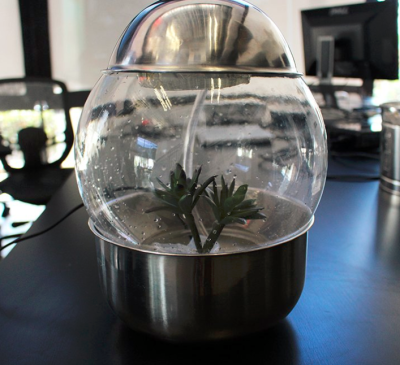
geoWe start with [Ashley Hennefer] and G.E.O, a project which is out of this world – literally. Geological Environment Observer, or G.E.O was created for NASA’s Space Apps Challenge. G.E.O’s mission is to keep astronauts on long-distance space flight missions connected with their home city (and planet). An astronaut programs the device with their home city and G.E.O takes it from there. Inside a glass globe, G.E.O creates weather patterns mirroring the programmed city. It does this with Adafruit NeoPixel LEDs, a water pump, a mist generator, and a wave shield. An Intel Edison controls the system. For now, weather data and programming are completed using a web interface. Once G.E.O launches though, data will be streamed via NASA’s deep space network.
flaps[Sephen DeVos] keeps track of the weather with a glance at his Internet Split Flap Weather Clock. Lots of weather apps use simple icons to display the current conditions. [Sephen] placed those icons on a mechanical split flap display which lets him know the conditions outside. The project’s case came from a donor clock given to [Sephen] by his parents. He then 3D printed an entire split flap mechanism, including the gears! Each 50 mm x 100 mm flap forms half an image.  A small stepper drives the flaps, while an IR detector lets the system know when it has reached a home position. Control is handled by an Arduino Nano and companion Ethernet shield. The Arduino checks the weather every 30 minutes. If conditions have changed, it flips to the right icon. Genius!
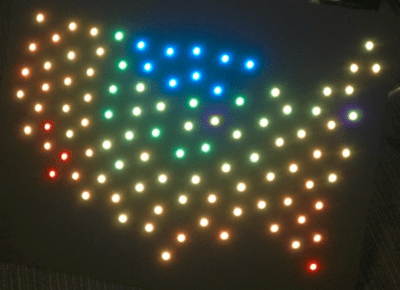
usmap[Dan Fein] is keeping track of the temperature across the entire USA with Weather Map. [Dan] works for Weather Underground, so it’s no surprise that he uses their API (accessed via a node.js script) for weather data. The data is fed into a spark core which then drives a string of 100 WS2812 LEDs. Each LED is mapped to a specific point in the continental USA. Color indicates the current temperature at that location. [Dan] does caution that you’ll have to slow down access to Weather Underground  if you’re using a free API key. Even with slower updates, this is still an awesome project!
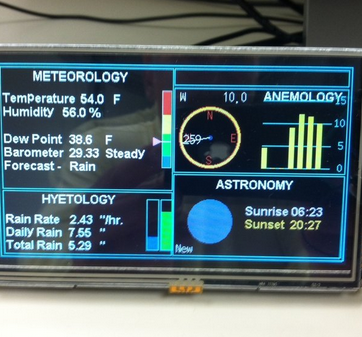
yaws[Jeff Thomas] went the traditional route with YAWS – (Yet Another Weather Station). YAWS uses a 5 inch TFT LCD to display weather data from a number of sensors. [Jeff] got his display and the driver board from buydisplay.com. The driver board uses the venerable RA8875 display driver chip. The RA8875 handles all the hard parts of driving an LCD, like video RAM, refresh, and clocks. This allows a relatively slow Arduino to drive all those pixels. [Jeff] created a very handsome interface to display all his data, but he has a small problem – a memory leak causes the system to freeze up every 18 hours! We’re hoping [Jeff] will share his source code so the Hackaday.io community can help him find that pesky bug!

If you want to see more projects like these, check the Weather Display Projects list on Hackaday.io. That’s it for this week’s Hacklet, As always, see you next week. Same hack time, same hack channel, bringing you the best of Hackaday.io!


Hackerspace Happenings: Santa Barbara Hackerspace Moving

Occasionally we get a few tips on our hotline telling us of hackerspace happenings. Either a space is moving, they need some help to install a moat around the space, or there’s a mini-conference of weird and esoteric technology happening sometime soon. The latest such tip is from the Santa Barbara Hackerspace. They’re moving, the new space doesn’t have a leaky roof, and they’re looking for some people to help out.

The new space features necessary hackerspace upgrades like no carpet, 120, 220, and 440 Volt outlets, actual parking, and a non-leaky roof. You can get by with a leaky roof in Santa Barbara, but having a roof that doesn’t have holes in it is always a bonus.

Add this to the space’s existing battery of equipment – everything from laser cutters, bandsaws, and welders to oscilloscopes, an amateur radio station, and a forge and anvil, there’s a lot anyone can do in this space.

Caption CERN Contest – Dr. Frankenstein Would Be Proud

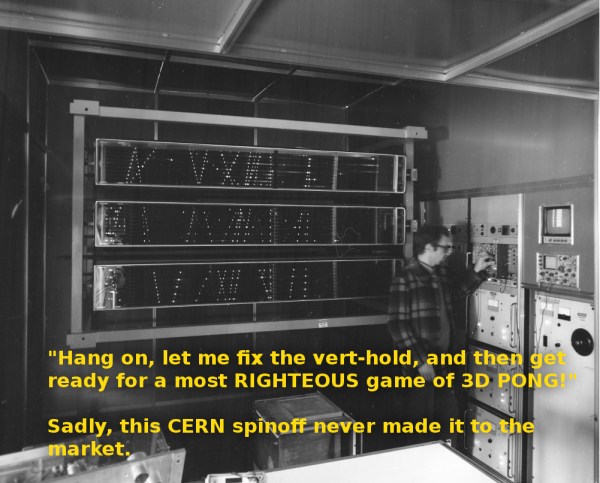
Week 16 of the Caption CERN Contest just flew by, but not without sparking some cosmic comic genius in the minds of everyone who wrote a comment. Thanks to everyone who entered! If you followed last week’s blog post, you already know that this image isn’t an early POV display, or some sort of strange data display technique. It’s actually a spark chamber. Spark chambers use high voltage and noble gases to create a visible trail of cosmic rays. Since this image is dated 1979, well after spark chambers were used for hard science, we’re guessing it was part of a demonstration at CERN’s labs.

The Funnies:

  • “Here we see Doug playing a Massively multiplayer Pong game against his peers in the next building over.” – [John Kiniston]
  • “It said “Would you like to play a game?” and I said yes. Are those missile launch tracks?”- [jonsmirl]
  • “Before Arduino you needed a whole room full of equipment to blink LEDs!” – [mjrippe]

After two weeks as a runner-up, this week’s winner is The Green Gentleman with “‘Hang on, let me fix the vert-hold, and then get ready for a most RIGHTEOUS game of 3D PONG!’ Sadly, this CERN spinoff never made it to the market”

We’re sure [The Green Gentleman] will be very courteous to his fellow hackers in sharing his new Bus Pirate From The Hackaday Store! Congratulations [The Green Gentleman]!

Week 17

cern-17-smCoils, gleaming metal, giant domes, now this is a proper mad scientist image! The CERN scientists in this image seem to be working on a large metal device of some sort. It definitely looks like an electrode which would be at home either at CERN or the well equipped home lab of one Dr. Frankenstein’s. We don’t have a caption, but we do have a rough date of August, 1961. What is happening in this image? Are these scientists setting up an experiment, or plotting world domination?

You tell us!

This week we’re giving away a Logic Pirate from The Hackaday Store.

Add your humorous caption as a comment to the contest log. Make sure you’re commenting on the contest log, not on the contest itself.

As always, if you actually have information about the image or the people in it, let CERN know on the original image discussion page.

Good Luck!

$50k In Play: Awarding 65 Stickvise This Week

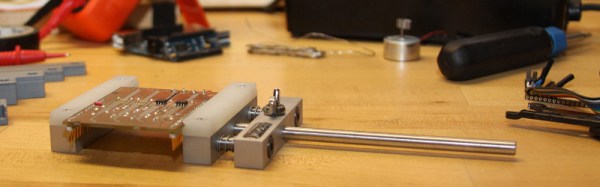
Pushing your circuit boards around the bench while trying to solder the components is a fools game. Clamp that board in place with a Stickvise you won from Hackaday! This week we’ll choose 65 projects to receive one of these PCB clamps. You must submit your project as a Hackaday Prize entry to be eligible. Do it now and you’ll be considered for our weekly prizes all summer long — they total $50,000 that we’re putting into your hands.

We’re particularly proud of the Stickvise story. It was posted as a project on Hackaday.io and immediately caught our eye as an interesting idea. We worked with [Alex Rich] as he made his way through the process of getting it ready for manufacturing and it just became available in the Hackaday Store.

Regarding your entry to win one: find a problem facing your community and start a project that helps to solve it. We’ve seen many great entries so far, but with so many prizes your chances of winning are still really good! We recommend adding a project log each week that discusses your progress and perhaps mentions what you would use the Stickvise for while progressing toward a working prototype. Even if you don’t think your idea can win one of the big prizes, a great idea and solid write up is definitely a contender for our $50k in Play weekly prizes. Just look at the projects that won last week:

Last Week’s 20 Winners of a Bulbdial Clock Kit

bulbdial-clock-50k-in-play-prize-blogview

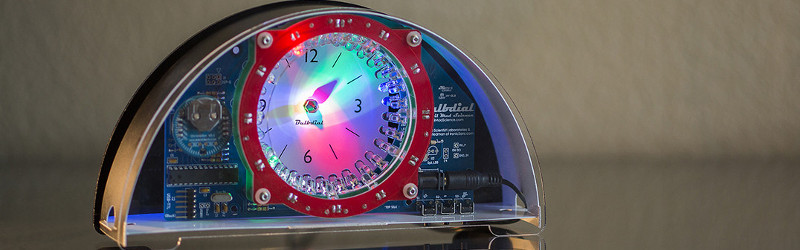
Congratulations to these 20 projects who were selected as winners from last week. You will receive a Bulbdial Clock Kit. It takes the concept of a sundial and recreates it using different colors of LEDs for each hand of the clock. This is our favorite soldering kit. It ventures a bit away from our mission of awarding tools and supplies to help with your entry, but sometimes you just need to have some fun!

Each project creator will find info on redeeming their prize as a message on Hackaday.io.


The 2015 Hackaday Prize is sponsored by: