Building A Hackerspace Entry System

A hackerspace is a place that generally needs to be accessed by a wide group of people, often at weird and unusual hours. Handing around keys and making sure everything is properly locked up can be messy, too. To make it easy for hackers to get in to [Peter]’s local hackerspace, a simple electronic system was whipped up to grant access.
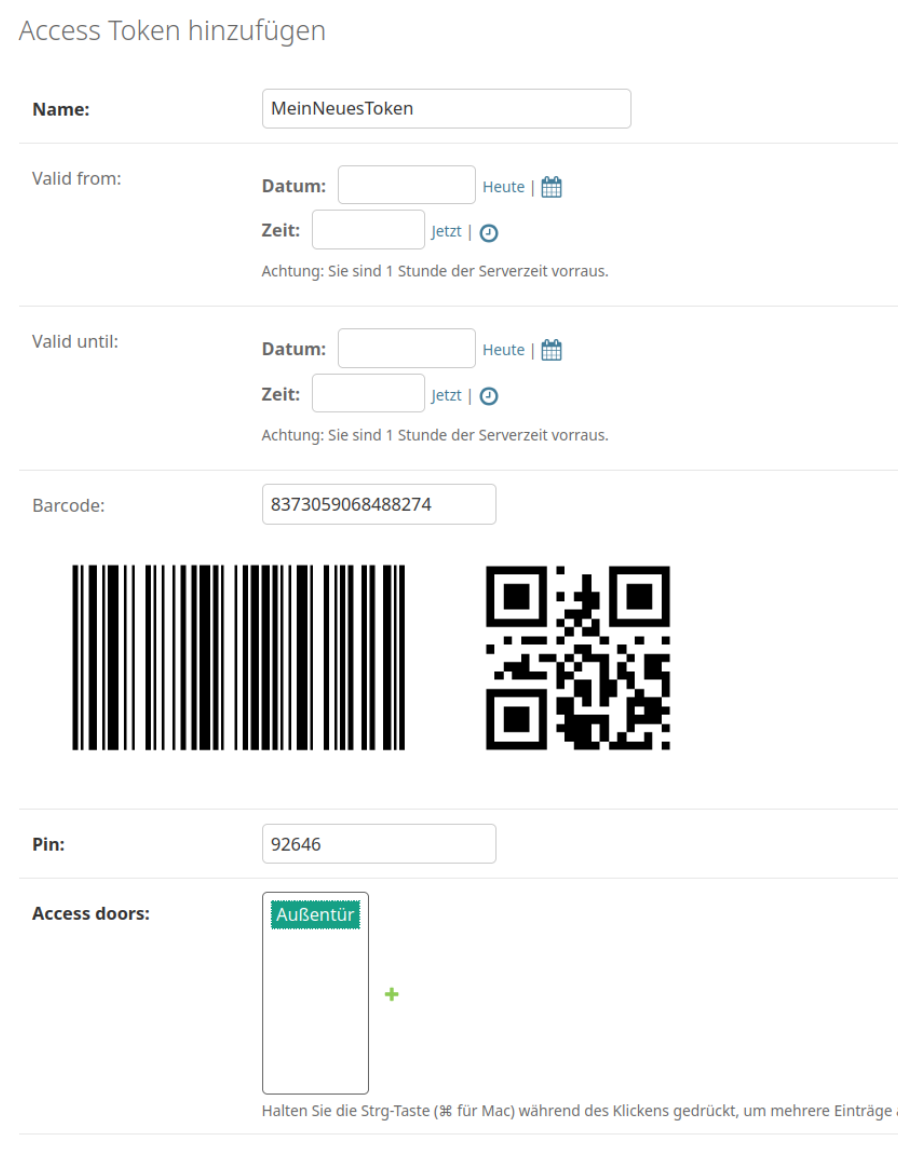
The combined use of QR code & PIN adds a layer of security.

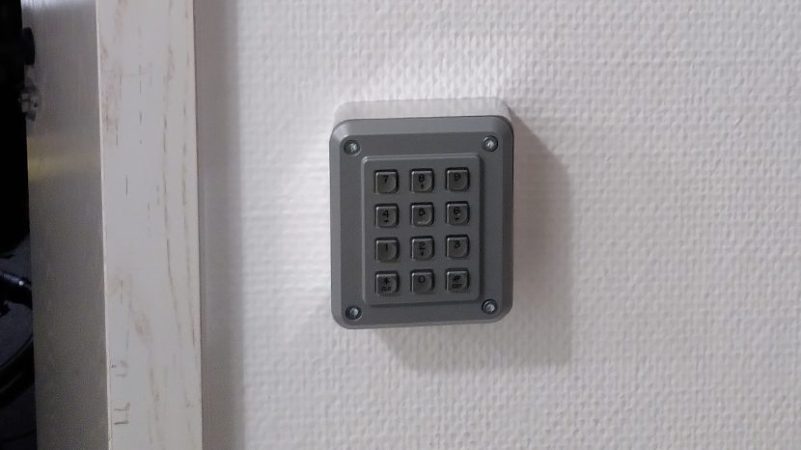
The basic components of the system are a keypad, a QR code and barcode scanner, a stepper motor, an Arduino Nano, and a Raspberry Pi. The keypad is read by an Arduino Nano, which is also responsible for talking to a stepper motor driver to actuate the lock cylinder. A secondary Arduino mounted inside the building is used to control the stepper motor, which actuates the lock cylinder once authentication is complete.

The system works on the basis of two-factor authentication. Regular users authenticate to enter by presenting a QR code or barcode, and entering a matching PIN number. The system can also be set up for PIN-only entry on a temporary basis.

For example, if the hackerspace is running an event, a simple four-digit pin can allow relatively free access for the duration without compromising long-term security. Actual authentication is handled by the Raspberry Pi, which takes in the scanned barcode and/or PIN, hashes it, and checks it against a backend database which determines if the credentials are valid for entry. If so,they command the second Arduino to unlock the door.

While it’s not technically necessary for a project like this — in fact, you could argue it’s preposterously overkill — we have to take particular note of the machined aluminum enclosure for the keypad. Mere mortals could just run it off on their 3D printers, but if you’ve got access to a CNC router and a suitably chunky piece of aluminum, why not show off a bit?
Continue reading “Building A Hackerspace Entry System”

Nottingham Railway departure board in Hackspace

All Aboard The Hack Train: Nottingham’s LED Revival

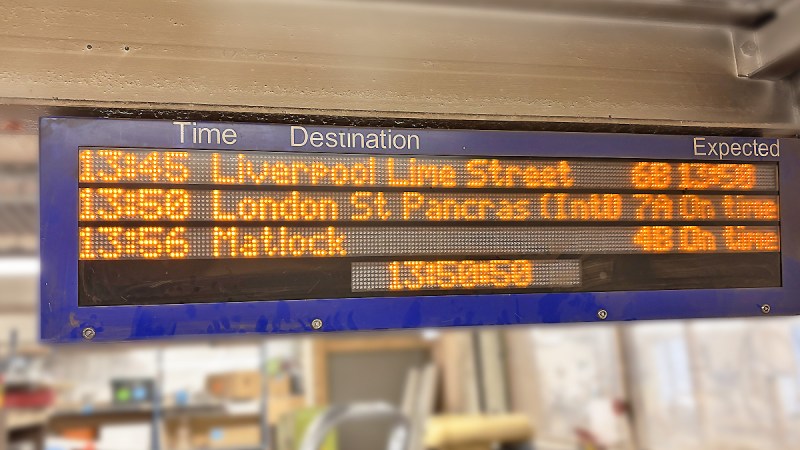
Hackerspaces are no strangers to repurposing outdated tech, and Nottingham Hackspace happens to own one of those oddities one rarely gets their hands on: a railway departure board. Left idle for over a decade, it was brought back to life by [asjackson]. Originally salvaged around 2012, it remained unused until mid-2024, when [asjackson] decided to reverse-engineer it. The board now cycles between displaying Discord messages and actual train departures from Nottingham Railway Station every few minutes. The full build story can be found in this blog post.

The technical nitty-gritty is fascinating. Each side of the board contains 4,480 LEDs driven as two parallel chains. [asjackson] dove into its guts, decoding circuits, fixing misaligned logic levels, and designing custom circuit boards in KiCAD. The latest version swaps WiFi for a WizNet W5500 ethernet module and even integrates the Arduino Uno R4 directly into the board’s design. Beyond cool tech, the display connects to MQTT, pulling real-time train data and Discord messages via scripts that bridge APIs and custom Arduino code.

This board is a true gem for any hackerspace, even more so now it’s working. It waited for the exact mix of ingredients why hackerspaces exist in the first place: curiosity, persistence, and problem-solving. Nottingham Hackspace is home to a lot more, as we once wrote in this introductory article.If you don’t have room for the real thing, maybe set your sights a bit smaller.

Do you have a statement piece this cool in your hackerspace or your home? Tip us!

Continue reading “All Aboard The Hack Train: Nottingham’s LED Revival”

An International Hackerspace Map

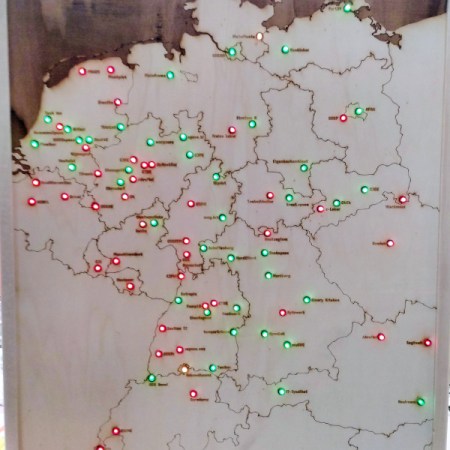
If you’re looking for a hackerspace while on your travels, there is more than one website which shows them on a map, and even tells you whether or not they are open. This last feature is powered by SpaceAPI, a standard way for hackerspaces to publish information about themselves, including whether or not they are closed.

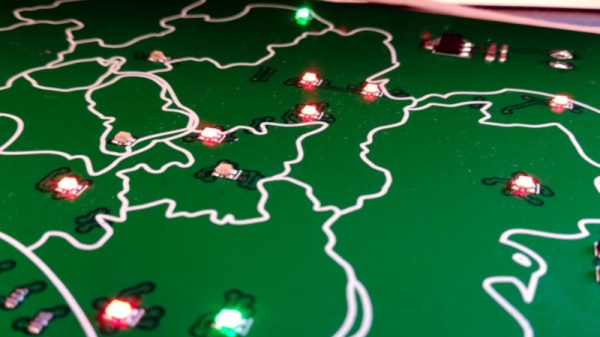
Given such a trove of data then it’s hardly surprising that [S3lph] would use it to create a gigantic map of central Europe with lights in the appropriate places (German language, Google Translate link) to show the spaces and their status.

The lights are a set of addressable LEDs and the brain is an ESP32, making this an accessible project for most hackers with the time to assemble it. Unsurprisingly then it’s not the first such map we’ve seen, though it’s considerably more ambitious than the last one. Meanwhile if your hackerspace doesn’t have SpaceAPI yet or you’re simply curious about the whole thing, we took a look at it back in 2021.

Thanks [Dave] for the tip.

My Space

If I could name one thing which has been the most transformative for our community over the last couple of decades, it would have to be the proliferation of hackerspaces. Ostensibly a place which provides access to tools and machinery, these organisations have become so much more. They bring together like-minded people, and from such a meeting of minds have come a plethora of high quality projects, events, and other good things.

Just What Is A Hackerspace?

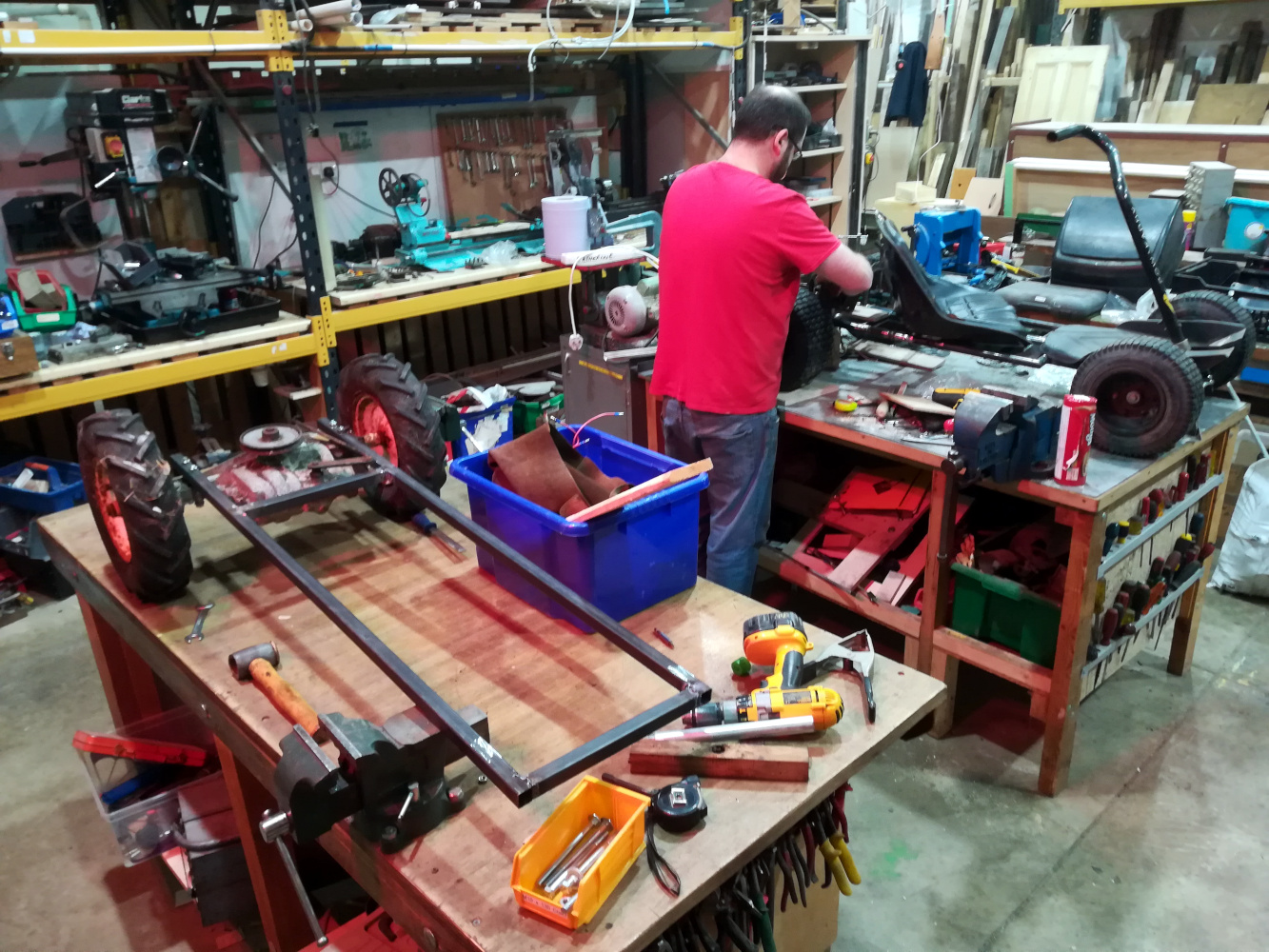
A workshop with benches that have small vehickes in various stages of construction on them.
A Hacky Racer takes shape in the MK Makerspace workshop

Hackerspaces loosely come in many forms, from co-working spaces or libraries who have invested in a 3D printer and imagine themselves to be a hackerspace, through to anarchist collectives in abandoned warehouses who support their city’s alternative communities with technology. For me, hackerspaces must be community organisations rather than for-profit ones, so for the purposes of this article I’m not referring to closely-allied commercial spaces such as FabLabs.

So a good hackerspace for me is a group of tech enthusiasts who’ve come together, probably formed a non-profit association, and rented a dilapidated basement or industrial unit somewhere. The tools and machines inside aren’t shiny and new but they mostly work, and round that fridge stocked with Club-Mate you’ll find a community of friends, people who don’t think it’s odd to always want to know how things work. In a good hackerspace you’ll have found your place, and you can be much more than you would have been alone.

I visit plenty of hackerspaces across Europe as I wander the continent on an Interrail pass. I’m a member of three of them at the moment, though my main home in the UK is at Milton Keynes Makerspace. I’ve sat on recycled sofas drinking caffeinated beverages in more cities than I can count, and along the way I’ve seen close-up the many different ways a hackerspace can be run. I’ve seen spaces falling apart at the seams, I’ve seen ones a little too regimented for my taste, and others with too much of an emphasis on radical ideology, but mostly I’ve seen spaces that get it about right and I feel at home in. So perhaps it’s time to sit down and talk about what I think makes a good hackerspace. What is my space?

Continue reading “My Space”

A Robot Game To Open Your Hackerspace

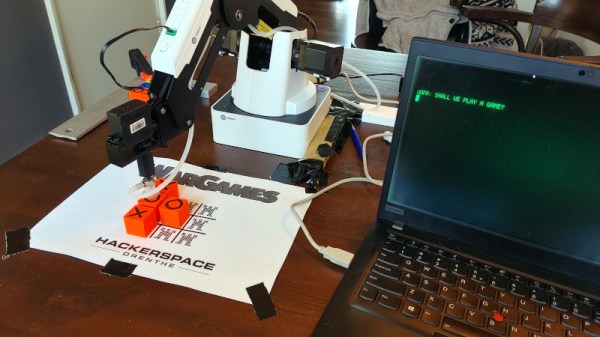
It’s always good to welcome a new hackerspace to the fold, and thus we’re pleased to hear about the upcoming opening of Hackerspace Drenthe, on the north-eastern edge of the Netherlands. Starting a new space during a global pandemic is something of a feat. As part of their opening something is required to demonstrate a robot for the curious public, and what could be more accessible than a robot arm playing tic-tac-toe!

It would be correct to say that a robot moving blocks with precision is not necessarily a ground-breaking achievement, but in its purpose of providing eye-candy for a hackerspace opening while also serving as an experiment for some of the students from the school adjacent to the space it is a success. The interface is a pleasingly retro War Games style terminal, and the software is written in Python. For the curious all can be found on a GitHub repository, and should you be in that region of Europe you can find Hackerspace Drenthe in the Netherlands border town of Coevorden and attend their opening on the 2nd of April.

Continue reading “A Robot Game To Open Your Hackerspace”

Remoticon 2021 // Vaibhav Chhabra And The M19 Collective Make One Million Faceshields

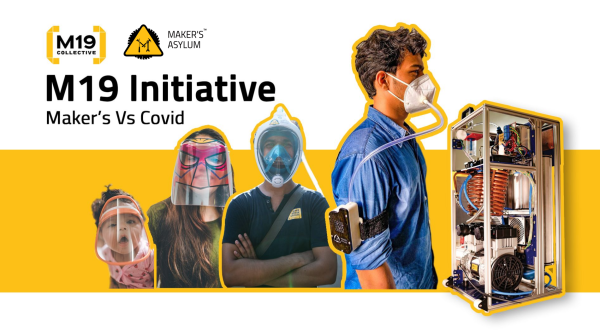
[Vaibhav Chhabra], the co-founder of Maker’s Asylum hackerspace in Mumbai, India, starts his Remoticon talk by telling a short story about how the hackerspace rose to its current status. Born out of frustration with a collapsed office ceiling, having gone through eight years of moving and reorganizations, it accumulated a loyal participant base – not unusual with hackerspaces that are managed well. This setting provided a perfect breeding ground for the M19 effort when COVID-19 reached India, mixing “what can we do” and “what should we do” inquiries into a perfect storm and starting the 49 day work session that swiftly outgrew the hackerspace, both physically and organizationally.

When the very first two weeks of the Infinite Two Week Quarantine Of 2020 were announced in India, a group of people decided to wait it out at the hackerspace instead of confining themselves to their homes. As various aspects of our society started crashing after the direct impact of COVID-19, news came through – that of a personal protective equipment shortage, especially important for frontline workers. Countries generally were not prepared when it came to PPE, and India was no different. Thus, folks in Maker’s Asylum stepped up, finding themselves in a perfect position to manufacture protective equipment when nobody else was prepared to help.

Continue reading “Remoticon 2021 // Vaibhav Chhabra And The M19 Collective Make One Million Faceshields”

Do You SpaceAPI?

Here at Hackaday we’re privileged to be part of a global community of hackers, makers, technology enthusiasts and creative people whose collective works make our daily news feeds such a fascinating read. We encounter you all directly in the physical world rather the virtual one at the many events across the community, or at the various hackerspaces we visit on our travels. But how can we keep track of the world of hackerspaces when there are so many? Maybe SpaceAPI might hold the answer.

Continue reading “Do You SpaceAPI?”