Build A Beach Winch For Wakeboarding

beachwinching itself is a hack of common wakeboarding. No waves? hrm... lets hack something together.

Here’s a build log for  a nice beach winch for your next trip out to go beachwinching. Beachwinching is when you use a fast winch on shore to pull you in, allowing you to wakeboard, wakeskate, or water skii without the need of waves or a boat or jet ski to pull you along. While there’s nothing amazingly groundbreaking here, we do love a nicely documented build log. We think a remote way to initialize the pull would be nice too.

You can catch an example video of beachwinching after the break

Continue reading “Build A Beach Winch For Wakeboarding”

The New Apple TV

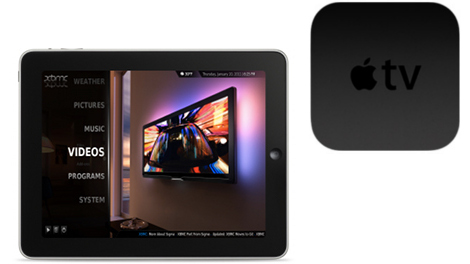
You’ve probably already heard about the Apple TV 2. It retails for $99 and packs a punch with HD video, optical audio, and WiFi in that tiny package. But as always, we like it for its hackability. Even though it’s just starting to ship, the hacks are already rolling in. The firmware is available from Apple’s servers and has already been unlocked with the yet-to-be-release SHAtter exploit. [Das_coach] even sent us a link to a video of the new Frontrow ported for the iPod touch (embedded after the break).

But the holy grail has to be XBMC. We’ve seen it on the first generation Apple TV and it was good. The second generation switches to the A4 processor which is an ARM Cortex-A8. Not quite as easy to port for as the Intel chip on the first generation was. But there is hope, one of the 2010 Google Summer of Code projects worked to port XBMC to another ARM device, it’s just a matter of inspiring some developers to take on the quest to make it happen. We can’t wait for the day that we can just velcro one of these to the back of our TV and be done with it, that first generation Xbox isn’t going to last forever.

Continue reading “The New Apple TV”

Lazarus-64, Not Actually 64 Bit But Still Blows Our Minds

Lazarus-64, breadboard game system; certainly sounds like something from the 1980s. We were surprised to find out not only the name, but also all the ICs used are only those available from the retro age of 30 years back (Save for the AVR controlling everything, of course). Even more amazing is how it has 256 flicker free color support, while not using NTSC chips. Which Goes to show that even if there are common solutions out there for cheap, building or compiling your own is not necessarily a bad thing or a waste of time.

There is a whole lot more to Lazarus, including double buffering and VMS, but sadly it appears progress has stopped on the Lazarus-64 breadboard game system, with the last update being last year. But we can still bask in the amazing glow that currently is.

Internet Controlled Remote

How often does this happen to you? You’re leaving on a long trip, and half way there you remember the TV was left on. Never? Alright then, how about wanting to control an Xbox 360 from within the other room and you don’t have the remote. Still a rare occurrence?

Perhaps you have a better situation where an internet controlled IR remote, that can be programmed to work with any TV or IR accepting device, would be useful. [Nicholas McClanahan] starts off with USB Propeller from Parallax, adds an Ethernet module making a mini server, and ends with an IR LED and receiver. The code is nearly as simple being a combination of SPIN, Html, and JavaScript. All coming together under a nice website GUI that prompts for what IR signals to send. To make the project even more straightforward, [Nicholas] has included an Instructable as well. In the end though, while the hack is great, we’re still trying to find a decent enough use. Video after the rift.

Continue reading “Internet Controlled Remote”

1953 Radio Includes Tubes, AM, FM, And MP3

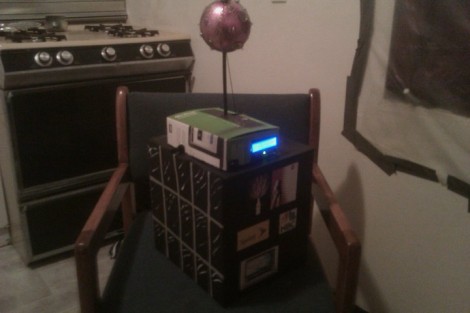
This vintage radio can play AM, FM, and MP3, all with a classic sound. Inside you’ll find a new AM radio tube-amp, providing the functionality you’d expect from the device. The rest of it comes from a conglomeration of parts; an FM receiver board from another radio and an MP3 player with remote control and USB connector. The classic sound we mentioned above comes from an AM modulator. That’s right, the auxiliary audio boards aren’t connected directly, but are broadcast on the AM band so that your latest MC Lars album has the same sound quality as the traffic report.

Check out this similar project from last year that adds RDS to a vintage radio.

EEVblog Dissects A Kindle 3

guts!

[Dave] over at the EEVblog did a review of the kindle 3 recently, but never got to the good stuff, the guts.  He is now rectifying this with a full video dissection of the eReader. Full of details on how to open it up as well as specifics on the internals, this is a fun video to watch. One thing that caught our attention was the RFID tag on the inside of the case.  It is probably for inventory tracking, but we can’t help but have a few tinfoil hat type thoughts. You can watch the video after the break.

Continue reading “EEVblog Dissects A Kindle 3”

Tube Preamp With A Dazzling Wood Case

It’s been a while since we’ve looked in on the world of vacuum tube audio equipment. [Bruce] just finished documenting a tube preamp he built. He actually made a couple of these with slightly different cases but they use the same circuit design. We found his discussion of common errors made when tying into ground quite interesting. It seems that many folks struggle with noise in their circuits because of ground loops. There’s some details about isolating the signal ground from a metal chassis, and also an admonition about not connecting the input or output jacks directly the chassis.
If you like this, don’t miss on of our favorite tube projects, [Bruce’s] Poddwatt.