Greenhouse Guard

pid

[Seth King] sent in his latest hack where he used an Arduino to regulate various aspects of a greenhouse. He has sensors for soil and air temperature as well as light and moisture. He built a custom circuit that uses relays to power fans, lights, and heaters. Using timers and the sensor data, the devices can be triggered to create the perfect environment for sprouts. He hopes to make the whole thing wireless by integrating XBees, but for now he ran a USB cord to his computer.

Related: Automatic grow light

Home Automation Via Twitter

[youtube=http://www.youtube.com/watch?v=PVm1VKB43ww]

We’ve seen tons of stuff hooked up to send updates to twitter when something happens. That’s what we expected when we first read this tip from [Matt]. We were pleasantly surprised to see he’s actually doing the opposite. He has rigged several items to an IoBridge module and he can control them by sending tweets to his account. In the video you can see him sound a buzzer and change a display on an LCD. Its nice to see twitter being used as part of the control as opposed to updating us every time someone flushes.

Cyclonic Dust Seperation

[youtube=http://www.youtube.com/watch?v=g6j-psU1aWs]

[Don] was having issues with dust when working with MDF. He had a shop vac overheat and die because of it. When looking for solutions, he saw several systems that used cyclonic dust seperation. Not wanting to buy something he could make for cheaper, he left the store and started scrounging parts. You can see his home made system in the video above. This seems like an absolute must have item for any workshop. Great job [Don].

Toilet Paper Dispenser

[youtube=http://www.youtube.com/watch?v=QTsXlTKaFq0]

Solving the age old problem of… wait, what problem are they solving? These students at UC Berkeley have built a toilet paper dispenser prototype. Not only does it meter out an exact amount for you, it will fold it and cut it as well. They mention this being the perfect accessory for a high tech bathroom, and we can agree. To be serious though, in public places, metering out limited amounts of toilet paper at a time could possibly result in major cost savings. We think the next prototype should have different preference settings such as; wadded, folded, or wrapped around your hand. Anyone else’s mind suddenly filled with unpleasant imagery?

[via Makezine]

Smart Can Crusher

[vimeo http://vimeo.com/4821403%5D

[Mangonha] has put together this interesting project involving aluminium can recycling (translated, sortof). They’re using an arduino to tally up how much aluminium they have accumulated. That information is then passed on and displayed on a google map. There are families that go around collecting the cans as a means of income, and this system could be very helpful to them. They state that their goal is to eventually have restaraunts and more families included. We’re a bit curious about how helpful this really is. How is that information actually changing the actions of the collectors? Would a simple flag on your door or window signalling enough cans to pick up or not be just as effective?

[via the Make flickr pool]

Various Cantenna Builds

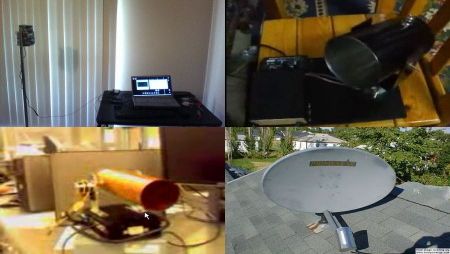
Here is a classic project used to increase wireless signal strength. Cantennas focus using a waveguide very much like a magnifying glass focuses light. [Robert] made a Natural Light beer cantenna, pictured in the upper left. His approach used three beer cans, a paper towel holder, and a shower curtain rod. On the tipline, he noted a signal boost from 11Mbps to 54Mbps. This is certainly something we can hack together if our room lacks adequate signal. Read about parabolic and seeking versions after the break.

Continue reading “Various Cantenna Builds”

Automated Dorm Room Door

[youtube=http://www.youtube.com/watch?v=46s7nE72nvI]

[Chris] wrote in to tell us about this project he did while living in the dorms. He built a system to automate his dorm room door. It handles unlocking and opening/closing the door via iPhone, secret knock, and even the key.  The lock/knob portion is handled by a servo while the opening/closing action is hydraulic. After living with it for a year, he says that it never gets old, but there were a few bugs. Apparently it would randomly open in the middle of the night sometimes. If you’re interested in doing something like this, but not damaging the door, maybe you should check out the RFID dorm door lock project.