Arguably, Microchip’s PIC microcontrollers do not get enough posts here. One of the drawbacks for some of us is that Linux support for PICs is not very well known. The information is out there, but no one has laid out the process of going from writing C code to programming a chip. Written for Linux users that are familiar with microcontrollers, basic circuits, the C programming language, and can read a datasheet, this how-to should get you up and programming a PIC quickly with Linux.
Linux Hacks570 Articles
Augen E-Go Booting Linux

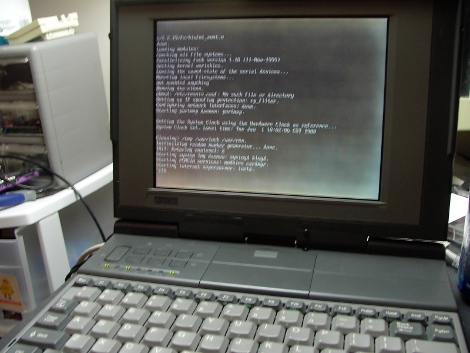
The Augen E-Go is billed as a Netbook that ships with Windows CE. [Moogle] got it to boot the Linux kernel after a bit of hardware snooping. He found a UART connector on the main board and discovered that if you tie the enable pin to ground you can send an ARM bootloader to the device during boot up. His past experience hacking the Didj and the Explorer helped him recognize the processor used in the Augen. This lead to using a zimage from the Didj to boot the Linux kernel. So far the process halts at a kernel panic, but that’s because he hasn’t built the image with a file system for the device yet.
If the E-Go ends up playing nicely with Linux, [Moogle] may have found a suitable replacement for the Zipit.
Update: Looks like we’ve got the wrong version of the E-Go pictured above (and linked below). Check out [Moogle’s] comment for model numbers.
[Augen photo credit: Newegg.com]
Building Linux Images For ARM Architectures

Want to try your hand at building a Linux package for an embedded device? [SnowBot] decided to give it a try and set out to build Ubuntu for a GumStix. The single-board computer will cost you about $150 to get started, plus a way to connect to the device’s serial port. But once you’ve got your hands on it there is a lot of power in a tiny package.
He’s using the RootStock package to assist in the build. This is a suite of tools that generates the root file system that can be loaded onto an SD card for use with the Gumstix. It’s not quite building from the ground up, but there’s already enough hoops to jump through that this package is a welcomed shortcut.
Already rolling your own Linux packages for embedded hardware? We want to hear about it.
$169 Linux Tablet… Sortof

The Insignia Infocast is a $169 simple media device being sold at Best Buy. Marketed as a way to share photos and run Chumby apps, hackers are starting to release packages to extend its features. [Bunnie] shows us one package in particular that allows it to be used as a web browser with an external keyboard. With an 800Mhz processor, an 800×600 touch screen, and 2 GB of memory, we can see that this is just scratching the surface of what is possible. [Bunnie] points out that some people are working on porting Android to the device, and if you really feel adventurous, you can dig into the hardware.
Serial Port Controlled CPU Fan

[Christian] was running a Linux box as a home server but needed a way to quiet the noisy machine. Like many Linux servers, he’s using some pretty old hardware which doesn’t have an on-board header for the CPU fan which generates much of the unwanted sound. Those headers are nice because software can monitor the CPU and board temperature and adjust the fan accordingly.
[Christian’s] solution was to use the serial port for the task. He built a small circuit in which serial pin 3 drives the base of a transistor, pin 5 provides ground, and a floppy drive power cable supplies 5 volts. From there he wrote a RUBY program to monitor the CPU temperature and generate a PWM signal on the serial port, throttling the fan speed as needed.
[CC Photo Credit: Garrette via Flickr]
BeagleBoard Cluster

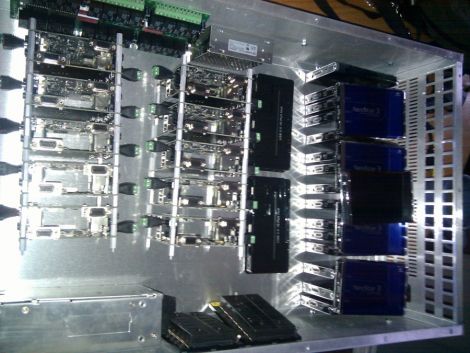
What do you do after you make a BeagleBoard graphing calculator? [Matt] over at Liquidware Antipasto made a BeagleBoard Elastic R Cluster that fits in a briefcase. Ten BeagleBoards, are connected to each other though USB to ethernet adapters and a pair of ethernet switches connected to a wireless router. The cost for this cluster comes in around $2000 and while consuming less than 40 watts of power, out-paces a $4500 laptop. How might you use this cluster? What improvements would you make? Continue reading “BeagleBoard Cluster”
Adding A Serial Port To The Zipit

[Geordy] added a serial port to his Zipit. It uses a 3.5mm jack as the connector. He managed to include an RS232 level converter inside the case. Both components were hard to fit into the cramped quarters but he did it and he kept the hacker-friendly device looking nice too.