Improved Thermocouples On A Microcontroller

ktype

If you’re reading a thermocouple with one of those fancy schmancy SPI thermocouple amplifiers, this one isn’t for you. If, however, you’re still going through those old-school analog thermocouple amplifiers like the AD595, [miceuz] has just the thing for you. He’s come up with a library for embedded devices that reads the temperature of a k-type thermocouple with +- 0.03°C of accuracy.

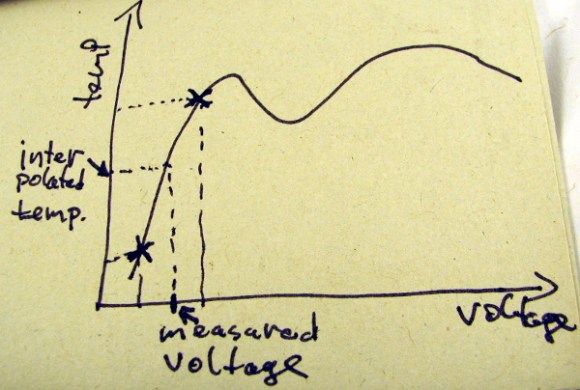
As with anything dealing with natural phenomena, the voltage generate by the bimetallic junction of a thermocouple probe is decidedly non-linear. This is a problem when dealing with embedded devices, as that would mean using floating point arithmetic, greatly increasing the amount of code. [micuez] found the NIST tables for a K-type thermocouple and interpolates the actual temperature of the thermocouple probe from the NIST data. The usual way of measuring thermocouples – a polynomial unction of some sort – has an error of about 0.06°C. [miceuz]’s library has an error of less than half that, all while using less code.

The library doesn’t support temperatures below zero, but this is still a work in progress. Still, if you’re looking for a very accurate library for a forge, crock pot sous vide build, or a toaster  oven reflow controller, you can’t do better than [miceuz]’s work.
Interactive LED Beer Pong Table Has More Features Than You Can Shake A Stick At

LED Beer Pong

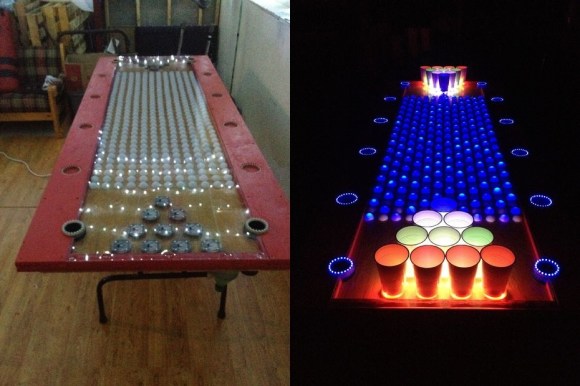
Holy cow. The amount of detail and functionality that went into this Interactive LED Beer Pong Table is absolutely incredible.

The table features 384 individually controlled RGB LEDs, covered with a 2′ x 8′ Lexan sheet to protect them from spills. Each cup holder (pod) contains an additional 4 RGB LEDs and an IR sensor that can detect whether or not the cup is in place — if it is removed, the IR sensor triggers an animation on either the 32 x 12 LED grid across the middle of the table or the other pods.

The rings of LEDs on the outside edge act as VU meters and pulse to the music in different animation patterns. What is really impressive is that [Jeff] also included a ping pong ball washer — A water reservoir connects under the table between the two LED rings at either end. When you put the ball into one, it gets sucked underneath and pops out the other side clean!

You seriously have to see the video of this thing in action.

Continue reading “Interactive LED Beer Pong Table Has More Features Than You Can Shake A Stick At”

Measuring Light With ChipKIT

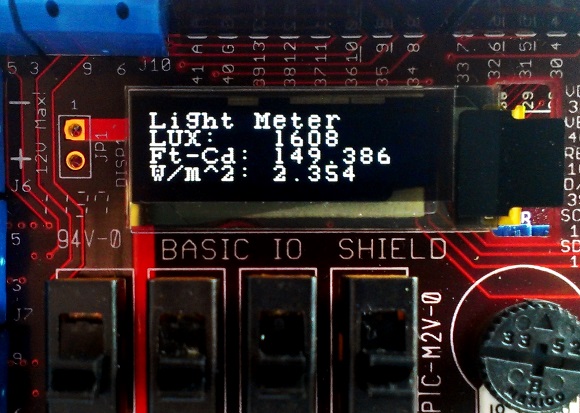
light meter showing LUX value

How does one go about measuring the amount of light in a given area? With a Light Meter of course! Maintaining proper lighting levels can be very important in places like schools, hospitals and even your own workbench.

[Raj] over at Embedded Labs has put together an excellent tutorial on how to construct your very own light meter based upon the chipKIT platform. The chipKIT Uno32 is similar to Arduino, but boasts a much more powerful PIC32MX320F128 microcontroller.  We’ve seen projects that feature the chipKIT Uno (pdf warning) here before. From playing pong to hosting several temperature sensors, it’s certainly a versatile platform.

The light meter uses an I/O shield and communicates to a BH1750FVI digital light sensor via I2C. The firmware divides the raw data coming off the sensor by a constant, and displays the light intensity data on an OLED display in Lux, foot-candles, and Watts/m^2 units. Be sure to check out the tutorial for full schematics and source.

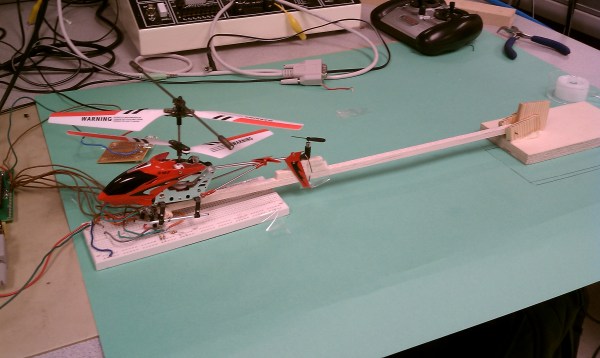
model helicopter attached to boom

Self-Learning Helicopter Uses Neural Network

Though this project uses an RC helicopter, it’s merely a vessel to demonstrate a fascinating machine learning algorithm developed by two Cornell students – [Akshay] and [Sergio]. The learning environment is set up with the helicopter at its center, attached to a boom. The boom restricts the helicopter’s movement down to one degree of motion, so that it can only move up from the ground (not side to side or front to back).

The goal is for the helicopter to teach itself how to get to a specific height in the quickest amount of time. A handful of IR sensors are used to tell the Atmega644 how high the helicopter is. The genius of this though, is in the firmware. [Akshay] and [Sergio] are using an evolutionary algorithm adopted from Floreano et al, a noted author on biological inspired artificial intelligences. The idea is for the helicopter to create random “runs” and then check the data. The runs that are closer to the goal get refined while the others are eliminated, thus mimicking evolutions’ natural selection.

We’ve seen neural networks before, but nothing like this. Stay with us after the break, as we take this awesome project and narrow it down so that you too can implement this type of algorithm in your next project.


Continue reading “Self-Learning Helicopter Uses Neural Network”

Low-Power Orientation Tracker And An Optimized Math Library For The MSP430

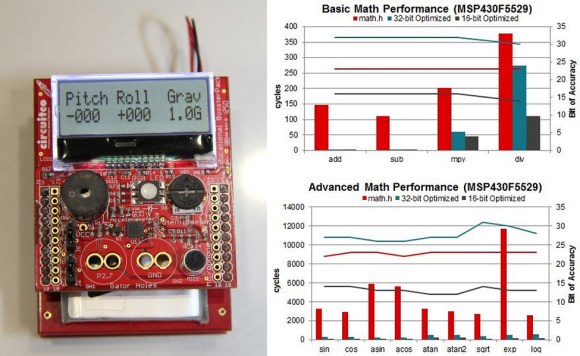
MSP430 Orientation Tracker

Orientation trackers can be used for a ton of different applications: tracking mishandled packages, theft notification of valuables, and navigation are just a few examples! A recent blog post from Texas Instruments discusses how to build a low-cost and low-power orientation tracker with the MSP430.

Based on the MSP430 LaunchPad and CircuitCo’s Educational BoosterPack, the orientation tracker is very simple to put together. It can also be made wireless using any of the wireless BoosterPacks with a Fuel Tank BoosterPack, or by using the BLE Booster Pack with a built in Lithium Battery circuitry. TI provides all the necessary code and design files in their reference application for getting your orientation tracker up and running. Be sure to see the device in action after the break! This project not only involves building a low-power orientation tracker, but also showcases IQmathLib, a library of optimized fixed point math functions on the MSP430. One of the more challenging aspects of using small MCUs such as the MSP430 or Arduino is how inefficient built in math libraries are. Check out the IQmathLib, it greatly improves upon the built in math functions for the MSP430.

It would be interesting to see this project modified to be a DIY pedometer or be used on a self-balancing robot. It would also be interesting to see the IQmathLib ported to other micros, such as the Arduino. Take a look and see how you can use this reference design in your own projects!

Continue reading “Low-Power Orientation Tracker And An Optimized Math Library For The MSP430”

Step Into The Ring With Fight Coach

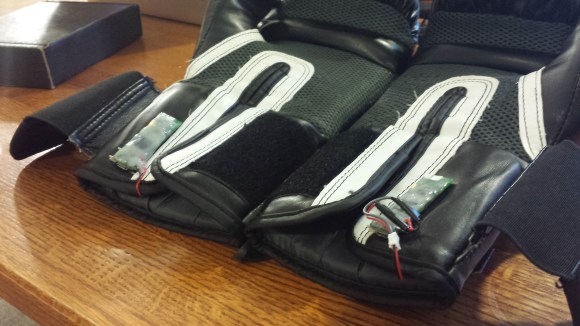
box01


As MMA continues to grow in popularity, the competition is getting tougher. There’s always someone else out there who’s training harder and longer than you are. So how do you get the advantage over your competitors? More push-ups? Sit-ups? Eat more vegetables? What about installing custom 2 by 1 inch, 5 gram PCB’s armed with an ATmega32U4, a MPU-6050 6 axis accelerometer and an RN-41 Bluetooth module into each of your gloves? Now that’s what we’re talking about.

[Vincent] and [Jooyoung] of Cornell joined their classmates in turning out another cool piece of electrical engineering. Fight Coach records data from the fighter’s gloves so that it can not only be analyzed to improve performance, but also interact with the fighter in real-time.  Though not quite as immersive as some fighter training techniques we’ve seen, Fight Coach might just give a fighter a slight edge in the ring.

Fight Coach offers 3 modes of training: Defense mode, Damage mode and Free-Training mode. As usual with Cornell projects, all code, schematics and a wealth of information on the project is just a click away. And stick around after the break for a video demonstration of Fight Coach.

Continue reading “Step Into The Ring With Fight Coach”

Steering Sound With Phased Array

entiresystem

[Edward] and [Tom] managed to build an actual phased array speaker system capable of steering sound around a room. Powered by an Atmega 644, this impressive final project uses 12 independently controllable speakers that each have a variable delay. By adjusting the delay at precise intervals, the angle of maximum intensity of the output wave can be shifted, there by “steering” the sound.

Phased arrays are usually associated with EM applications, such as radar. But the same principles can be applied to sound waveforms. The math is a little scary, but we’ll walk you through only what you need to know in case you’re ever in need to steer sound with a speaker and a servo phased array sound system.

Continue reading “Steering Sound With Phased Array”