AVR: The Facts About Flash Memory

Here’s a nice little discussion about reading and writing AVR flash memory that [Windel] put together. He’s using an In System Programmer to read the flash memory from an ATmega328 using AVRdude, the programming software which we used in our AVR Programming Tutorials. He covers the particulars of the commands, how this might be useful, and finishes up with the gotcha’s involved in reading back code from the chip. We recently tried this out with that LED light bulb but were unsuccessful because the lock bits on the ATtiny13 chip had been set in order to protect the firmware from our prying eyes. Hopefully you’ll have more luck with these methods.

MCP2200 USB To Serial Chip Hacked To Do Your Bidding

Mircrochip has a new USB to Serial converter available called the MCP2200. [Sjaak] suspected that it may have been made from an existing 20-pin PIC and found that reading the device signature with the PICKIT3 shows that the chip is an 18F14K50. Most likely this is running Microchip’s USB stack but it’s hard to tell because chip is code-protected, reading back all zeros. So he set out to write some replacement firmware which would provide the same functionality and give you access to the rest of the chip’s features.

There were some speed bumps along the way. The first one is that Microchip’s licensing for their USB stack won’t allow you to open source your firmware. That’s okay, it seems there is already a USB stack that can be ported which doesn’t have this restriction. The second wrinkle in the plan is that [Sjaak’s] code doesn’t come with a VID/PID pair that you can use like V-USB does for AVR chips. But that doesn’t diminish the accomplishment of getting the device to work by echoing back characters it receives. Full USB to serial support with the replacement firmware is on the way.

[Thanks Chris]

Attitude Control For A Really Big Rocket

If this is meant for a model rocket it must be the biggest we’ve ever seen. [Scott] and [Trevor] took on the task of building a rocket attitude control system after reading about some research on the topic. But that researcher only tested the theories using simulations so they set out to build their own. The prototype above has a tank of compressed Nitrogen which can hold up to 3000 PSI. You can begin to understand why this needs to be used with a big rocket. The pressurized gas is connected through a regulator to four valves which feed nozzles around the circumference of the fuselage. An Arduino takes readings from a gyroscope and actuates the gas valves via a relay board.

You can check out the test rig in the video after the break. The prototype is suspended horizontally from a wire and its orientation held at one position by the system. There’s also a paper (PDF) if you’re interested in the equations that went into the stabilization control. This system would have been right at home on that huge sugar rocket we saw back in October.

Continue reading “Attitude Control For A Really Big Rocket”

OLED Displays And Small Microcontrollers

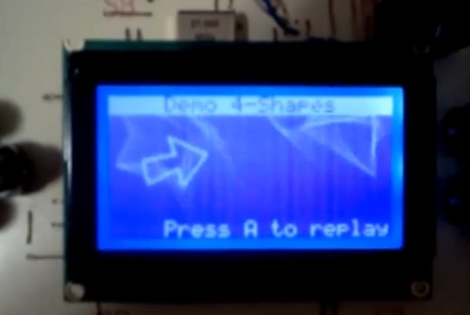
If you’ve ever thought of utilizing a small and inexpensive OLED display in your project [Rossum] has the details you need to get started. In the past we’ve seen him take a tour of available LCD screens and this is much the same, detailing his look at three different models. In the video after the break each is connected to a driver board that he made. The boards have two important components, the first is a boost driver for the 12-16V input the screens need, the second is an octal buffer necessary if you are using a 5V microcontroller. These take care of the hardware considerations, making it simple to drive them with a chip of your choosing.

Continue reading “OLED Displays And Small Microcontrollers”

Data Logging Football

[Ben Kokes] threw together a hardware package to capture data from a football. In the center of a Nerf football he made room for an accelerometer, gyroscope, and an electronic compass.  All three can capture 3-axis data and, along with the LEDs ringing the circumference, they’ve controlled by an XMEGA192 microcontroller.

This makes us think back to a time when baseballs with a built-in speed sensor first hit the market… does this hack have mass marketing potential? Perhaps, but only if the $225 sensor price tag were greatly reduced. When we first started reading the description we hoped that [Ben] had coded an interpreter that would render 3D playback video from the data. He hasn’t done that, but from the data graphs he did assemble we don’t think that functionality is out of the question. We’ll keep our fingers crossed.

PIC Spectrum Analyzer Uses Fast Fourier Transform Routine

[Simon Inns] just rolled out his latest project, a PIC based spectrum analyzer. He’s using a Fast Fourier Transform routine crafted in C to run as efficiently as possible on the 8-bit chip. The video after the break shows that the results are quite pleasing, with just a bit of noticeable lag between the sound and the waveform representation on the graphic LCD. We found his notes about using an audio amplifier chip to be interesting. He utilizes the properties of an LM386 to move the input signals from a range of -0.5V to +0.5V into a very ADC friendly range of 0-5V.

Continue reading “PIC Spectrum Analyzer Uses Fast Fourier Transform Routine”

Developing An Electronic Board Game

[Zach] enjoys playing the game Catch Phrase, but the complexity of the words makes this game a no-go for the little ones. We remember that the game used to be mechanical, using paper disks with the words on them. Those would be easy to recreate with your own dictionary set, but since it has transitioned to an electronic unit that option is out the window. So [Zach] decided to build his own version of the game that lets you use custom word sets after drawing inspiration from another Catch Phrase hack.

He’s calling it AVRphrase since it uses an AVR ATmega328. You’ll also find five buttons, a piezo buzzer, and a character LCD included in the design. He saw the project all the way through to the end, having a PCB manufactured, and installing it in a project box. A demonstration of the finished game can be seen after the break. [Zach] ended up with 9 working units at a cost of about $30 each.

Continue reading “Developing An Electronic Board Game”