Making A Coil Gun Without Giant Caps

Whenever we see a coil gun project on the Internet, it seems to involve a bank of huge capacitors. [miroslavus] took a different approach with his gun–he wanted his project to be built without those monster caps.

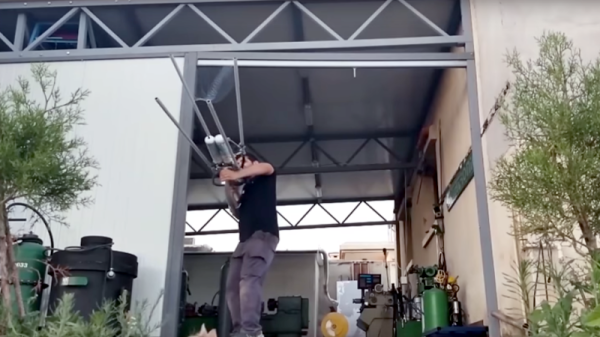
It’s powered by quadcopter LiPo batteries, 2x 1400 MaH drone batteries wired up in series and triggering 21SWG copper coils that [miroslavus] created with the help of a custom 3D-printed winding rig he designed. The rigs have ridges to help you lay the coils down neatly, and they also have mounts for photodiodes, ensuring the gun knows when it’s loaded.

When triggered, the Arduino Nano activates a pair of IRF3205 MOSFETS with logic signals stepped up to 20V, shooting lengths of 7mm or 8mm steel rod. The gun isn’t exactly creating plasma discharges with its launches, but it’s a fascinating project nonetheless.

Check out the disposable camera coil gun project and the coil guns for newbies posts we previously ran.

Continue reading “Making A Coil Gun Without Giant Caps”

Alexa In A Bunny Rabbit

The Raspberry Pi is the perfect candidate for Google’s AIY where you can talk to a cardboard box with some electronics in it. [BuddyCasino] took on the challenge of squeezing an Alexa Client in an ESP32 and to make things interesting, a bunny rabbit was chosen as the host of the virtual assistant.

A few months ago, we did a teardown of the Google AIY Kit where [BuddyCasino] commented that he managed to port the Echo Dot client into and ESP32. Sure enough, the video below shows a demonstration of the build in action. The project uses the MAX98357A which is the same I2S DAC used in the Google AIY Voice Hat. For the microphone, the device is again an I2S component however unlike the Google AIY kit which uses the SPH0645LM4H, [BuddyCasino] opted for the ICS-43434.

Two NeoPixels are employed as visual indicators for various purposes. This project is an excellent example of how simple and cheap modern-day designs have become. We are hoping to see the author add more features to the design and who knows maybe we will see a Google Assistant port on the ESP32 in the future. Check out the original teardown for more inspiration. Continue reading “Alexa In A Bunny Rabbit”

A Gas Model Made Of Magnets

Magnets are great stuff and everyone loves them, there are so many things you can do with them, including creating a model of the crystalline structure of solids, just as [Cody´s Lab] did using a bunch of magnets inside a pair of plexiglass sheets.

Crystal structure of ice. Image from Wikemedia Commons.

Many materials have their atoms arranged in a highly ordered microscopic structure — a crystal — including most metals, rocks, ceramics and ice, among others. The structure emerges when the material solidifies looking for the minimum energy configuration. Every atom interacts with its neighbors via microscopic forces forming several patterns depending on the specific material and conditions.

In his macroscopic world, [Cody´s Lab] used the magnets as his “atoms” and the magnetic repulsion between them represent the microscopic forces. Confining the magnets inside two transparent walls, one can see the formation of the crystal structure as magnets are added one by one.

This is an excellent teaching resource and also a fun way to play with magnets if you want to give it a try. Or if you want another magnet hack, we have tons of them, including implanting them in your body, or making your own with 3D printing.

Continue reading “A Gas Model Made Of Magnets”

Pouring 1200° Tea: Foundry In A Fire Extinguisher

Let’s face it — the design of most home foundries leaves something to be desired. Most foundries are great at melting metal, but when it comes to pouring the melt, awkward handling can easily lead to horrific results. That’s why we appreciate the thought that went into this electric melting pot foundry.

Sure, electric foundries lack some of the sex-appeal of gas- or even charcoal-fueled foundries, but by eschewing the open flames and shooting sparks, [Turbo Conquering Mega Eagle] was able to integrate the crucible into the foundry body and create what looks for all the world like a Thermos bottle for molten aluminum.

The body is a decapitated fire extinguisher, while the crucible appears to just be a length of steel pipe. An electric stove heating element is wrapped around the crucible, PID control of which is taken care of by an external controller and solid state relay. Insulated with Pearlite and provided with a handle, pours are now as safe as making a nice cup of 1200° tea.

You’ll perhaps recall that [Turbo Conquering Mega Eagle] has a thing for electric foundries, although we have to say the fit and finish of the current work far exceeds his previous quick-and-dirty build using an old electric stove.

Continue reading “Pouring 1200° Tea: Foundry In A Fire Extinguisher”

Manually-Adjustable Three-Axis Gimbal

[Tim Good] built a 3-axis gimbal out of 3D-printed and machined pieces, and the resulting design is pretty sweet, with a nice black-on-black look. He machined the flat pieces because they were too long to be printed in his 3D-printer.

The various axes swivel on four bearings each, and each ring features a manual locking mechanism made out of steel stainless pins that immobilize each axis. The gimbal operation itself appears to be manual. That said, [Tim] used 12-wire slip rings to power whatever camera gets mounted on it–it looks like the central enclosure could hold a camera the size of a GoPro.

[Tim] has shared his design files on Thingiverse: it’s a complicated build with 23 different files. This complexity got us wondering: aren’t there two pitch axes?

We definitely love seeing gimbal projects here on Hackaday. A few cases in point, a gimbal-mounted quadcopter, another project with a LIDAR added to a camera gimbal, and this gimbal-mounted coffee cup.


Turning And Burning With A CNC Pyrography Machine

With CNC machines, generally the more axes the better. Three-axis machines with a vertical quill over a rectangular workspace are de rigueur, and adding an axis or two can really step up the flexibility of a machine. But can only two axes be of any use? Sure can, as witnessed by this two-axis CNC wood burning machine.

As [tuckershannon] tells the tale, this was a newbie build aided by the local hackerspace. Axis one is a rotary table of laser-cut wood gears powered by a stepper. Axis two is just a stepper and lead screw sitting on a couple of blocks of wood. A Raspberry Pi under the hood controls the motors and cycles the pyrography pen on and off as it scans across a piece of wood on the rotary table, burning a spiral pattern that makes for some interesting art. Hats off to [tuckershannon] for figuring out the math needed to adapt to the changing speed of the pen over the wood as the diameter gets bigger.

We love this build, can’t help but wonder if some clever gearing could eliminate the need for the second stepper. And perhaps an upgrade from the standard resistive wood burner to an arc lighter pyrography pen would improve resolution. Still, it’s hard to argue with results, and this is a great hack.

[via r/raspberrypi]

Thanks to [Liz] for the tip!

You Know You Can Do That With A 555

Hardly a week goes by that we don’t post a project where at least one commenter will lament that the hacker could have just used a 555. [Peter Monta] clearly gets that point of view. For a 555 design contest, he created both digital logic gates and an op amp, all using 555 chips. We can’t quite imagine the post apocalyptic world where the only surviving electronic components are 555 chips, but if that day were to come, [Peter] is your guy.

Using the internal structure of the 555, [Peter] formed a basic logic gate, an inverter, latches, and more. He also composed things like counters and seven-segment decoders. He had a very simple 4-bit CPU design in Verilog that he was going to attempt until he realized it would map into almost 400 chips (half of that if you’d use a dual 555, but still). If you built this successfully, we would probably post it, by the way.  You can see a video of the digital logic counter, below.

Continue reading “You Know You Can Do That With A 555”