Programmable DC Backup Power Supply

The uninterruptible power supply was once a standard fixture in the small office/home office as a hedge against losing work when the electrons stop flowing from your AC outlet. Somewhat in decline as computing hardware shifts away from dedicated PCs toward tablets, phones and laptops, the UPS still has a lot of SOHO utility, and off-the-shelf AC units are easy to find. But if your needs run more to keeping the electrons flowing in one direction, then you might want to look at [Kedar Nimbalkar]’s programmable DC backup power system.

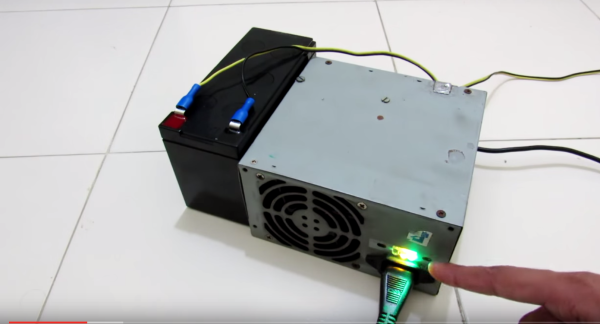
Built inside a recycled ATX power supply case, [Kedar]’s project is heavy on off-the-shelf components, like a laptop power supply for juice, a buck converter to charge the 12 volt sealed lead acid battery, and a boost converter to raise the output to 19.6 volts. An Arduino and an optoisolator are in charge of controlling the charging cycle and switching the UPS from charging the battery to using it when mains voltage drops.

 If you need a DC UPS but would rather skip the battery, you could try running a Raspberry Pi with electrons stashed in a supercapacitor. Or if you’ve got an aging AC UPS, why not try beefing it up with marine batteries?

[Thanks for the tip, Morris]

Building An Atomic Force Microscope On The Cheap!

LEGO2NANO, are building an open hardware AFM (Atomic Force Microscope).

AFMs are a kind of probe microscope. Unlike an optical microscope, a probe is used to “feel” the topology of a surface. An atomic force microscope uses a flexible cantilever with a nanometer scale tip on the end. As the tip scans across the surface it will be deflected by its interaction with the surface. A laser spot is usually reflected off the back of the cantilever, and captured by a photodiode array. The angle of the reflected beam, and therefore which photodiodes are excited lets you know how much the cantilever was deflected by the surface.

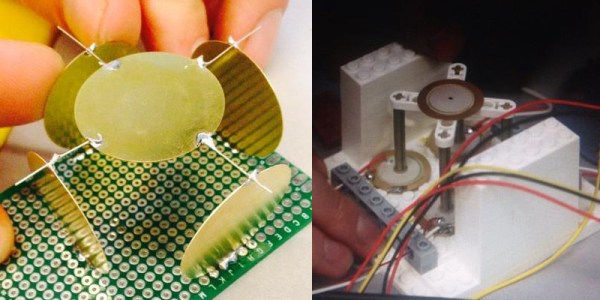
One of the challenges of building an AFM is developing an actuator that can move with nanoscale precision. We recently reported on [Dan Berard]s awesome capacitor actuator, and have previously reported on his STM build which uses a piezo buzzer. LEGO2NANO are experimenting with a number of different configurations, including using Piezo buzzers, but in a different configuration to [Dan]s system.

The LEGO2NANO project runs as a yearly summer school to encourage high school students to take part in the ambitious task of building an AFM for a few hundred dollars (commercial instruments cost about 100,000USD). While the project isn’t yet complete, whatever the outcome the students have clearly learned a lot, and gained an exciting insight into this cutting edge microscopy technique.

Hack Your Own Analog Camera

We remember making pinhole cameras as kids out of cigar boxes. The Focal Camera website wants to enable you to make sophisticated cameras from a selection of building blocks. We’re talking cameras with film, not digital cameras (although we wondered if you could mount an image sensor… but that’s another hack).

The modules do require access to a laser cutter, and you’ll need to scrounge or otherwise acquire things like mirrors and lenses. The site has advice on how to hack things like first surface mirrors out of cheap items like acrylic mirrors.

The intent is to be able to build up your own cameras from the modules. They do have a pinhole camera, in case you are nostalgic, but you could also build SLRs, large format cameras, or even stereo cameras. Not all the modules are ready yet, but there are several example cameras and pictures taken with them on the site. Like most building blocks, the real treat will be when users begin to combine them in unexpected ways.

Continue reading “Hack Your Own Analog Camera”

Using A Capacitor As An Actuator?!

[Dan Berard] has been using capacitors as actuators.

We’ve featured Dan’s awesome self built STM (scanning tunneling microscope) before. These microscopes work by moving a tip with nanometer precision across a surface. While the images he acquired are great, one disadvantage of the actuator he used is its poor rigidity. This limits the system to faster scan speeds.

In his search for a better actuator [Dan] thought he’d try using MLCC capacitors! While not known for their electromechanical properties, you may have encountered capacitors that appear to “sing” (PDF), emitting an audible tone. This is due to the piezoelectric properties of BaTiO3. Effectively the capacitor acts as a weak piezo electric speaker.

Using a 100V drive voltage [Dan] was able to get 300nm of deflection using the capacitor. To extend the range of the actuator he decided to ‘pole the ceramic dielectric’ this involved heating the capacitor above its Curie temperature of 120C. For this he used a transistor to heat the part as an ad-hoc hotplate. This increased the range of the actuator to 800nm, ideal for many STM (and other SPM) systems.

[Dan] is still weighing up his options for his next build, but MLCC capacitors are certainly a cheap and interesting choice.

Adventures With Vacuum Deposition Power Supplies

[macona] called this a “fail of the week”, but of course failure is just another part of the hacker adventure. Fail and fail often! He’s been slowly assembling a vacuum deposition system. These systems let you deposit thin films on a substrate. Vacuum deposition systems have all sorts of exciting applications, not only are they used in semiconductor manufacturing, but as [Ben Krasnow] has shown can create conductive transparent coatings. They’re even sometimes used for silvering mirrors.

A common feature of these systems is that they require high voltage, we’re not talking a few hundred volts or even a few thousand volts. But 10 to 20 kilovolts. You need such a high voltage in order to accelerate electrons and ions, which are used to eject atoms from a source and deposit them as a thin film on a substrate.

It was this HV supply [macona] was working on, cobbling the system together from parts found on eBay. Unfortunately he could only reach 9kv unloaded, which we’d expect to drop considerably under load. So [macona] has now found a different solution. But this teardown and write up still makes great reading.

We’re left to pondering on what projects the spare parts could be useful for: “I might be able to series the secondaries and get 30kv at 500ma! That would make one hell of a bug zapper! Actually these transformers scare the hell out of me….” me too Jerry! Me too!

You Can Have My TIPs When You Pry Them From My Cold, Dead Hands

We’ve seen a growing number of posts and recommendations around the net regarding components, specifically transistors. “Don’t use old parts” they cry,  “Go with newer components.”  You can often find these recommendations on Arduino forums. This all came to a head with a page called “Do Not TIP,” which was linked in the Arduino subreddit.  This page belongs to [Tom Jennings], creator of Fidonet, and one of the early authors of what would become Phoenix BIOS. [Tom] and a few others have been calling for everyone to send their old parts to the landfill – not use them, nor gift them to new experimenters. Get them out of the food chain. No offense to [Tom], but we have to disagree. These parts are still perfectly usable for experienced designers, and have a lot to offer new hardware hackers.

TIP is the part number prefix for a series of power transistors created by Texas Instruments.  In fact, “TIP” stands for Texas Instruments Power. The series was originally released in 1969. Yes, that’s right, 1969. Why are we still using parts designed when man first walked on the moon? The same reason people are still using the 555 timer: they’re simple, they’re easily available, they’re robust, and most of all, they get the job done. The TIP series has been used in thousands of classes, tutorials both online and off, and millions of projects over the years. Much of that documentation is already out there on the internet. The TIP series is also out in the distribution channel – they’ve been used for 40 years. Any retail shop that stocks a few electronics parts will have at least one of the TIP series.

The TIP series aren’t always the best transistors for the job. However, for most hobbyist-designed circuits, we don’t need the best performance, nor the best price – we’re going to use the parts we have on hand. There is always room to improve once you get the basic circuit working.

Continue reading “You Can Have My TIPs When You Pry Them From My Cold, Dead Hands”

Becoming A State Machine Design Mastermind

Imagine a robot with an all-around bump sensor. The response to the bump sensor activating depends on the previous state of the robot. If it had been going forward, a bump will send it backwards and vice versa. This robot exhibits behavior that is easy to model as a state machine. That is, the outputs of the machine (motor drive) depend not only on the inputs (the bump sensor) but also on the current state of the machine (going forward or backward).

As state machines go, that’s not an especially complicated one. Many state machines have lots of states with complex conditions. For example, consider a phone switchboard. The reaction to a phone going off hook depends on the state of the line. If the state is ringing, picking up the phone makes a connection. If the state is idle, the phone gets a dial tone. The switchboard also has to have states for timeouts, connection failures, three way calling, and more.

If you master state machines your design and debug cycles will both move along faster. Part of this is understanding and part is knowing about the tools you can choose to use. I’ll cover both below.

Continue reading “Becoming A State Machine Design Mastermind”