High Voltage Rig Wipes CDs Clean

hv_cd_destruction

Here at Hackaday, we’re not against showing videos of gratuitous destruction just for the sake of it, though we try not to make it a habit. In this case we just couldn’t help ourselves. However, this video technically constitutes a security hack, as it does involve erasing sensitive information from CDs…

…with awesome!

This may be the coolest CD eraser we’ve seen yet. Positioned between two high-voltage transformers, the spinning CD has its data violently stripped off in just a matter of seconds. To be fair, the data isn’t erased per se, but the metallic substrate on which the data is recorded is flaked off by the aggressive application of electricity.

Having destroyed our fair share of AOL CDs in the microwave over the years, we are now a bit sad over the fact that they were disposed of in such a lackluster fashion – if only we had one of these around!

Since we’re on the topic of mindless destruction, you might as well take a few minutes and check out this thermite-roasted Thanksgiving turkey, this self-destructing hard drive, or perhaps this thermic lance built from spaghetti.

You know, for science.

Continue reading “High Voltage Rig Wipes CDs Clean”

EagerFeet Lets You Scrape Your Nike+ Data From The Web

Runners that wear shoes with the Nike+ system can upload GPS data about their runs to the proprietary website. If you’ve been using this for a while you may be reluctant to switch to another service that works with the hardware because you don’t want to lose the historical data. Faced with this issue, [Robert Kosara] developed some software that can scrape Nike+ data. Not only did he write the code, but he also threw up a website that shows how well it works. EagerFeet lets you copy and paste your Nike+ ID for mapping on Google Maps.

Data is scraped from Nike+ and assembled as GPX files, which are backups of GPS data. From there you can use it for whatever you like. Since the code is available in a Git repository it’s easy to depend on it with your own projects, and still get updates if the scraping system needs to be changed in the future. Even if you don’t want to use the GPX files in your own projects, they can be imported on some third party exercise tracking sites if that’s what you’re interested in.

Of course you could try to pull the data straight off of your iPod.

Apple II Weather Display (part 2)

In part one of the Apple II weather display I quickly went over how data is fetched and phrased. Now its time to do something with it in part 2. In the order of functions I do the text parts first, and though its very similar to the process that the radar image goes through, its in monochrome and a bit simpler to explain. Before I go into how it works I should explain how I am dividing the Apple II’s screen.

Continue reading “Apple II Weather Display (part 2)”

Mechanical Twitter Feed For Offline Reading

mechanical_twitter_feed

Twitter can be a great tool for keeping up to date with your favorite person/company/band/etc. You can find a Twitter client for just about anything that plugs in these days, but sometimes we find that we simply need a break from our computers and smart phones – even if just for a few minutes. What happens when you want to unplug, but still need to know what everyone is up to?

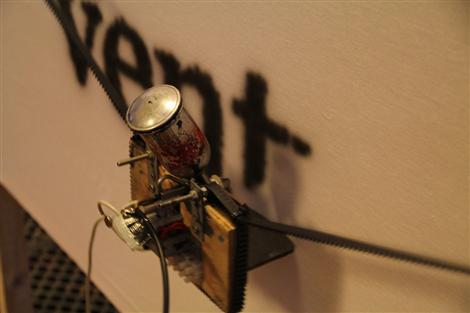
[Patrick Dinnen] asked himself the same thing, and decided that the solution was a mechanical Twitter feed display. The display consists of a static user list strung up against the wall, with a mobile speech bubble mounted next to it. The bubble moves to the user who has most recently updated their status (presumably using a pair of servos), and uses a projector to display their messages. The effect is pretty neat, and it still allows you to get your Twitter fix without staring blankly at your computer screen or smart phone.

We think it would be even cooler if it used a projector on both sides, enabling it to dynamically shuffle through users and status messages at the same time. [Patrick] says that for right now it is merely a proof of concept, so there is no telling how he’ll tweak it going forward.

Continue reading to see his mechanical Twitter feed in action.

[via Adafruit]

Continue reading “Mechanical Twitter Feed For Offline Reading”

Apple II Weather Display (part 1)

Due to computer issues I had to rob some parts from my “electronics” computer, which wasn’t bad, since I was not working on anything at the time and I felt a software project itch. I also wanted to do something with my Apple //c, which resides on my computer desk, so this ghetto brute force “solution” to use the 25 year old computer as a weather display came about.

In a nutshell there is the Apple II, a serial cable, and a PC running linux mint 10 and a handful of command line utilities. My specific Apple is the fist revision of the //c which means its got a buggy rom and the serial port(s) can be troublesome, the best speed I was able to get was 600 baud with just basic, though every other model could probably go a little faster.

On the linux side, wget downloads html and the radar image from Weather Underground’s mobile site, which is not a perfect source, but its easy. A lua script phrases text and graphics into string patterns that the Apple II can handle as keyboard input, and its sent down a serial cable where it is drawn on screen in basic.

Yea its pretty darn slow … it typically takes about eight to twelve minutes to redraw the screen, which is not all that horrid (imo) considering what is going on, but anyone with a more serious take on this could find numerous ways to optimize it, I just wanted to see what it would look like.

Join us after the break for a short video and to read all the details about how this all works!

Continue reading “Apple II Weather Display (part 1)”

Pinewood Derby Cars Have Come A Long Way

Get your graphite and hike a wheel, [Aron Hoekstra] writes in to completely embarrass us with some excellent pinewood derby cars.    In the pursuit of that extra something [Aron] consulted with his sons who came up with some cool ideas for cars, one Tron themed and the other basically a Wiimote with wheels! The official Pinewood derby rules say nothing about electronics, so as long as nothing helps the block-o-wood travel down the track faster, anything goes. This means you are free to load up whatever cool lights you want, but will have to earn your robotics merit badge some other way.

[Aron] Starts the builds by carving out the shape of the cars, each feature a hollowed out cavity underneath to accommodate the batteries and electronics. For the Tron Light Runner car, one continuous EL strip weaves in and out of the derby car’s body, and a single AAA battery runs the driver. [Aron] notes that it took around five feet of EL wire to cover the little car, which is two more than the driver is rated for. Fortunately the extra little bit of additional wire had little effect on its brightness.

The Wiimote car has detailed 3d buttons, a breadboard with a linear regulator,  and PIC 16F628 driving  blue LEDs.  For the majority of the time the PIC simply runs a chase routine for the four LEDs, but [Aron] went through the trouble to program in the Wiimote’s start-up sequence!

Shown above the [Hokestra]’s work is my older brother’s pinewood derby car (top left) and my… potato rocket… thing… (top right)  from many many years ago. I now seriously regret not considering LEDs! Although I think all that existed then was red,  green and IR.

Check out videos of the [Hoekstra] bros’ cars after the jump!

Continue reading “Pinewood Derby Cars Have Come A Long Way”

aquarium_pump_shutoff

Aquarium Overflow Sensor Saves Your Fish And Your Floors

If you’ve ever had a water leak in your home, you know the sinking feeling that comes over you as you walk through the door to the sound of running water. [Greg] knows this feeling quite well, having returned home to a sopping wet floor and an overflowing reef aquarium on more than one occasion.

Both of the overflows he experienced were due to a clogged drain in his display, but there was little he could do as far as walling off the drain from potential blockages. With all of the delicate creatures living in the tank, the only possible solution that came to mind was monitoring the aquarium’s water level.

Unfortunately he had no idea how to get this done aside from using probes (which would rust in the salt water) or expensive off the shelf systems. [erich_7719] from the All About Circuits forums helped [Greg] out and designed a circuit for him which would monitor the water level using an IR sensor. The circuit simply shuts off the pump if the water level gets precariously high. As you can see in the video below it works quite well, and as a safety measure, requires a manual restart of the pump once the high water sensor has been tripped.

If you have a need for the same sort of setup, swing by his site for a detailed schematic as well as a bill of materials.

Continue reading “Aquarium Overflow Sensor Saves Your Fish And Your Floors”