Nerf Gun Converted To CO2 Powered Semi-automatic

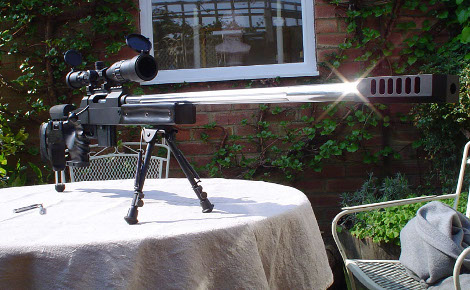
[Philysteak527] modified a Nerf rifle, making it semi-automatic thanks to the powers of compressed air. This is not a simple change to make, and rests on his ability to design and manufacture a bolt-action that fits in the gun, works with the Nerf ammo, and uses a CO2 canister and solenoid valve for the firing action. Knowing that, it’s not surprising to find that he’s an engineering student at Stony Brook University. He started with some POM, or polyoxymethylene plastic sold under the brand name Delrin, and used a CNC lathe to machine the parts for the bolt. Add in some brass fittings, a solenoid, tubing, and the electronics and you’re in business.

We’ve embedded the test footage after the break. Looks like the new internals allow a rather fast firing rate (maybe 2-3 shots per second?) and achieve a distance between seventy and one hundred feet.

Continue reading “Nerf Gun Converted To CO2 Powered Semi-automatic”

Water-blob Launcher

This rifle-shaped water cannon looks great and packs a big punch. We guess you could say that it’s a water balloon launcher, but the balloons are torn off and drop like the wad from a shotgun shell when fired. So we think this launches water blobs, or orbs, or something along those lines.

[Wolf] built it using PVC and some brass fittings that allow for the injection of compressed air. There’s a slick valve system that he developed which we don’t get a great look at in the build pictures. Fortunately, there’s an animated GIF that shows the various stages. Using his valve there’s no need for any electrical system like a lot of other pneumatic launcher systems use.

Just like the water-filled ping-pong gun, you’ve got to be careful with this thing. As you can see in the clip after the break there’s lethal force behind these projectiles. Especially when [Wolf] swaps out the water balloons for big steel darts.

Continue reading “Water-blob Launcher”

Hopefully Detect Trolls Before They Devour You

In the cold and mysterious wilderness of Norway, it pays to be ready for anything–especially heavy-walking trolls. The team at [nullohm] decided to prepare thoroughly for their trek into the woods to witness the Leonids meteor shower by putting together an Arduino-based “troll detector”.

The device is based on the superstition of hammering a steel spike into a tree to keep trolls away from camp. This goes one step further by including an accelerometer and LED indicators so that you can tell exactly what type of troll is just about to feast upon your tender human flesh.

When the detector is installed into a nearby tree, it takes an average seismic measurement and then looks for telltale footfalls. Even if you’re not concerned with perpetuating superstitions, you might find a use for the source code for simple seismic activity monitoring at home to supplement your miniature seismic reflector.

Making Model Rocket Motor Igniters

[Stephan Jones] has an easy method for making your own model rocket engine igniter. The solid state motors used in this hobby consume one igniter with each electrically triggered launch. Whether you’re making your own motors or not, this construction technique should prohibit you from every buying an igniter again. The process involves bending some nichrome wire around a paper clip, adding some structural support to the leads using masking tape, and insulating the business end with a quick dip in paint.

Now would be a good time to send us your launchpad hacks. All we’ve seen so far is a launchpad for water rockets.

[via Make]

Final Take On The Machine: Winners

It’s finally here, the last episode of Scion’s Take on the Machine with Mitch Altman. In this episode all the teams are given a recap over their success and failures, and the clear winner is placed on top. We’re not ones to spoil the surprise so you’ll just have to click the link and watch to find out.

But lets take a moment to remember each team, The Transistor and their live action zombie game. Crash Space and their musical building. Pumping Station: One and their ice cream maker. Artisans Asylum and their breakfast machine. And lastly, NYC Resistor and their drink mixing slot machine.

Who’s ready for next season? There isn’t a next season you say? Perhaps a new influx of sponsored hackerspace competitions will spring up, or the whole concept will die out as quickly as it came. Either way, it’s all about the money fun and educating experience, right? And that’s all that matters.

[Thanks Deven, sorry you guys didn’t win.]

DIY Vaporizer

Here’s a DIY vaporizer build. It uses a 30 watt Radio Shack soldering iron as a heat source that is regulated with a common dimmer switch. This is done by removing the soldering tip and replacing it with threaded rod attached to a brass pipe fitting assembly. This is housed inside of a Mason jar with a copper pipe for air intake and another for output. Not surprisingly the creator tipped us off anonymously, saying that this a “smoking accessory”. A bit of searching and we came across this Wikipedia article about a Volcano Vaporizer which sheds light on what one is used for.

We don’t condone using illicit substances. But even more so, we’re skeptical about breathing through this thing because of the warning that [Anon] included about noxious vapors put off by the epoxy putty when it heats up. Still, it’s an interesting build so we though we’d share.

Carbon Fiber Part Fabrication Guide

If you’re thinking of working with carbon fiber this guide should be a big help. The example is aimed at the automotive crowd but the principles transfer quite easily. Carbon fiber parts are constructed in a similar manner as fiberglass parts. A mold is covered in a release agent, the fibers are put in place and covered in epoxy. With fiberglass the fibers are often sprayed on but carbon fiber components use woven mats of the material to build up multiple layers. Vacuum bags are used to hold the layers together, removing air and impregnating the fibers with the epoxy. This guide even outlines the construction of a vacuum pump needed for that step.

The benefits of carbon fiber are many, including strength and weight reduction. This makes it a great material for adding parts to weight-sensitive hacks such as quadcopters. But the mesh also has an interesting look which is why it shows up in custom electronics cases. The one real drawback is that when this material fails it is a catastrophic failure, tending to crumble across the entire structure rather than limiting damage to a small area. That means that a rough landing might be the end of your new parts.

[Thanks MS3FGX]