Another IKEA Linux Cluster

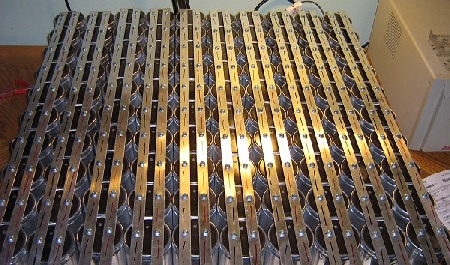
In a bit of serendipity, reader [Tim Molter] had decided on the IKEA Helmer cabinet for his new cluster right before seeing the previous IKEA cluster we covered. He and his coding partner recently completed building their own version of the IKEA Linux cluster. The cabinet was $30 and holds six headless boxes. Each board has a quad-core AMD processor for a total of 24 cores. They also feature 1GB of RAM and an 80GB laptop SATA drive. The latter was chosen because of space limitations in the case. [Tim] describes the Helmer cabinet as being almost perfect. The power supply lines up with the top edge of the drawer and the motherboard fits with a millimeter to spare. Power buttons were added to the front plus slots for airflow. It looks like a really clean installation and at $2550, incredibly cheap for the processing power.

Space Tech Helps Athlete Attain World Record

German athlete [Wojtek Czyz] set a new world record for the long jump at the Paralympics 2008 in Beijing, with the aid of his space tech enhanced prosthetic leg. He jumped a record 6.5 meters, 27 centimeters more than the previous record. Prior to switching to his new prosthetic leg for athletic competitions, he was prone to breaking the prosthesis when he performed to the best of his abilities. [Czyz] and his trainer met with ESA’s Technology Transfer Programme (TTP) technology broker MST Aerospace to assess the most important parts of the prosthesis. According to [Dr. Werner Dupont], MST Aerospace Managing Director, the crucial element was the connection angle, or L-bracket. Working with German company ISATEC, they developed a new L-bracket using a much lighter and stronger material from the Alpha Magnetic Spectrometer (AMS), which is an instrument that will be installed on the ISS to study extraterrestrial matter. We find it interesting and pretty cool that space technology can help enhance a disabled athlete’s performance, and think that this could lead to interesting possibilities, even for those who aren’t athletes.

[via Boing Boing]

Hack A Day Is Always Hiring


We’re always looking for people to contribute posts daily and help expand the site. We’ve added a handful of contributors in the last couple months, which you can see in our new How-tos.

This is a paid, freelancing position that requires professionalism, consistency, and reliability. We want to hear from people that are passionate about software/hardware hacking and growing Hack a Day. To apply, send the following to jobs@hackaday.com

  • A short bio about yourself
  • 3 example daily posts written in the style of Hack a Day
  • 3 software or hardware how-tos you’d like to see. For examples of work we’ve done in the past, look here, here, here, and here.
  • A couple sentences on how you would improve the site either through features or content
  • Any additional reasons why you would make a good fit for Hack a Day

Do not send any attachments. Having your own blog you can show off is a definite plus.

[photo:fbz]

Animated LED Eyes For Halloween

[Matt Daughtrey] sent us this sweet little project he’s doing for Halloween. He’s building some animated LED eyes. He says that the whole thing is 3 individual LMDriver platforms, another project he’s working on. There isn’t any info available about that, but he does expand a little. He states that each display module uses an Atmega169 with some heavy multiplexing.  The eyes really don’t look that impressive sitting on the bench, but watch the video to see how cool they really are.

We noticed that the back of the boards appear to have http://www.embeddedether.net on them.  Unfortunately that site seems to have been grabbed by a domain squatter.

How-to: Networked Graffiti Wall

[youtube=http://www.youtube.com/watch?v=G8KprTVbHD4]

Wondering what we did with our web server on a business card project from last week? It’s powering a giant LED graffiti wall. Animations can be user-submitted using the online designer. You can watch a live feed of user animations as well. The online interface runs on the Google App Engine for maximum scalability and resilience.

In today’s How-to we cover all the ins and outs of building your own networked graffiti wall. Continue reading “How-to: Networked Graffiti Wall”

Arduway: A Mini Segway Using The Arduino

[Joe L] sent in the Arduway on the tipline. It is a robot made of Arduino and Lego NXT components based on the Segway. A software library to control LEGO NXT motors and a few sensors he used is available on SourceForge. This robot does a good job of balancing itself while moving forwards and backwards.

There is a YouTube video of it in operation after the break.
Continue reading “Arduway: A Mini Segway Using The Arduino”

PICBASIC Complex LED Matrix

This PICBASIC complex LED matrix solution was developed by [Olivier de Broqueville] to drive a matrix of LEDs. Using some cheap transistors, common red LEDs, and a PIC16F628, he is able to drive a 6×6 LED matrix. This project is very well documented and has everything available including: circuit board layouts, schematics, PICBASIC source, VB computer interface program, and parts list.