
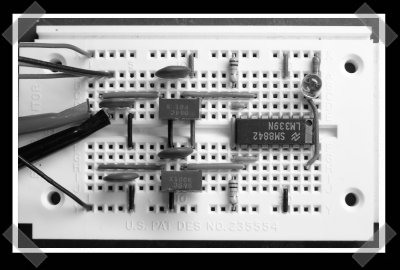
This is an interesting way to monitor your speakers. [Keith] put together this speaker line monitor after a commenter requested it on his blog. It’s designed to check for power on the speaker line and drive a logic/led output. Apparently there’s some risk of shorting your amp, so he’s planning to redesign the input stage. Still, it’s neat little hack to keep an eye on things. Personally, I’d just put em on their own class A amp and automate the power switching, but there are plenty of situations where this could be useful.
Misc Hacks4029 Articles
Quarter Shrinker (can Crusher Follow-up)

[Paul Anderson] sent in this classic quarter shrinker after seeing the can crusher the other day. It’s another high powered pulse shot into a coil system, but uses a solenoid actuated spark gap switch to swith those sweet high voltages. The results are quite impressive.
Home Brewing Beer Brewery

I saw this last month in Popular Science, but it wasn’t online for a while. This (nearly) all-in-one brewery was built by [John Carnett]. It does everything but requires malt extract for now. It boils wort, cools it for fermenting, delivers the brew to the kegs and most interestingly to me – uses cold plate cooling to cool the beer just before it exits the tap. I’m pretty sure they’re using peltier junctions, but I’d like to know for sure. Props to [Nate] for inadvertently reminding me of the thing when he sent in this effort to brew beer inside a pumpkin!
Electromagnetic Aluminum Can Crushing

This has been around for a while, but we never covered it – and it’s friggin’ awesome. [jesse] sent in this crusher, but I featured this one due to a sort of draconian copyright notice on the former. The latter also uses some easier to find, hackable parts. They’re both built on similar concepts – use a large bank of capacitors to store up the energy needed, and deliver it in one large pulse to a coil electromagnet. The resulting force lasts for a short time, but is enough to physically crush an aluminum can inward without touching it. Yet another one has some more dramatic examples of crushed cans.
Hooptyrides, Inc. Open House
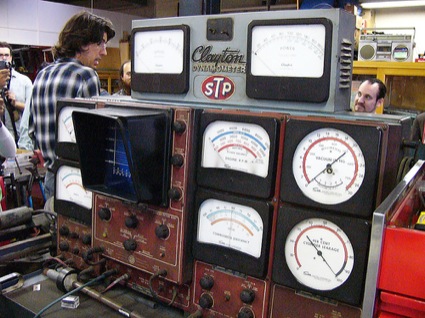
We didn’t even pause for a second when offered a chance to tour Mr. Jalopy’s studio. Even if it meant a 600 mile roundtrip, we’d be there. You’ll probably recognize Mr. Jalopy as the author of Hoopty Rides and as a frequent Make Magazine contributor know for his giant iPod and guerilla projector. Dorkbot SoCal organized a studio tour so that fellow hackers could pick up some of the Hoopty Rides secret sauce.
DIY Coil Winding Machine
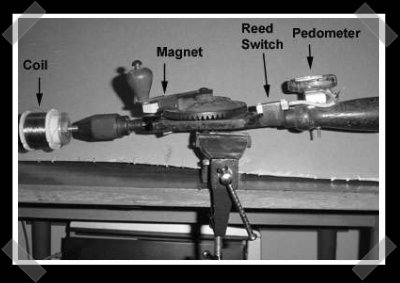
This will probably be more useful to custom speaker builders, but coil winding has always been a bit tedious. [iwicom] put together a simple coil winder using a hand drill, a magnet, a reed switch that triggers a pedometer. Aside from the coil winder, I love the idea of using the pedometer as a cheap event counter.
Computer Controlled Lawn Defender
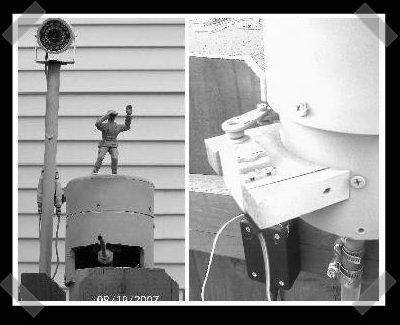
I found this thanks to [Mark









