
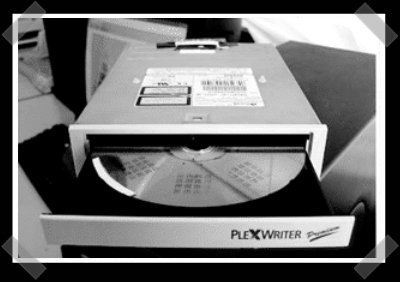
[bodiby] was first to send in this New Scientist article about converting a DVD drive into a lab scanner. I did some digging and came up with the details. Here’s the paper describing the process and results. Here’s a basic schematic and description of the mod. A set of samples is placed onto a CDR. A photo sensor is used to locate the samples on the CD, while the laser is fired through each sample. A planar photodiode is used to measure the attenuation of the laser as it’s transmitted through each sample. Sadly, I couldn’t find any details on the custom control electronics.
Misc Hacks4029 Articles
Serial Output For Your Weather Station
I spent part of my weekend with some sort of stomach virus, so Eliot stepped in for me yesterday. I’m taking next week off, so we’ll have a special guest starting Friday – but I’m not revealing who just yet.
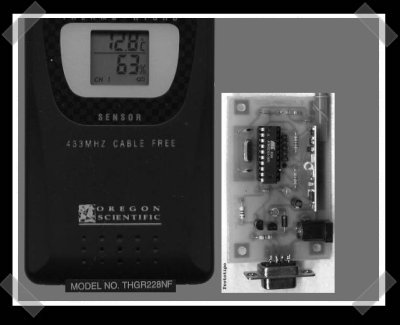
[Fickara] sent in his AVR interface(in Italian) for an Oregon Scientific remote weather station. Thanks to the AVR, data is output via RS232. There are quite a few less expensive weather stations – usually PC output models are over $100, so this could be pretty handy. His page has several other projects including an oscope clock, POV on a stick, etc.
Simple IPhone Headphone Mod
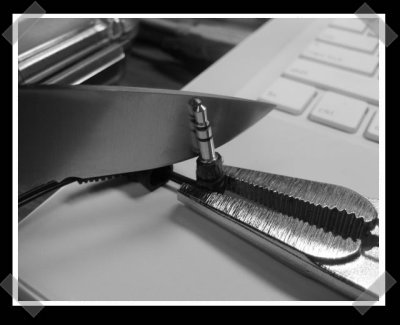
Apparently the iPhone jack isn’t quite standard – it’s a bit recessed to the point that third parties are offering adapters for it. [John] offers this simple method for modding Etymotic’s fine ER6i headphones. (If only I could find mine. I haven’t seen them for 8 months.) I suggest using a utility knife over a pocket knife. It’s simple, easy, and will probably work on most headphones.
Haptic RADAR: Electronic Whiskers
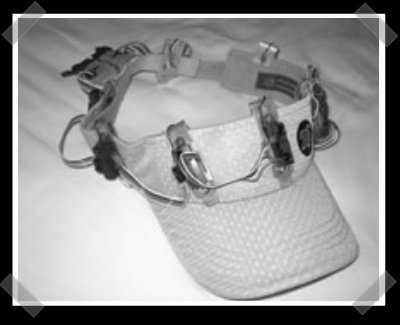
[thomph-zhu] sent in this interesting project. If you’ve ever wished for cat like senses, you’ll dig this. It’s a set of electronic whiskers – it uses IR to detect nearby objects, and vibrates against your head upon detection. It’s definitely an interesting use of tactile feedback. The initial idea is for construction safety, but this could be useful for plenty of other applications. (Robotic control, etc)
Copper Multi-tool
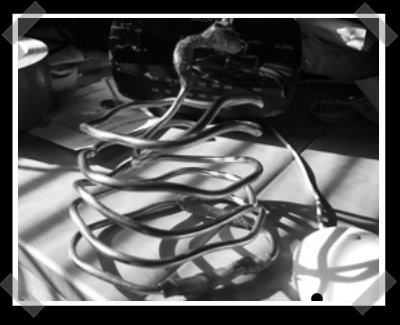
I definitely dig this one. (McGuyver was my favorite show as a kid, and it definitely reminds me of that show.) In order to perform on demand unlocking of doors without bump keys or lock picking, [Dean] keeps a roll of copper wire, augmented with a 1/4 inch bolt. It’s handy for yanking on doors or mounting a camera. Most doors are designed to keep users in, not out…
Update: Here’s a new link.
Remote Control Your Blinds
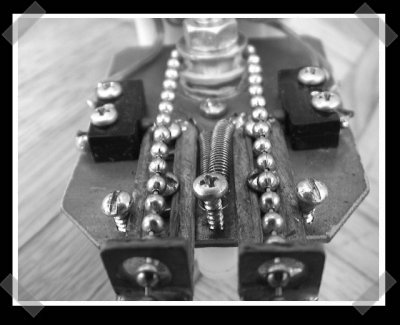
I was dredging my brain for interesting topics to cover and this vertical blind hack popped into my head. The page isn’t the prettiest, but it’s the hack that counts. The mechanism is constructed from PC board. A motor fitted with a ball chain drive gear pulls the chain in either direction. When the end of travel is reached, a micro-switch is triggered by the stand off that’s actuated by the chain. The motor is driven by a pair of relays that latch to form a simple direction control. When power is triggered on or off, the motor starts moving until the stop is triggered.
Hard Drive Clock (not A Lame Clock With A Hd Face)
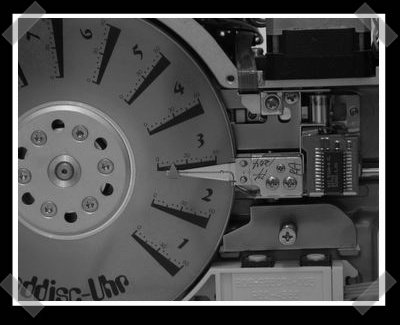
[Fred] sent in this awesome hard drive clock. Nope, just parts of a HD into a clock, but the actual drive mechanism and heads are used for this one. The arms move in and out to indicate minutes and the platter position is used to show the hour. It uses a 50hz clock, logic chips and some scrounged parts to get it all done.









