Putting Guitar Pedals In A Web Page

Only half of playing guitar – according to a few musician friends of mine – is moving your fingers up and down a fretboard and banging out some chords. The other half is the artistry of mastering your tone, usually through amp settings and stomp boxes.

Effects pedals – little boxes of electronics that go between the guitar and amp – are able to amplify and distort a guitar’s output, add reverb and delay, and even filter the tone via a wha or envelope pedal. These pedals can be simulated in software, but we can’t believe that they can now be emulated completely in JavaScript.

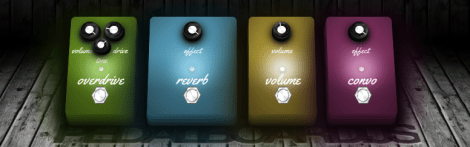
Pedalboard.js is a project put together by [dashersw], and aims to put a slew of pedals ‘in the cloud’ and turn editing and effects board as easy as building a web page.

The project is built around Webkit’s W3C audio API, allowing this virtual pedal board to work in Chrome, Safari, and other Webkit-enabled browsers. Pedals are programmed as nodes, each configurable to have and input, output, or analyzer that is able to modify the gain, wave shape, or filter of anything received by the line in on your computer.

Thee is a small demo of Pedalboard.js available here with a pre-recorded guitar track feeding into a few stomp boxes. It’s a pretty cool idea if you’d like to play around with a few guitar effect, but we can’t wait to see this bit of JavaScript implemented by effects pedal manufacturers allowing us to try before we buy.

LED Illuminated Isomorphic Keyboard Looks As Good As It Sounds

Unlike the traditional ebony and ivory found on pianos, isomorphic keyboards arrange buttons on a grid. This makes every chord the same shape, and to transpose a piece it’s simply a matter of moving your fingers a few places to the left or right. [Brett Park] sent in an isomorphic keyboard he built loaded up with LEDs, and we’re thinking it the perfect instrument for musicians looking to move up from playing their MacBook.

The body of [Brett]’s keyboard is made out of a sheet of acrylic. After drilling 64 holes for each of the clear arcade buttons, [Brett] bent the sides of his hexagonal keyboard into a very sturdy-looking enclosure.

On the hardware side, [Brett] used a 64 button Arduino shield and a Sparkfun MIDI shield. The RGB LEDs behind each button are controlled via MIDI sysex messages generated outside the instrument, making it perfect for a little bit of visual feedback from whatever soft synth you desire.

In the videos after the break, you can check out the light patterns in action along with one of [Brett]’s improvs. Notice how all the chords are the same shape, and changing the key only requires [Brett] to move his hands slightly to the side.

Continue reading “LED Illuminated Isomorphic Keyboard Looks As Good As It Sounds”

LEGO Record Player

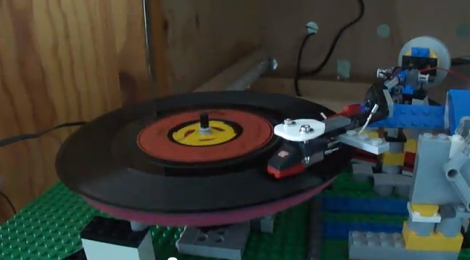
Some people claim that the sound of vinyl is superior to digital playback. While this hack wont win any awards for audio quality, [Ryan]’s LEGO Record Player is a unique use of one of our favorite toys. Most of the components including the tone arm, counterweight, and base, are built entirely of LEGO. A large gear from an educational construction set is used for the platter. Unfortunately, the rotation isn’t terribly smooth, and the playback is rather distorted.

The turntable uses a standard cartridge and stylus, which should allow it to be connected to any receiver with a phono preamplifier. Using these off the shelf parts, it’s possible to build the mechanical components a turntable out of a variety of things. As the video demonstrates, getting the platter to turn correctly is a bit of a challenge.

Check out a video of the wobbly playback featuring Cindy and Bert after the break.

Via Make

Continue reading “LEGO Record Player”

MIDI Man-in-the-middle Hack Lets You Add Pedal To The Mix

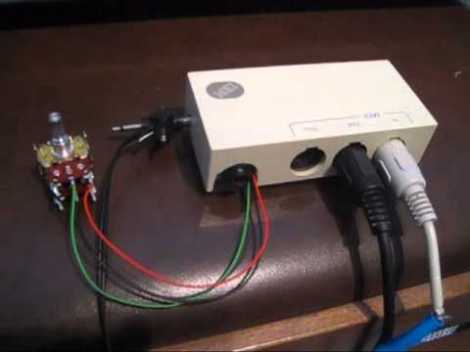
[Sebastian] has a friend who would like to use a pedal with his MIDI setup, but his keyboard doesn’t support one. Some might interpret that as a sign you need to buy a new keyboard. But [Sebastian] has already done a lot of work with the MIDI protocol. He knew it should be possible to create a MIDI pass-through which adds support for a pedal.

You can see the two MIDI cables connected to the box above. One is the input from the keyboard, the other is the output to the synthesizer. There is also a jack for a pedal input to the left. The chip inside intercepts each packet, rolling in values based from the pedal input and passing on the altered packets to the synthesizer. As you can hear in the video after the break, this works like a charm.

Catch more of [Sebastian’s] midi work by following his keyboard sensor replacement projects.

Continue reading “MIDI Man-in-the-middle Hack Lets You Add Pedal To The Mix”

BaceMaker Weds Organ Foot Pedals With Guitar Whammy Effects

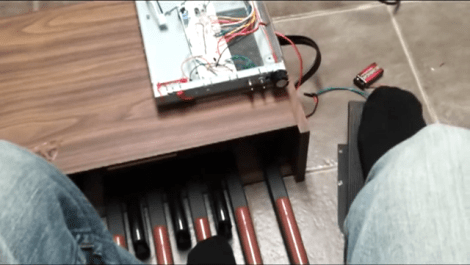
[Jon Ferwerda] managed to fry the analog electronics on an old electric organ while conducting some circuit bending experiments. It’s a loss, but he’s still left with some cool equipment to play with. Recently he got to work generating tones using the organ’s foot pedals.

There were two types of foot pedal included with this organ, the set that is arranged like a keyboard, and a rocker pedal similar to what you might use with an electric sewing machine. Since the music generation was handled by those fried bits of organ [Jon] got to work interfacing the foot keyboard with a 555 timer. He used a fairly large capacitor to get the frequency into the bass range and wired individual pedals to different parts of a resistor network. But he didn’t stop with that. The rocker pedal has its own variable resistor hardware which lets him bend the pitches are they are being generated which sounds  alike like a guitar whammy effect. He shows his work in the clip after the break. We think he nailed it! This is a perfect supplement to any type of electronic music setup.

Continue reading “BaceMaker Weds Organ Foot Pedals With Guitar Whammy Effects”

How To Make Your Own Piezoelectric Speaker

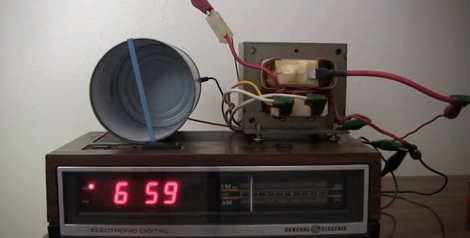
Piezoelectric speakers are found all around you, from musical greeting cards to the tweeters in your car stereo setup. Making your own piezo speakers is actually very easy, as [Steven] shows us after replacing the speaker in a clock radio.

Piezo speakers require a small crystal with piezoelectric properties, so this build is the perfect followup to [Steven]’s tutorial for making Rochelle salt crystals. After attaching two strips of aluminum foil to his Rochelle salt crystal, [Steven] took the wires that previously went to the clock radio speaker, connected them to the crystal, and turned on the radio. When attached to a tin can, the newly created piezo speaker created a little bit of sound, but the results weren’t very impressive.

To boost the sound output of his homemade speaker, [Steven] needed to increase the voltage across his piezo speaker. At first he tried a doorbell transformer with somewhat better results, but much more sound was produced when he used a transformer taken from a microwave oven.

After experimenting with his microwave transformer and Rochelle salt, [Steven] moved on to piezo elements found in BBQ and cigarette lighters. These homemade speakers were much clearer than the chunk of Rochelle salt he was using previously, and surprisingly produced about the same audio quality as a commercially made piezo speaker [Steven] picked up at Radio Shack.

You can check out the build video for [Steven]’s crystal speaker after the break.

Continue reading “How To Make Your Own Piezoelectric Speaker”

Log Guitar Uses Tube As A Bridge, Actually Is The Blues

In the never ending quest to replicate the tone of depression-era blues records, [Valve Child] managed to build the most backwoods guitar ever seen.

The body of [Valve Child]’s slide guitar was taken from the limb of a red gum tree felled during a wind storm. After taking a chainsaw, router, and sander to the guitar, [Valve] sealed it with linseed oil.

The real beauty of this build comes from the bridge and electronics: the pickup is made from six stacks of magnets encased in hot glue and wound with enamel wire. The bridge of the guitar is actually made from a 6GM8 dual triode. Not only does this provide the guitar with a wonderful brassy sound, the tube serves as a wonderful low-tech preamp when powered by a 6 volt battery.

The three strings on the guitar are tuned DAD, perfect for the likes of [Robert Johnson], or, for the younger kids, [Jack White]. Surprisingly, [Valve Child]’s guitar actually sounds really good. as heard in the video demo after the break.

Continue reading “Log Guitar Uses Tube As A Bridge, Actually Is The Blues”