Moonbounce Music

There’s something inspiring about echos. Who among us hasn’t called out or clapped hands in a large space just to hear the sound reflected back? Radio takes this to a whole new level. You can bounce signals from buildings, aircraft, the ionisphere, or even the Moon itself. Humans have been bouncing radio waves from the moon for decades. It’s been used at war, and in peacetime. But [Hainbach] might be the first to use it for music.

Earth Moon Earth or EME communication is quite popular with amateur radio operators. With the right equipment, you can bounce a signal off the moon and hear the echo around 2.5 seconds later. The echo isn’t quite normal though. The moon and the earth are both rotating and moving in relation to each other. This causes Doppler shifts. At higher frequencies, even the craters and surface features of the moon can be heard in the echo.

[Hainbach] spent some time learning about moonbounce at a large radio telescope, and wanted to share this strange audio effect with the world. Unfortunately, most of us don’t have the large microwave dish required for this. The next best thing was to create an application which emulates the sound of a moon bounce. To this end, [Hainbach] created a Moon Echo, an audio plugin that emulates a moonbounce.

Moon Echo was created using sounds from a soprano signer and a double bass. [Hainbach] had to be careful not to be too musical, as ham operators are not allowed to broadcast music. This meant all the tests had to be broken into short non-musical clips. Rolling all this empirical data into a model took quite a bit of work, but the end result is worth it.

If you’d like to learn how to moonbounce yourself, check this article out.
Continue reading “Moonbounce Music”
The Luminiferous Theremin

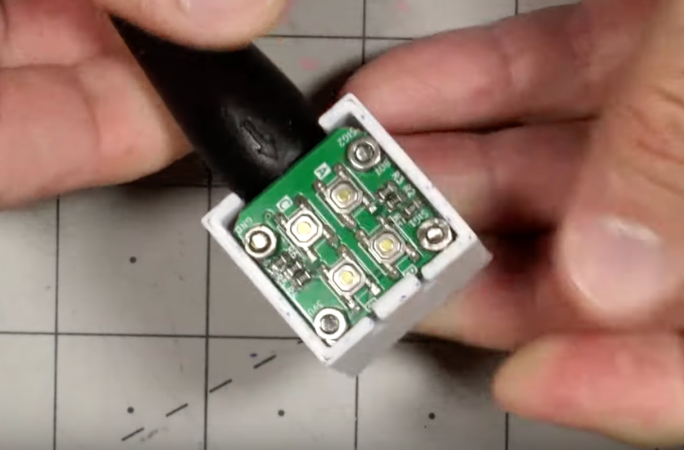
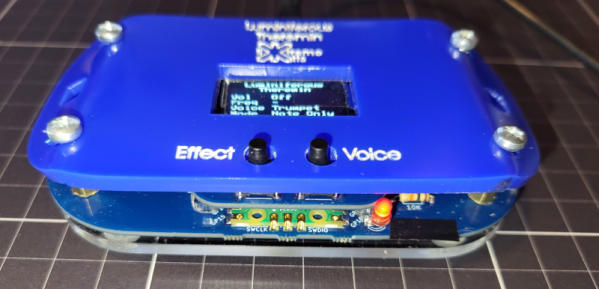
[Extreme Kits] asks the question: “What the hell is a luminiferous theremin?” We have to admit, we know what a thermin is, but that’s as far as we got. You’ve surely seen and heard a theremin, the musical instrument developed by Leon Theremin that makes swoopy music often associated with science fiction movies. The luminiferous variation is a similar instrument that uses modern time of flight sensors to pick up your hand positions.

The traditional instrument uses coils, and your hands alter the frequency of oscillators. Some versions use light sensors to avoid the problems associated with coils. While the time of flight sensors also use light, they are immune to many false readings caused by stray light.

Continue reading “The Luminiferous Theremin”

Tulip Is A Micropython Synth Workstation, In An ESP32

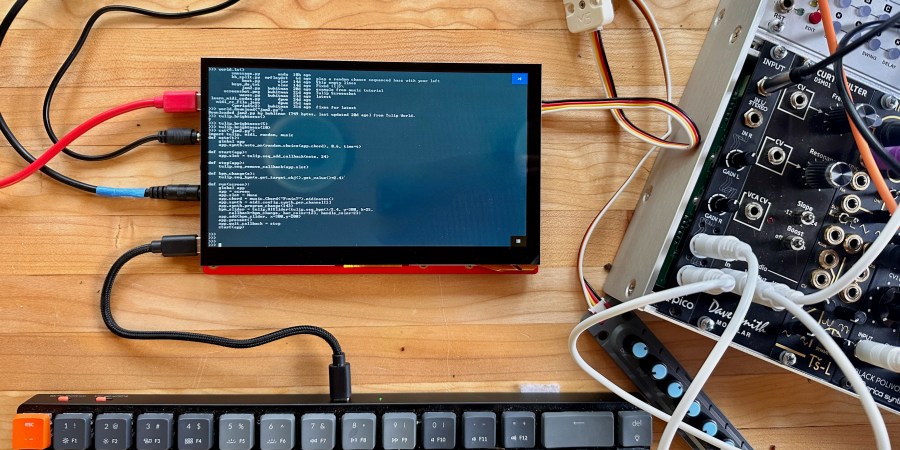
We’re not sure exactly what Tulip is, because it’s so many things all at once. It’s a music-making environment that’s programmable in Python, runs on your big computer or on an ESP32-S3, and comes complete with some nice sounding synth engines, a sequencer, and a drum machine all built in. It’s like your dream late-1980s synthesizer workstation, but running on a dev board that you can get for a song.

And because Tulip is made of open-source software and hardware, you can extend the heck out of it. For instance, as demonstrated in this video by [Floyd Steinberg], you can turn it into a fully contained portable device by adding a touchscreen. That incarnation is available from Makerfabs, and it’s a bargain, especially considering that the developer [Brian Whitman] gets some of the proceeds. Or, because it’s written in portable Python, you can run it on your desktop computer for free.

The most interesting part of Tulip for us, as programmer-musicians, is that it boots up into a Micrypython REPL. This is a synth workstation with a command-line prompt as its primary interface. It has an always-running main loop, and you make music by writing functions that register as callbacks with the main loop. If you were fast, you could probably live-code up something pretty interesting. Or maybe it wants to be extended into a physical musical instrument by taking in triggers from the ESP32’s GPIOs? Oh, and did we mention it sends MIDI out just as happily as it takes it in? What can’t Tulip do?

We’ve seen some pretty neat minimalist music-making devices lately, but in a sense Tulip takes the cake: it’s essentially almost entirely software. The various hardware incarnations are just possibilities, and because it’s all open and extremely portable, you can freely choose among them. We really like the design and sound of the AMY software synthesizer engine that powers the Tulip, and we’re sure that more synthesizer models will be written for it. This is a music project that you want to keep your eyes on in the future.

A black guitar with red rings on its body is held by a man in a black shirt. Text pointing to the red ring of guitar picks says, "This spins."

1000 Picks Make For A Weird Guitar

String instruments have a long history in civilization, helping humans make more complex and beautiful music. We wonder what our forebears would think of this guitar strummed with 1000 picks?

[Mattias Krantz] wondered what the best number of picks was to play guitar and took the experiment to its illogical extreme. Starting with zero picks and working up through various 3D printed multi-picks he tests all the feasible combinations of handheld picks.

After that, he switches gears to a fishing rod-actuated system of several picks in a ring. Not pleased with the initial acoustics of the picks in this system, he switched to printing his picks in a more flexible filament to better approximate the characteristics of the human thumb. Finally, he takes us to the undiscovered country of a spinning ring of 1000 picks strumming the underside of the strings and the… interesting acoustic result. As many pointed out in the comments, this blurs the line between a guitar and a hurdy gurdy.

If you want more melodic musical mischief, perhaps try this optical guitar pickup, a $30 guitar build, or get fancy with a 3D printed violin?

Continue reading “1000 Picks Make For A Weird Guitar”

PC-9800 Boot Sounds For Modern Computers!

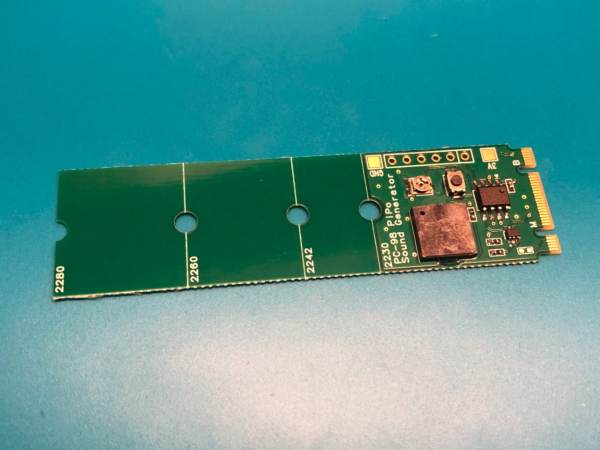
There have been many computers that played a little jingle to greet you upon booting. The NEC PC-9800 is a famous example, though almost all the Macintosh computers played either the soothing “booting” chord or sometimes the Sad Mac “error” chord. And of course, consoles have long played music on startup, with the original PlayStation boot music heralding a whole new era of video games. But modern machines don’t do anything, except maybe a single beep if you’re lucky. So why not pop in this M.2 card (JP) and bring some quirky flair to your PC?

While this particular card is aimed at the Japanese market and specifically evokes the PC-9800, we hope to see some hackers creating projects bringing other custom boot sounds to laptops and PCs around the rest of the world! A simple microcontroller, DAC, speaker and flash storage for the waveform would be all that’s required. It could even be capacitively coupled into the system’s sound output for some extra nerd points. You could pull the ultimate prank and have your friend’s laptop play the opening notes to “Never Gonna Give You Up” upon boot. Or you could have your favourite hacker movie quote play – “I can trace her physical location by looking at the binary!”. Brilliant!

In the meantime, if you want one of these cards, you’ll likely have to use a Japanese mail forwarding service as the cards are only available from Japanese retailer Kadenken — though for only ¥2880, or just under $20 USD, which is a great deal.

[via Techspot]

The Last Instrument To Get Auto-Tuned

Various decades have their musical signature, like the excessive use of synthesizers and hairspray in the 1980s pop music scene. Likewise, the early 2010s was marked by a fairly extreme use of autotune, a technology that allows sounds, especially vocals, to be shifted to precise pitches regardless of the pitch of the original source. In this dark era, a wide swath of instruments and voices on the charts were auto-tuned at some point, although we don’t remember this iconic instrument ever being featured among the annals of pitch-shifted pop music.

The auto-tuned kazoo created by [Guy Dupont] does its pitch corrections on-the-fly thanks to a built-in ESP-32-S3 microcontroller which, through a microphone inside the kazoo, listens for note of the musician’s hum and corrects it to the closest correctly pitched note. Once it identifies the note it outputs a kazoo-like pitch-corrected note from a small speaker, also hidden inside the instrument. It does this fast enough for live performances using the YIN fundamental frequency estimation algorithm. Not only can the kazoo be played directly, but thanks to the implementation of MIDI it can be used to control other synthesizers or be played through other means as a stand-alone synthesizer.

Much like the 80s, where the use of synthesizers relaxed from excessive use on nearly every instrument on every track throughout the decade to a more restrained use as the decade faded, so has autotune been toned down in most music to be more subtly applied. But like our enjoyment of heavily synthesized tunes outside the 80s like those by Daft Punk or The Weeknd, we can also appreciate something heavily auto-tuned outside of the 2010s like a stylized kazoo or a T-Pain-style guitar effects pedal.

Continue reading “The Last Instrument To Get Auto-Tuned”

MIDI Controller In A Cubic Inch

MIDI as a standard has opened up a huge world to any musician willing to use a computer to generate or enhance their playing and recording. Since the 80s, it has it has revolutionized the way music is produced and performed, allowing for seamless integration of digital instruments, automation of complex sequences, and unprecedented control over everything from production to editing. It has also resulted in a number of musical instruments that probably wouldn’t be possible without electronic help, like this MIDI instrument which might be the world’s smallest.

Fitting into a cubic inch of space, the tiny instrument’s volume is mostly taken up by the MIDI connector itself which was perhaps an acceptable size by 1980s standards but seems rather bulky today. A two-layer PCB split into three sections sandwiches the connector in place and boasts an ATtiny85 microcontroller and all the associated electronics needed to implement MIDI. Small threaded screws hold the platform together and provide each layer with a common ground. Four small pushbuttons at the top of the device act as the instrument’s keys.

The project’s creator (and Hackaday alum!) [Jeremy Cook] has it set up to play notes from a piano right now, but has also made the source code available so that any musical action can be programmed onto these buttons. Flexibility is perhaps MIDI’s greatest strength and why the standard has lasted for decades now, as it makes it fairly straightforward to build more comprehensive, easy-to-learn musical instruments or even musical instruments out of retro video game systems.

Continue reading “MIDI Controller In A Cubic Inch”