Crank Out The Jams With [Dino]’s Fuzz Face

Weekly Hack a Day feature [Dino] is back again, this time with his very own guitar pedal. It’s modeled on a three-transistor Fuzz Face clone and sounds very good in our humble opinion.

Fuzz pedals were some of the first guitar pedals on the market, and for good reason. Their easy construction and simple theory of operation (just amplify sound until the transistor saturates) made them an economical and available pedal for the legends of rock in the 60s. [Dino]’s build follows this tradition of simplicity with a common 2N3904 transistor and a pair of BC547 Silicon transistors. We’re guessing [Dino] couldn’t find any cred-worthy and mojo-giving Germanium transistors, but the result sounds just as good as we could imagine.

To test out his pedal, [Dino] hooked up a [Jack White] style single string lap steel and turned everything up to 12*. The result is rock. Check out the build vid after the break.

Continue reading “Crank Out The Jams With [Dino]’s Fuzz Face”
Portable Electronic Drum Kit Made From Plastic Bowls

portable-drum-kit

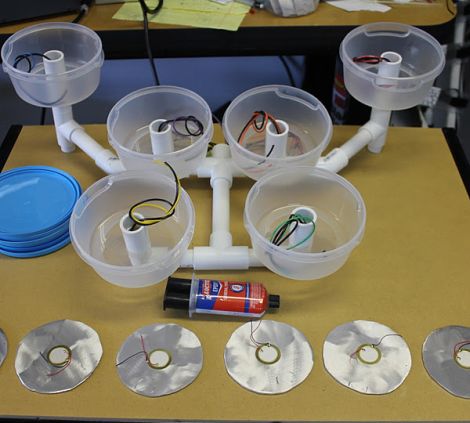
[Ian Cole’s] son is learning to play the drums on an electronic drum set, and he wanted a way to continue practicing during his frequent visits to his grandparents’ house. [Ian] had picked up a Spikenzielabs “Drum Kit Kit All-Inclusive” (DKKAI) earlier this summer, and set out to build an easily transportable drum set.

The DKKAI comes with an ATmega168-based board and a set of piezos that can be used to register hits. It was up to [Ian] to provide the rest of the kit, so he set off to IKEA in search of cheap, durable drum heads. He returned with a handful of 1/2 Liter plastic bowls, which he mounted on a PVC pipe drum stand.

The piezos were mounted on thin aluminum discs, which were in turn glued to the back side of the bowl lids. The piezos were wired to the DKKAI kit via the PVC tubing, with the signals ultimately fed into an iPad running Garage Band. [Ian] says that his portable drum set works quite well, and although there are some things that require changing, his son is very happy with his new practice set.

Check out the video below to see the portable drum kit in action.

Continue reading “Portable Electronic Drum Kit Made From Plastic Bowls”

The GATARI “2600” Musical Instrument

gatari

So do you have an Atari 2600 laying around collecting dust? Perhaps you’d like to have a musical instrument to take up the time that you would spend playing video games if you had a modern console. Well, look no further than the GATARI 2600!

[cTrix] made this device with a custom EPROM chip plugged in as a cartridge. Although details of the build are somewhat vague, this custom chip allows music to be written for the device. Everything is controlled with a joystick that tells the GATARI to generate the desired track. From this basic track, the sound is modified using three pedals including an equalizer, a flange pedal, and a hold pedal.

Check out the video after the break for a brief explanation of how it was built. Skip to 1:05 if you’d rather just see it in action at [Blipfest] in Japan!

If you’d rather listen to music rather than playing it, why not build your own snap together boombox instead!

Continue reading “The GATARI “2600” Musical Instrument”

A Floppy Drive Orchestra

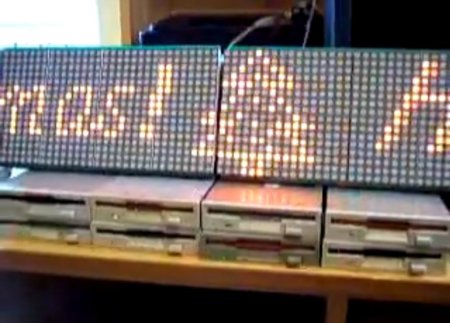
With 8 drives working in concert, this “floppy drive array orchestra” takes drive music to a whole new level!  As if that wasn’t enough, [SileNT] decided to use the16x64 LED array that he’s been working on in concert with the drives.

For those that remember, we’ve actually featured [SileNT], AKA [Pawel]’s, work before, where we were impressed that he was able to play the Imperial March from Star Wars on 2 floppy drives. He’s planning more information about his floppy drive music making in the future and maybe even instructions on building your own personal disk drive orchestra. Apparently [SileNT] has an abundant supply of 3 1/2 inch drives, so maybe even this feat can be topped…

Be sure to check out the video after the break of these 8 drives in action. In the video, more tunes are promised “soon”, so be sure to check back or subscribe to him on Youtube for more sweet melodies. Continue reading “A Floppy Drive Orchestra”

Digital Synth For The Non-chiptune Inclined

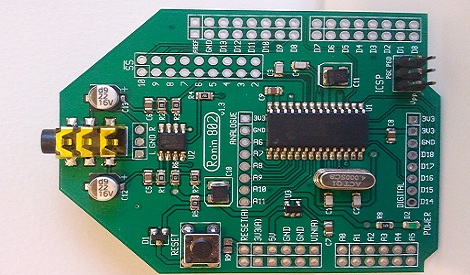
Chiptunes are great, and we can’t imagine a world without the Mega Man 2 soundtrack, but sometimes we all like a more 70’s style synth. This is where the Roninsynth steps in. It’s an Arduino shield that puts the basic components of a wall of synth into your pocket.

Unlike the analog oscillators of yore, the Roninsynth is based on a single dsPIC33F chip. It has all the waveforms we would expect from its big brother – sine, saw, triangle, square, and noise – and a couple modulation options.  What’s really interesting is the GUI the Roninsynth team put together. Instead of going with the knobs and buttons approach of the MIDIbox SID, the Roninsynth does everything with software. Think of it as a hardware-based softsynth.

Of course, there isn’t support for looping and phrases like what we saw yesterday, but there’s a ton of neat sounds that can be made and the capability for analog input. If you’ve ever wanted to sound like Radiohead, we can’t think of an easier way to build an Ondes Martenot.

Snap Together Boombox Great For Taking Your Music On The Go

fab-boombox

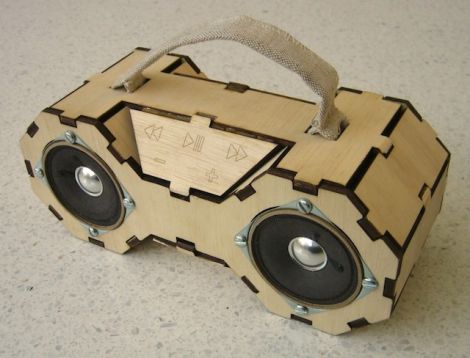
[Matt Keeter] wanted to take his music on the go, and wrote in to share a great looking boombox he built for under $100. His goal was to put something together that could be made in pretty much any hackerspace/fab lab, so his boombox was made using simple materials.

He first modeled the boombox using cardboard, later fabbing it from wood on a laser cutter. The design allows the stereo to be snapped together, though [Matt] says that some joints were glued as an extra precaution. Inside the boombox resides an custom PCB he built which incorporates an ATmega328, an MP3 decoder, and an SD card to store his music.

One feature we really like is the control scheme [Matt] built into the boombox. Each of the capacitive touch buttons are positioned on top of a copper pad, which are wired into the control board. He says that while good in theory, he had a difficult time getting the buttons to work properly, though they seem to do the job well enough.

If you’re looking for a portable music solution and have access to a laser cutter, be sure to check out [Matt’s] page for schematics and firmware.

Bitbuf Delivers Some Of The Best Chiptune Effects Around

Wow. And furthermore, WOW! Just looking at that clean prototype you know that a lot of work has gone into the project, but when you hear this chiptune MIDI device you’ll really be impressed. We know what you’re thinking, but really, you’ve got to hear this to appreciate the quality [Linus Akesson] achieved in this synthesizer. You can catch it after the break.

He does a great job of showing off the different waveforms that can be produced by the ATmega88 on this board. But there’s much more. It also serves as a 16 frame, 16 channel sequencer for creating and layering your own loops.

He mentions that eight oscillators are used for the waveform generation. We don’t see hardware for this on the board. Either we’re missing it, or these oscillators are being created with software? If you have an idea of how this works please clue us in by leaving a comment.

Continue reading “Bitbuf Delivers Some Of The Best Chiptune Effects Around”