This Week In Security: Rackspace Falls Over, Poison Ping, And The WordPress Race

In what’s being described as a Humpty-Dumpty incident, Rackspace customers have lost access to their hosted Exchange service, and by extension, lots of archived emails. The first official word of trouble came on December 2nd, and it quickly became clear that this was more than the typical intern-tripped-over-the-cable incident. Nearly a week later, Rackspace confirmed what observers were beginning to suspect, it was a ransomware attack. There’s not a lot of other answers yet, and the incident FAQ answers are all variations on a theme.

Our investigation into the incident is ongoing and will take time to complete. To ensure the integrity of the ongoing investigation, we do not have additional details to share at this time.

Knowing the security issues that have plagued Microsoft Exchange over the last couple of months, one has to wonder if Rackspace was breached as a result of the PowerShell problems. What’s staggering is that a week after the incident, Rackspace still has no timeline for service restoration.

Rackspace isn’t the only major ransomware attack this week, as a hospital in Versailles has partially shut down due to another ransomware attack. Operations were canceled, and work has to be done the old fashioned way, without the network to support.

Continue reading “This Week In Security: Rackspace Falls Over, Poison Ping, And The WordPress Race”


Singapore Branches Out Into Internet Of Trees

Five years ago, a 38-year-old woman was enjoying an outdoor concert with her family with one of her twin infants in her arms. In the week prior, it had been windy and rainy, but today, the weather was nice, and the concert was crowded. Without warning, a 270-year-old tembusu tree fell on the woman, pinning and ultimately killing her after the other concertgoers couldn’t remove it in time. This tragedy happened in spite of twice-yearly inspections where the tree showed no visual signs of trouble.

It’s exactly this type of incident that Singaporean officials hope to avoid by building an Internet of Trees. The equatorial island nation is home to roughly 5.5 million people, and around 7 million trees — about 6 million of which are tracked by Singapore’s National Parks Board, so that they can be managed remotely with an app. (The Board only tracks trees once they’ve reached a certain size, so we’ll assume that the other million are too young to join the fun just yet.)

While tree-triggered deaths are fairly few and far between, there are plenty of other ‘tree incidents’ that can occur, such as a branch falling, or a tree trunk snapping or uprooting. Depending on the size of the branch, this can be a dangerous nuisance as it could block roads, obscure signage, or destroy property. Thanks to the efforts of the National Parks Board, these incidents have dropped from around 3,000 per year at the turn of the millennium to under 500 per year today.

Continue reading “Singapore Branches Out Into Internet Of Trees”

Miracle Of Science: Scotch Tape Improves Generator

We were always amused that one of the biggest scientific discoveries of the recent past — graphene — was started with pencil lead and Scotch tape. Now, researchers at the University of Alabama in Huntsville have determined that double-sided Scotch tape can improve triboelectric power generators. Triboelectric generation, of course, is nothing new. These energy harvesters take mechanical and thermal energy and turn them into tiny amounts of electricity. What’s new here is that PET plastic, aluminum, and double-sided tape can make an inexpensive generator that works well.

Keep in mind we are talking about little bits of power. In the best scenario with the device stimulated at 20 Hz, the generator peaked at 21.2 mW. That was better than some designs that only got to 7.6 mW in the same configuration.

Continue reading “Miracle Of Science: Scotch Tape Improves Generator”

Better Coding Through Sketching

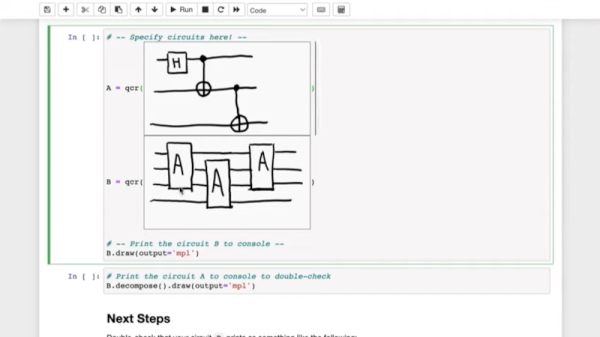
Back in the late 1970s and early 1980s, engineering students would take a few semesters of drafting and there would usually be a week or two of “computer-aided drafting.” In those days, that meant punching cards that said RECTANGLE 20,30 or something like that and getting the results on a plotter. Then we moved on to graphical  CAD packages, but lately, some have gone back to describing rather than drawing complex designs. Cornell University researchers are trying to provide the same options for coding. They’ve built a Juypter notebook extension called Notate that allows you to sketch and handwrite parts of programs that interact with traditional computer code. You can see a video about the work below.

The example shows quantum computing, but the idea could be applied to anything. The example has sketches that generate quantum circuits. Naturally, there is machine learning involved.

Continue reading “Better Coding Through Sketching”

Cargo Culting And Buried Treasure

I have no idea how true the stories are, but legend has it that when supplies were dropped on some Melanesian islands during WWII, some locals took to replicating runway signs in order to further please the “gods” that were dropping them. They reportedly thought that making landing strips caused laden airplanes to visit. Richard Feynman later turned this into a metaphor about scientific theory – that if you don’t understand what you’re doing deeply, you may be fooling yourself.

I’d like to be a little bit more forgiving of adherents of technological cargo cults. Because the world around us is very complicated, we often just take things as they are rather than understanding them deeply, because there’s simply only so deep you can go into so many fields.

Is someone who doesn’t know the i386 machine language cargo-culting their way through a job as a web backend developer? Probably not. But from the perspective of an assembly-language programmer, any of us who write in compiled or interpreted programming languages are cargo-culting coding. You don’t need to understand a cell phone to dial home, but can you really say that you understand everything about how one works?  Or are you just going through the motions?

So while some reliance on metaphor and “well, it worked last time” is perfectly normal, I think noticing when you cargo-cult is also healthy. It should also be a warning sign, or at least a flag to remind yourself that there may be dragons here. Or maybe just a buried learning opportunity, the X that marks the spot where digging deeper might be productive.

tiny surface mount seven segment display

Nano-Sized 7-Segment LED Display On A Surface Mount Module

Inspired by a prank tweet, [Sam Ettinger] endeavored to create an SMD seven-segment display.  The NanoRaptor NanoSegment implements a panel of seven-segment display modules sized at “0806” each or just a bit wider than a standard 0805 SMD footprint.  Each of the seven segments is a single 0201 LED.  Six I/O lines and three resistors are required to operate each module.

To demonstrate the operation of his tiny display modules, Sam also created the “6Pin 7Seg” development board featuring an ATtiny84 microcontroller coupled to PCB footprints sized to receive the NanoRaptor NanoSegment display modules.  A demonstration of the board counts through digits displayed on one of the tiny seven-segment modules.

Hoping to reduce the module’s interface to two pins, Sam is now experimenting with a seven-segment display on a flex PCB that folds up into a 1208 footprint.  He is attempting to fold the resistors and a ATtiny20 microcontroller into an “origami PCB” configuration.

If these hacks are getting a little too small for your tastes, we’ve got you covered with this giant seven-segment display.


3d printed escalator, from side, showing mechanism

Tiny 3D Printed HO Scale Escalator That Works

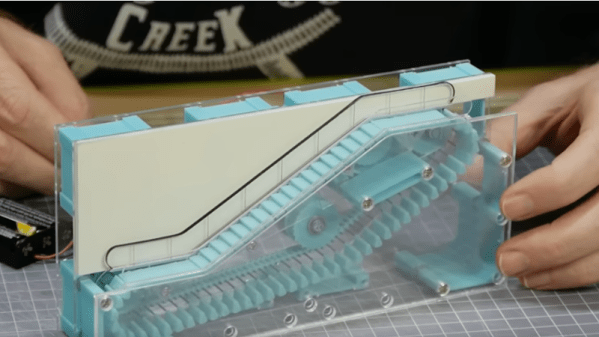
[Luke Towan] has a cool HO scale Escalator mostly made of 3D printed parts, with some laser cut acrylic, for a station on his HO model railroad.

Escalators are mesmerizing to watch – there’s something magical about the stairs unfolding at the bottom and folding up at the top. But they’re very hard to model.

[Luke Towan] has done it – his 3D printed version closely resembles the real thing mechanically. Pins are carried around, cantilevered out from a 3D printed chain. A stair swivels on each pin – at the bottom each stair’s free end rests on a ‘bottom’ far enough down for the stairs to be level, while on the incline the ‘bottom’ is just below the pins. It’s a tricky build.

If you like pushing the envelope of what 3D printing can do this is an interesting project, even if you’re not planning to build an escalator. There are lots of tips for making small mechanisms with 3D printing, and for making small mechanisms that work reliably without stuttering.

He’s not the first to build an escalator. Back in 2015 we covered this wooden escalator for slinkies,  and just recently this 3D printed version from [AlexY].