Intel Rolls Out 49 Qubits

With a backdrop of security and stock trading news swirling, Intel’s [Brian Krzanich] opened the 2018 Consumer Electronics Show with a keynote where he looked to future innovations. One of the bombshells: Tangle Lake; Intel’s 49-qubit superconducting quantum test chip. You can catch all of [Krzanch’s] keynote in replay and there is a detailed press release covering the details.

This puts Intel on the playing field with IBM who claims a 50-qubit device and Google, who planned to complete a 49-qubit device. Their previous device only handled 17 qubits. The term qubit refers to “quantum bits” and the number of qubits is significant because experts think at around 49 or 50 qubits, quantum computers won’t be practical to simulate with conventional computers. At least until someone comes up with better algorithms. Keep in mind that — in theory — a quantum computer with 49 qubits can process about 500 trillion states at one time. To put that in some apple and orange perspective, your brain has fewer than 100 billion neurons.

Of course, the number of qubits isn’t the entire story. Error rates can make a larger number of qubits perform like fewer. Quantum computing is more statistical than conventional programming, so it is hard to draw parallels.

We’ve covered what quantum computing might mean for the future. If you want to experiment on a quantum computer yourself, IBM will let you play on a simulator and on real hardware. If nothing else, you might find the beginner’s guide informative.

Image credit: [Walden Kirsch]/Intel Corporation

Speculative Execution Was A Troublemaker For Xbox 360

Part of why people can’t stop talking about Meltdown/Spectre is the fact that all the individual pieces have been sitting in plain sight for a long time. When everyone saw how it all came together last week, many people (and not even necessarily security focused people) smacked themselves on the forehead: “Why didn’t I see that earlier?” Speculative execution has caused headaches going way back. [Bruce Dawson] tells one such story he experienced back in 2005. (Warning: ads on page may autoplay video.)

It’s centered around Xbox 360’s custom PowerPC processor. Among the customization on this chip was the addition of an instruction designed to improve memory performance. This instruction was a hack that violated some memory consistency guarantees held by the basic design, so they knew up front it had to be used very carefully. Even worse: debugging problems in this area were a pain. When memory consistency goes wrong, the code visible in the debugger might not be the actual code that crashed.

Since we’re talking about the dark side of speculative execution, you can already guess how the story ends: no matter how carefully it was used, the special instruction continued to cause problems when speculatively executed outside the constrained conditions. Extensive testing proved that instructions that were not being executed were causing crashes. That feels more like superstition than engineering. As far as he can recall, it ended up being more trouble than it was worth and was never used in any shipped Xbox 360 titles.

[Main image source: AnandTech article on Xbox 360 hardware]

Retro Rear-Projection Numeric Display Gets A Teardown

We recently featured an entertaining project here, a digital clock with a variety of different retro display technologies forming its numerals. Among those was an extremely unusual device, a rear-projection display with an array of bulbs each able to shine through a different letter or numeral slide. There was such interest in this device that its owner [Suedbunker] subjected one to a teardown for all to see.

The displays came from an organ which he suggests may have been manufactured around 1900. We suspect that may be a rather early estimate due to its use of a printed circuit board, but it is no less a fascinating device for it. A rectangular enclosure secured by twist-tabs opens to reveal a matrix of small filament bulbs on a PCB and supported by a stack of resin boards, in front of which was placed a slide with a letter or number for each one. Before that lies a sheet of glass, and then a molded plastic lens assembly which provides an individual lens for each of the 12 bulbs. When a bulb is illuminated with these in place, the letter or number is projected on the screen at the front of the unit.

It has the advantage of simplicity, no need for a high voltage, and high-quality characters and flexibility in displaying alternatives through different slides, though at the expense of quite a bulky package. The bulbs are quite energy-sapping, so for his clock he replaced them with LEDs. We like it as one of the more practical retro numeric displays, but its size means we probably won’t see a comeback.

You can see our write-up of the clock using the projection display here.

The PlyPad: CNC Machine Yourself A Tiny House

The Maslow CNC project is a CNC mill for sheet woodwork that is designed to be as inexpensive as possible and to be assembled by the end user. They’ve dropped us a line to tell us about a recent project they’ve undertaken as part of a collaboration to produce the PlyPad, a tiny house for Kenton Women’s Village, a project to tackle homelessness among women in part of the City of Portland.

Their write-up is a fascinating look at the issues surrounding the design and construction of a small dwelling using CNC rather than traditional methods. As an example their original design featured an attractive sawtooth roofline with multiple clerestory windows, but sadly a satisfactory solution could not be found to the problem of keeping it waterproof and they were forced to adopt a more conventional look.

The walls of the building are a ply-foam bonded sandwich, and the house is constructed in 4 foot sections to match the width of a sheet of ply. There are several section designs with built-in furniture, for example containing a bed, or storage space.

This house was designed to be part of a community with central washing and sanitary facilities, so it does not incorporate the bathroom you might expect. However it is not impossible to imagine how sections could be designed containing these, and could be added to a full suite of construction choices. We are reminded of its similarity to the WikiHouse project.

We covered the Maslow project back in 2016, it is especially pleasing to see that it has been something of a success.

Lowering JavaScript Timer Resolution Thwarts Meltdown And Spectre

The computer security vulnerabilities Meltdown and Spectre can infer protected information based on subtle differences in hardware behavior. It takes less time to access data that has been cached versus data that needs to be retrieved from memory, and precisely measuring time difference is a critical part of these attacks.

Our web browsers present a huge potential surface for attack as JavaScript is ubiquitous on the modern web. Executing JavaScript code will definitely involve the processor cache and a high-resolution timer is accessible via browser performance API.

Web browsers can’t change processor cache behavior, but they could take away malicious code’s ability to exploit them. Browser makers are intentionally degrading time measurement capability in the API to make attacks more difficult. These changes are being rolled out for Google Chrome, Mozilla Firefox, Microsoft Edge and Internet Explorer. Apple has announced Safari updates in the near future that is likely to follow suit.

After these changes, the time stamp returned by performance.now will be less precise due to lower resolution. Some browsers are going a step further and degrade the accuracy by adding a random jitter. There will also be degradation or outright disabling of other features that can be used to infer data, such as SharedArrayBuffer.

These changes will have no impact for vast majority of users. The performance API are used by developers to debug sluggish code, the actual run speed is unaffected. Other features like SharedArrayBuffer are relatively new and their absence would go largely unnoticed. Unfortunately, web developers will have a harder time tracking down slow code under these changes.

Browser makers are calling this a temporary measure for now, but we won’t be surprised if they become permanent. It is a relatively simple change that blunts the immediate impact of Meltdown/Spectre and it would also mitigate yet-to-be-discovered timing attacks of the future. If browser makers offer a “debug mode” to restore high precision timers, developers could activate it just for their performance tuning work and everyone should be happy.

This is just one part of the shock wave Meltdown/Spectre has sent through the computer industry. We have broader coverage of the issue here.

Let’s Talk Intel, Meltdown, And Spectre

This week we’ve seen a tsunami of news stories about a vulnerability in Intel processors. We’re certain that by now you’ve heard of (and are maybe tired of hearing about) Meltdown and Spectre. However, as a Hackaday reader, you are likely the person who others turn to when they need to get the gist of news like this. Since this has bubbled up in watered-down versions to the highest levels of mass media, let’s take a look at what Meltdown and Spectre are, and also see what’s happening in the other two rings of this three-ring circus.

Meltdown and Spectre in a Nutshell

These two attacks are similar. Meltdown is specific to Intel processors and kernel fixes (basically workarounds implemented by operating systems) will result in a 5%-30% speed penalty depending on how the CPU is being used. Spectre is not limited to Intel, but also affects AMD and ARM processors and kernel fixes are not expected to come with a speed penalty.

Friend of Hackaday and security researcher extraordinaire Joe Fitz has written a superb layman’s explanation of these types of attacks. His use of the term “layman” may be a little more high level than normal — this is something you need to read.

The attack exploits something called branch prediction. To boost speed, these processors keep a cache of past branch behavior in memory and use that to predict future branching operations. Branch predictors load data into memory before checking to see if you have permissions to access that data. Obviously you don’t, so that memory will not be made available for you to read. The exploit uses a clever guessing game to look at other files also returned by the predictor to which you do have access. If you’re clever enough, you can reconstruct the restricted data by iterating on this trick many many times.

For the most comprehensive info, you can read the PDF whitepapers on Meltdown and Spectre.

Update: Check Alan Hightower’s explanation of the Meltdown exploit left as a comment below. Quite good for helping deliver better understanding of how this works.

Frustration from Kernel Developers

These vulnerabilities are in silicon — they can’t be easily fixed with a microcode update which is how CPU manufacturers usually workaround silicon errata (although this appears to be an architectural flaw and not errata per se). An Intel “fix” would amount to a product recall. They’ve already said they won’t be doing a recall, but how would that work anyway? What’s the lead time on spinning up the fabs to replace all the Intel chips in use — yikes!

So the fixes fall on the operating systems at the kernel level. Intel should be (and probably is behind the scenes) bowing down to the kernel developers who are saving their bacon. It is understandably frustrating to have to spend time and resources patching these vulnerabilities, which displaces planned feature updates and improvements. Linus Torvalds has been throwing shade at Intel — anecdotal evidence of this frustration:

“I think somebody inside of Intel needs to really take a long hard look at their CPU’s, and actually admit that they have issues instead of writing PR blurbs that say that everything works as designed.”

That’s the tamest part of his message posted on the Linux Kernel Mailing List.

Stock Sales Kerfuffle is Just a Distraction

The first thing I did on hearing about these vulnerabilities on Tuesday was to check Intel’s stock price and I was surprised it hadn’t fallen much. In fact, peak to peak it’s only seen about an 8% drop this week and has recovered some from that low.

Of course, it came out that back in November Intel’s CEO Bryan Krzanich sold off his Intel stock to the tune of $24 Million, bringing him down to his contractual minimum of shares. He likely knew about Meltdown when arranging that sale. Resist the urge to flame on this decision. Whether it’s legal or not, hating on this guy is just a distraction.

What’s more interesting to me is this: Intel is too big to fail. What are we all going to do, stop using Intel and start using something else? You can’t just pull the chip and put a new one in, in the case of desktop computers you need a new motherboard plus all the supporting stuff like memory. For servers, laptops, and mobile devices you need to replace the entire piece of equipment. Intel has a huge market share, and silicon has a long production cycle. Branch prediction has been commonplace in consumer CPUs going back to 1995 when the Pentium Pro brought it to the x86 architecture. This is a piece of the foundation that will be yanked out and replaced with new designs that provide the same speed benefits without the same risks — but that will take time to make it into the real world.

CPUs are infrastructure and this is the loudest bell to date tolling to signal how important their design is to society. It’s time to take a hard look at what open silicon design would bring to the table. You can’t say this would have been prevented with Open design. You can say that the path to new processors without these issues would be a shorter one if there were more than two companies producing all of the world’s processors — both of which have been affected by these vulnerabilities.


There Once Was An IC Dedicated To Blinking An LED

Today you can buy flashing LEDs; a simple two-lead component that requires only a power supply to produce even flashes of light. They look for all the world like any other LED, though embedded in the plastic dome is an integrated circuit to do all that flashing work.

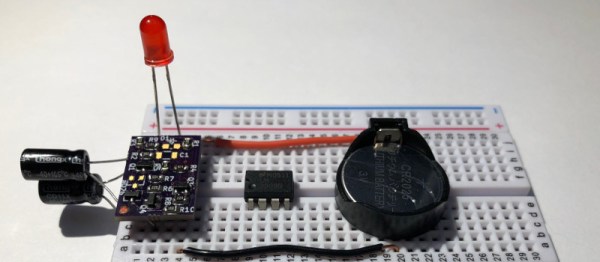
There was a time though when a flashing LED was something of a big deal, so much so that National Semiconductor produced a dedicated chip for the task. The LM3909 boasted the ability to flash an LED for over a year using a single C battery. That part is now long out of production, so [Dillon] has implemented the LM3909 circuit using discrete components on a small PCB designed to take pins and fit the footprint of the original.

Why on earth might a reborn LM3909 be of interest to him, you ask? Well, he wasn’t able to make a 555 flash the LED from a coin cell, and a friend mentioned this chip which piqued his interest. The internal schematic is in the data sheet (found in the files section of his project), so he was able to implement it relatively easily using common parts. It still requires an external capacitor just like the original, but there is space on-board should you wish to put it there.

He’s produced a video we’ve placed below the break showing the device in action, proving it to be a drop-in replacement for an original. Recreations of classic chips using discretes are nothing new, we recently brought you a reborn PSU regulator chip made in 2014. An while you’re playing around with coin cell batteries, may we direct your attention to the Coin Cell Challenge.

Continue reading “There Once Was An IC Dedicated To Blinking An LED”