
Commodore PET Mods At VCF West 2016

28193708113_821f852139_zHere at the Vintage Computer Festival, we’ve found oodles of odds and ends from the past. Some, however, have gotten a modern twist like [bitfixer’s] recent Commodore PET project upgrades.

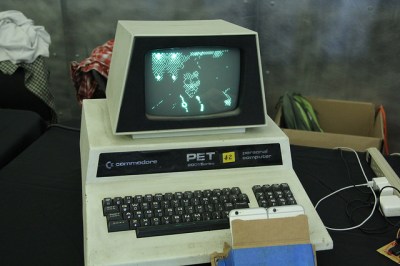
First off is [bitfixer’s] Augmented Reality upgrade. By the power of two iPhones and one raspberry Pi, the user dons a Google-Cardboard-esque heads-up-display and can visualize a 3D, ASCII rendering of the world before them. Not only does this view show up in the HUD, however, it’s also streamed to a Raspberry Pi whch then serializes it info a video display on the Commodore PET.
28191391174_7186b4758d_z
TRON Legacy, can you tell??

This hack builds on some of [bitfixer’s] prior work getting ASCII video streaming up-and running. Of course, the memory on the Commodore PET is nowhere near capable of being able to process these images. In fact, streaming and storing the video data onto the PET’s memory would fill it up in under one second! Instead, [bitfixer] relies on some preprocessing thanks to the far-more-powerful (by comparison) Raspberry Pi and iPhone processors that are capturing the images.


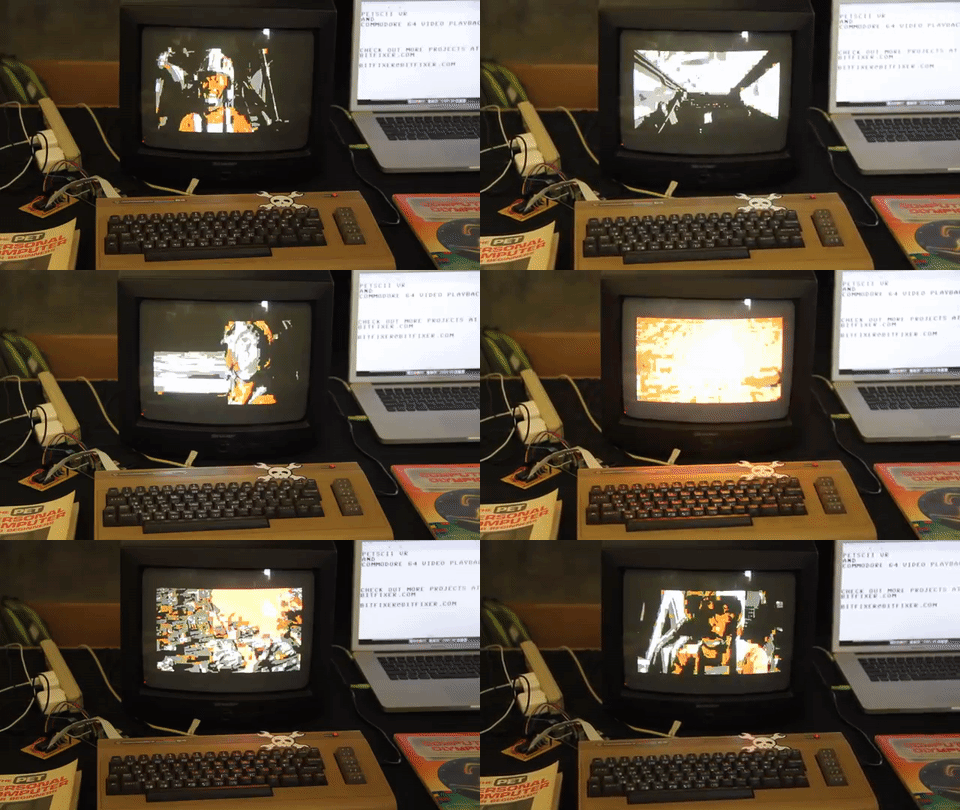
Next off is [bitfixer’s] full-color video display on the same Commodore PET. Again, leveraging another RaspPi to encode and reduce the video to bitmap images, the Commodore PET simple grabs these images and streams them to the screen as fast as possible–at a beloved 5.8 frames per second.


 

Editor Wars: The Revenge Of Vim

Rarely on these pages have I read such a fluff piece! Al Williams’ coverage of Emacs versus Vim was an affront to the type of in-depth coverage our Hackaday readers deserve. While attempting to be “impartial” he gave a seven-sentence summary of Vim, the Ultimate Editor. Seven sentences! Steam is pouring out of my ears like Yosemite Sam.

yosemite+samAl, like a lot of you out there, thinks that he “knows how to use vi”. I’m here to tell you that he doesn’t. And unless you’ve spent the last few years alone in a cave high in the Himalayas, with only food, drink, a laptop, and Vim Golf, you probably don’t either. Heck, I don’t consider myself a Vim master, but I’m going to write this overwrought essay praising it (using Vim, naturally).

The reason I’m writing this is not to perpetuate the vi-versus-Emacs war. That idea is silly anyway, and was probably invented by Emacs folks to steal some of vi’s limelight. You see, vi-versus-Emacs is a red herring. Vi and Vim are so strange, so different from any other editor you might use, that it makes Emacs look simply boring in comparison: it’s just a normal editor with decent extensibility (if you can stand Lisp), horrible key combinations that may or may not cause carpal tunnel syndrome, and code bloat that rivals Microsoft Word. If you’re comfortable using Pico or Nano or Joe or Notepad++ or Gedit or Kate, or anything else for that matter, you can be comfortable using Emacs in a month or so. It’s really just another editor. Yawn.

Vi is something else. It’s a programming language for editing text that’s disguised as an editor. If you try to use it like a normal text editor, you will suffer. If you approach your text editing chores like factoring code into functions, you’re starting to understand Vi.

Continue reading “Editor Wars: The Revenge Of Vim”

Differential Analyzer Cranks Out Math Like A Champ At VCF 2016

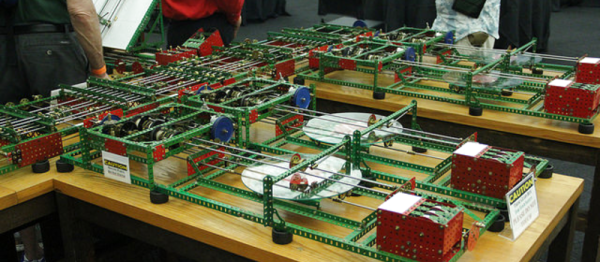
Here at VCF, we stumbled across a gigantic contraption that spanned several tables. Rube Goldberg machine this was not. Instead, this device actually does something useful! [Tim Robinson’s] differential analyzer can solve differential equations through several stages of mechanical integrators. The result is a pen-plot graph of the solution to the input equation, input by displacing a rod as a function of time.

Differential analyzers have been around for over a century. [Tim’s] claim to fame is that this particular DA is constructed entirely from Meccano-branded parts. We’re thrilled to see Meccano, over 100 years old at this point, continue to find new uses outside the toy box.

diff_analyzer
The Torque Amplifier

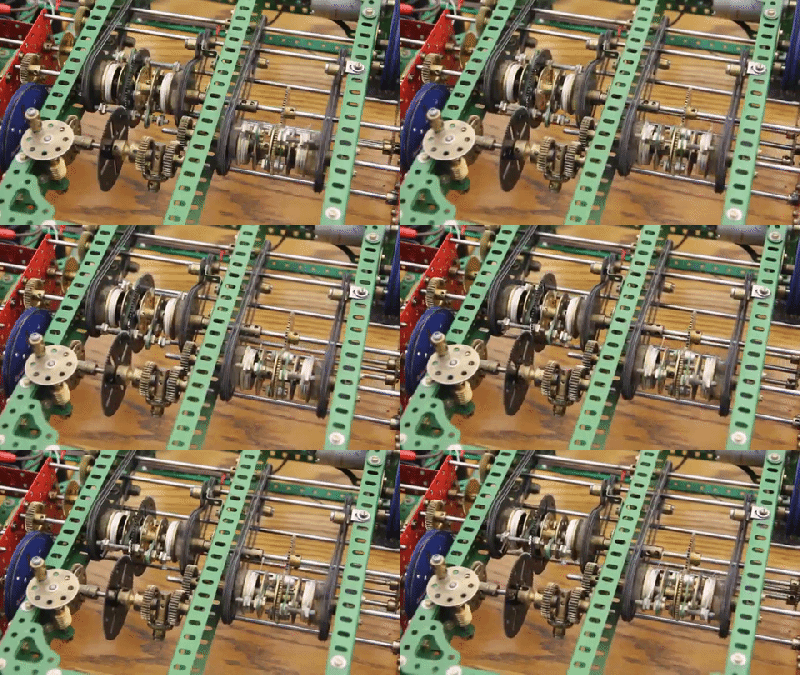
The differential analyzer is riddled with mechanisms that are bound to swing some heads for a double-take. Since the input shaft that transmits the input function f(x), has very little friction, the result can only be carried through the remainder of the machine with some means of torque amplification. To do so, [Tim], and most other DA designers implement a torque analyzer. For [Tim], though, this feat proved to be more difficult (and more triumphant) than other solutions, since he’s using a set of parts that are entirely from Meccano. In fact, this feature took [Tim] through about 20 iterations before he was finally satisfied.

VCF West continues to run through the end of the weekend at the Computer History Museum in Mountain View, CA. If you haven’t already packed your bags for DEF CON, stop by for a few more bewildering brain teasers.

DEF CON’s X86 Badge

This year’s DEF CON badge is electronic, and there was much celebrating. This year’s DEF CON badge has an x86 processor, and there was much confusion.

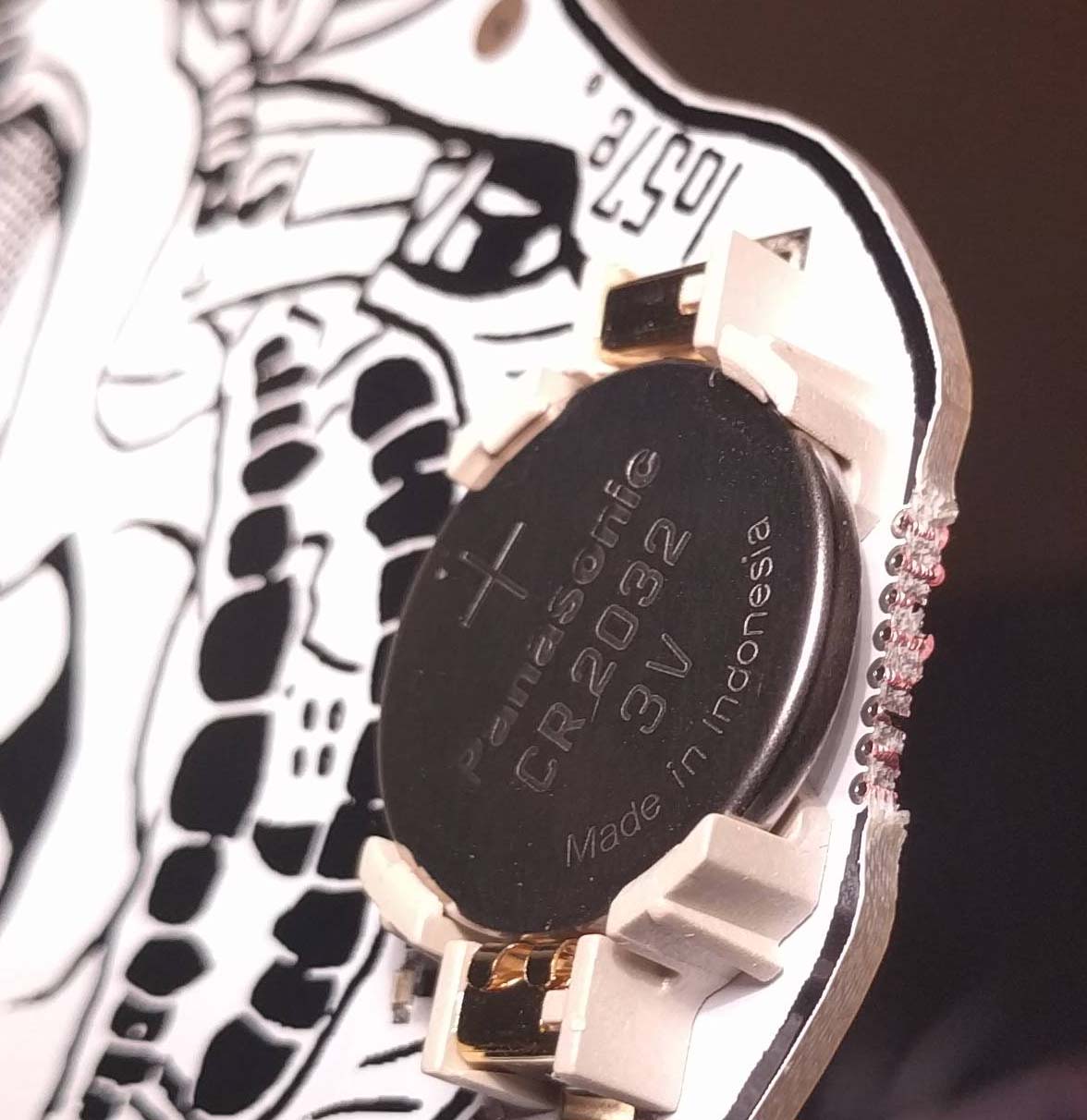
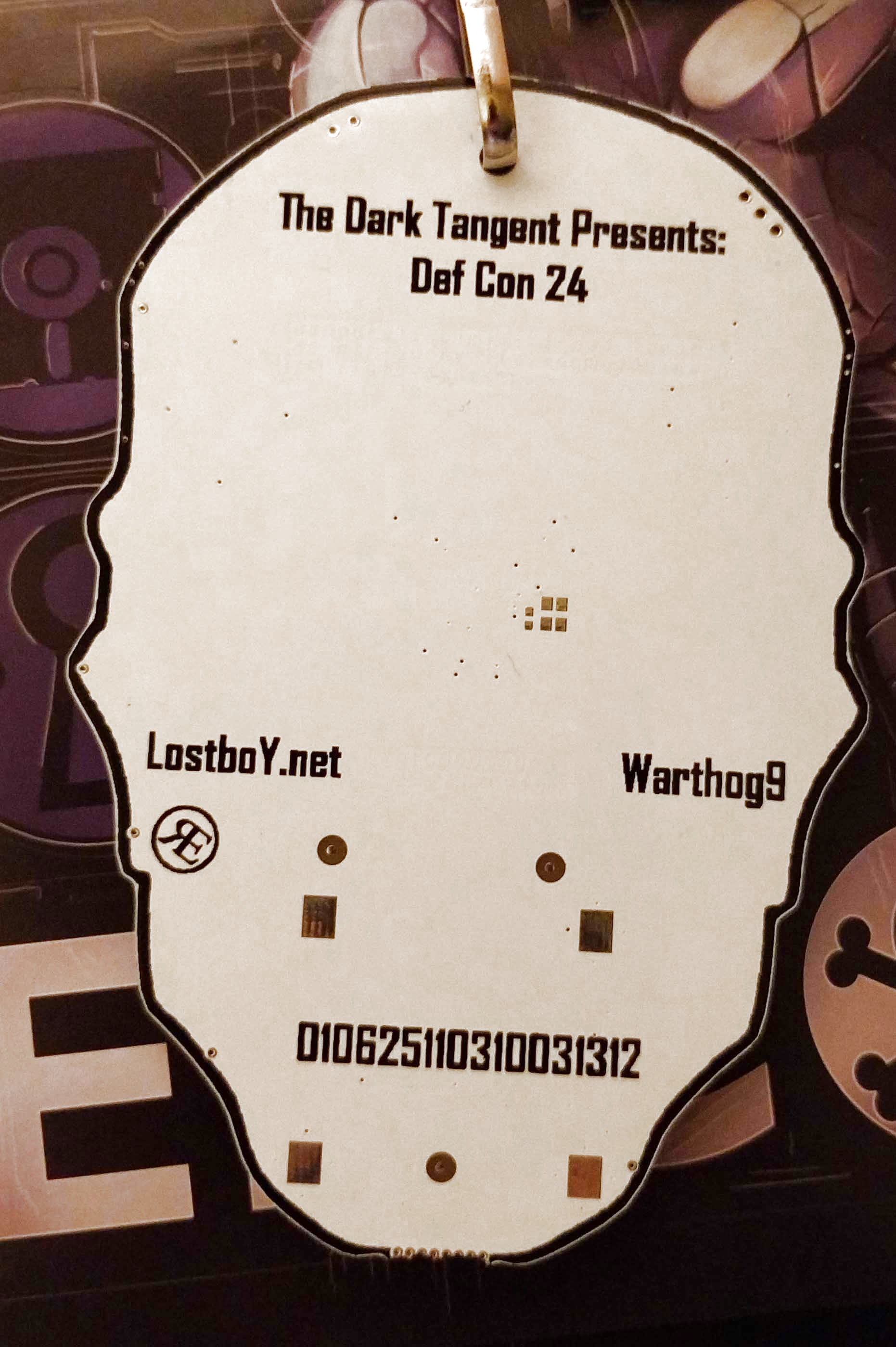
These vias are connected to something.

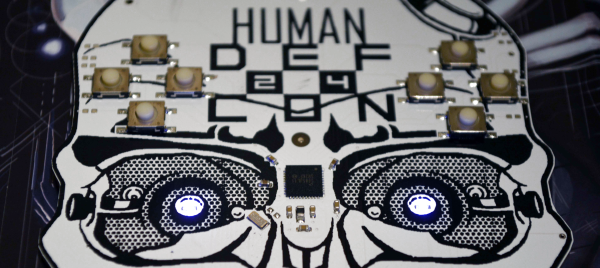
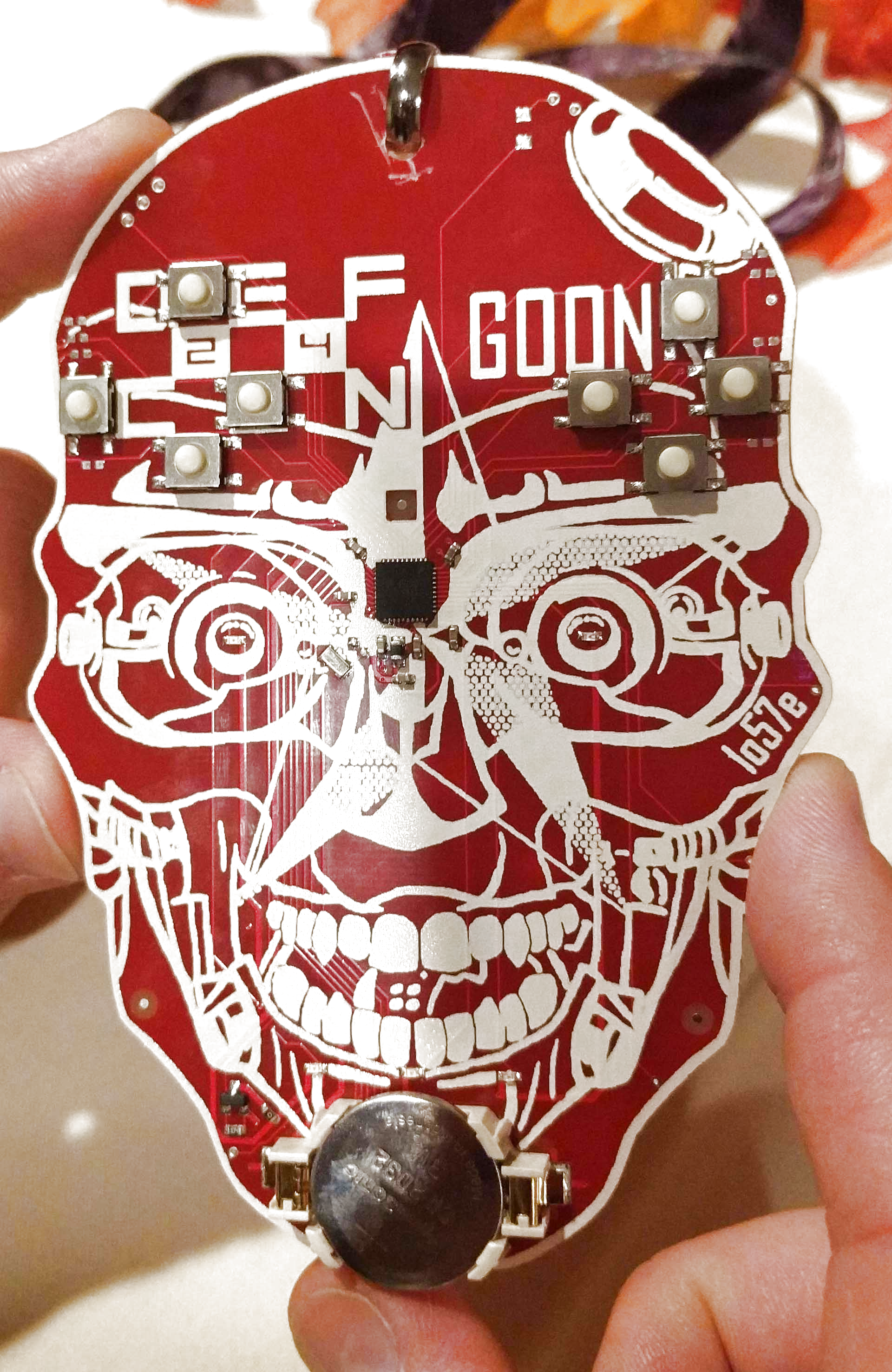
The badge this year, and every year, except badges for 18, 17, 16, 15, and 14, designed by [Joe Grand], and badges from pre-history designed by [Dark Tangent] and [Ping], was designed by [1057], and is built around an x86 processor. Specifically, this badge features an Intel Quark D2000 microcontroller, a microcontroller running at 32MHz, with 32kB of Flash and 8kB of RAM. Yes, an x86 badge, but I think an AT motherboard badge would better fulfill that requirement.

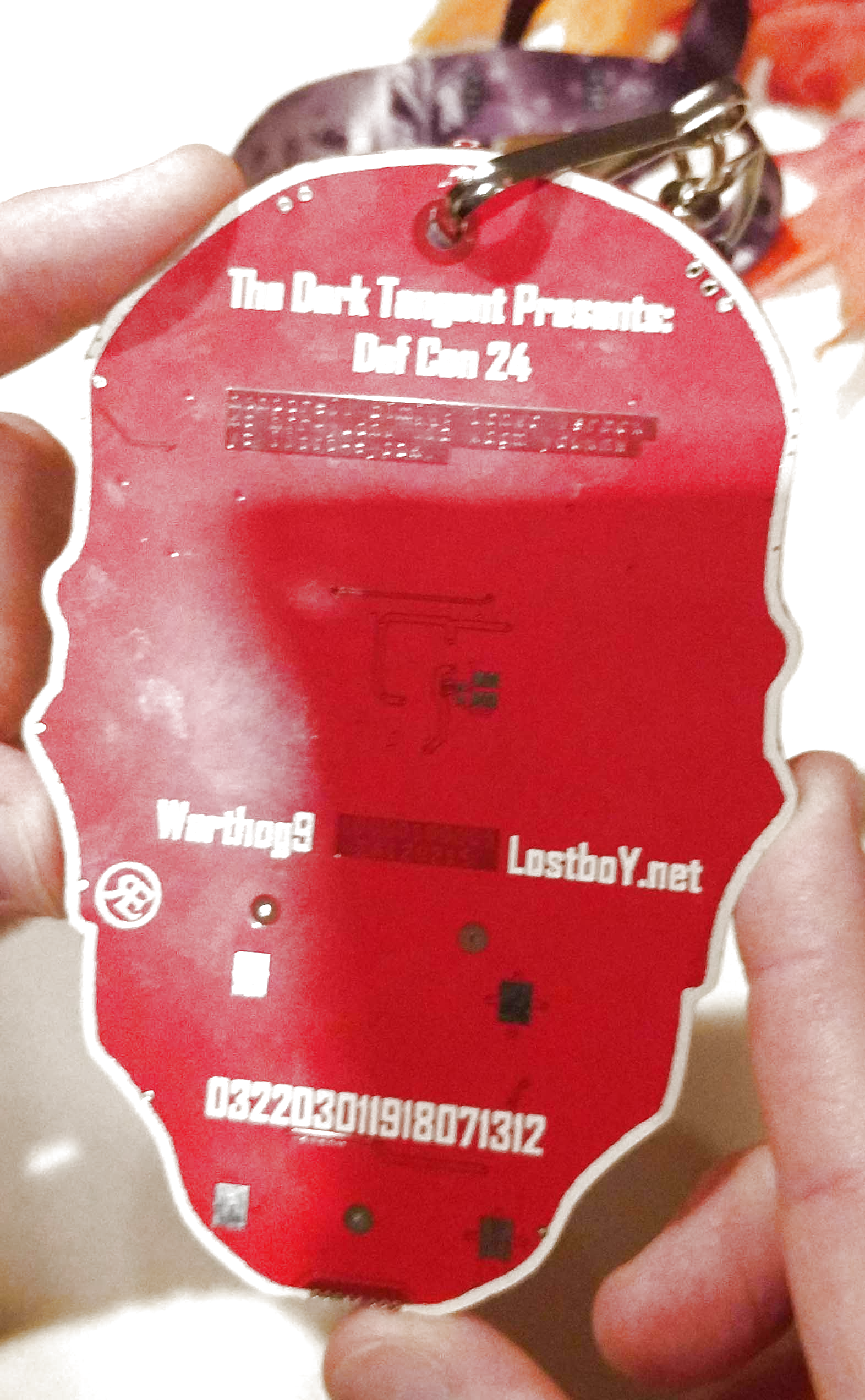
As far as buttons, sensors, peripherals, and LEDs go, this badge is exceptionally minimal. There are eight buttons, laid out as two directional pads, five LEDs, and a battery. There’s not much here, but with a close inspection of the ‘chin’ area of the badge, you can see how this badge was programmed.

As with any [1057] joint, this badge features puzzles galore. One of these puzzles is exceptionally hard to photograph as it is in the bottom copper layer. It reads, “nonpareil bimil: Icnwc lsrbcx kc htr-yudnv ifz xdgm yduxnw yc iisto-cypzk”. Another bottom copper text reads, “10000100001 ΣA120215”. Get crackin’.

A gallery of the Human and Goon badges follows, click through for the best resolution we have.

This post has been updated to correct the record of who designed badges for previous cons.

EMF: You Shall Find Us At The Sign Of The Jolly Wrencher

It’s frustrating, the reluctance of some of my fellow hackspace members to put the cordless drill battery back in the charger after use.  As this is being written I’ve just coaxed enough energy from the drill to make a few holes in a piece of PVC pipe that will form part of an improvised flagpole, and upon that pole will hang Hackaday’s Jolly Wrencher flag at this weekend’s EMF Camp. We’re sharing a village with Oxford Hackspace, and as both your Hackaday scribe and an OxHack member the last week has been a little busy.

In theory it’s a simple enough process, getting a hackspace and all its assorted accoutrements down to Guildford. Three or four members’ cars will be loaded to the gunwales and will set off in good time to have everything under way without still desperately getting ready when the fun begins. In practice it’s been a procession of narrowly averted disasters, from the gazebo someone bought at auction turning out to have five walls and no roof, to the large ball that forms an essential part of one of the projects OxHack will be featuring being a buy-while-stocks-last remaindered product from last years Argos catalogue that only certain stores seem to still have.

We’ll be on the border between camping areas A and B, next to our friends from the Netherlands. I’m told that this location was requested due to likely proximity to a source of stroopwafels.  If you come along on Friday between 6 and 8 PM we’re holding the Tindie bring-a-hack event, at which we’ll be inviting attendees to bring along their hacks to share with the masses. All projects are welcome, but if you have a Hackaday Prize entry, a Hackaday.io project or a Tindie item we’d especially love to see you. My colleague Jasmine assures me that there will be a limited amount of Hackaday and Tindie swag on offer.

If you’re going down to EMF Camp this weekend then please drop by and have a chat if you’re passing our village. Otherwise you’ll probably encounter us on our travels as we try to seek out the interesting projects and hacks to feature on these pages. We hope the British weather doesn’t deliver any unpleasant surprises, and may all your projects work when you demonstrate them in front of the masses!

Jenny List is a director of Oxford Hackspace when she is not writing for Hackaday.

Noise Cancelling Speech Recogntion

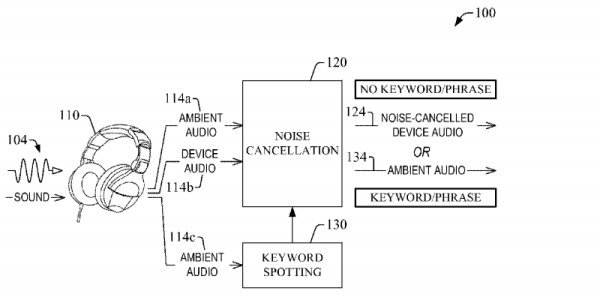
If you are like us, you’ll read a bit more and smack your forehead. Amazon recently filed a patent. That isn’t really news, per se–they file lots of patents, including ones that cover clicking on a button to order something and taking pictures against white backgrounds (in a very specific way). However, this patent is not only a good idea, but one we were surprised didn’t arise out of the hacker community.

There can’t be an invention without a problem and the problem this one solves is a common one: While wearing noise cancelling headphones, you can’t hear things that you want to hear (like someone coming up behind you). The Amazon solution? Let the headphones monitor for programmable keywords and turn off noise cancellation in response to those words. We wonder if you could have a more sophisticated digital signal processor look for other cues like a car horn, a siren, or a scream.

We’ve talked about fixing commercial noise cancelling headphones before. If you don’t mind going low-tech, there’s always the easy way out, but those aren’t likely to accommodate speech recognition.

FCC Reaches Agreement With Router Manufacturers

Last year, the Federal Communications Commission proposed a rule governing the certification of RF equipment, specifically wireless routers. This proposed rule required router manufacturers to implement security on the radio module inside these routers. Although this rule is fairly limited in scope – the regulation only covers the 5GHz U-NII bands, and only applies to the radio subsystem of a router, the law of unintended consequences reared its ugly head. The simplest way to lock down a radio module is to lock down the entire router, and this is exactly what a few large router manufacturers did. Under this rule, open source, third-party firmwares such as OpenWRT are impossible.

Now, router manufacturer TP-Link has reached an agreement with the FCC to allow third-party firmware. Under the agreement, TP-Link will pay a $200,000 fine for shipping routers that could be configured to run above the permitted power limits.

This agreement is in stark contrast to TP-Link’s earlier policy of shipping routers with signed, locked firmware, in keeping with the FCC’s rule.

This is a huge success for the entire open source movement. Instead of doing the easy thing – locking down a router’s firmware and sending it out the door – TP-Link has chosen to take a hit to their pocketbook. That’s great news for any of the dozens of projects experimenting with mesh networking, amateur radio, or any other wireless networking protocol, and imparts a massive amount of goodwill onto TP-Link.

Thanks [Maave] for the tip.